


Audio By Carbonatix
Facebook has announced a breakthrough in its plan to create a device that allows people to type just by thinking.
It has funded a study that developed machine-learning algorithms capable of turning brain activity into speech
It worked on epilepsy patients who had already had recording electrodes placed on their brains to asses the origins of their seizures, ahead of surgery.
Facebook hopes it will pave the way for a "fully non-invasive, wearable device" that can process 100 words per minute.
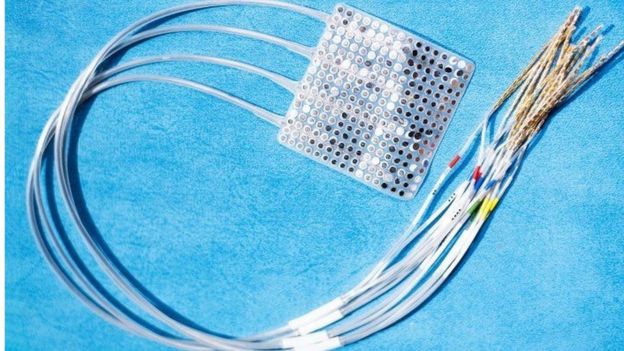 Image caption: Electrodes were temporarily placed on the surface of the brain of epilepsy patients
"Ultimately, the researchers hope to reach a real-time decoding speed of 100 words per minute with a 1,000-word vocabulary and word error rate of less than 17%," Facebook wrote on its blog.
"And by demonstrating a proof-of-concept using implanted electrodes as part of their effort to help patients with speech loss, we hope UCSF's work will inform our development of the decoding algorithms and technical specifications needed for a fully non-invasive, wearable device.
"Rather than looking down at a phone screen or breaking out a laptop, we can maintain eye contact and retrieve useful information and context without ever missing a beat."
Meanwhile, Elon Musk's Neuralink company has applied to US regulators for permission to start testing its own brain-hacking device on humans.
Some in the field believe it is time to pause to consider the ethics of such research and the possibilities it opens for the future.
"To me, the brain is the one safe place for freedom of thought, of fantasies and for dissent," neuro-ethicist Prof Nita Farahany told MIT Review.
Image caption: Electrodes were temporarily placed on the surface of the brain of epilepsy patients
"Ultimately, the researchers hope to reach a real-time decoding speed of 100 words per minute with a 1,000-word vocabulary and word error rate of less than 17%," Facebook wrote on its blog.
"And by demonstrating a proof-of-concept using implanted electrodes as part of their effort to help patients with speech loss, we hope UCSF's work will inform our development of the decoding algorithms and technical specifications needed for a fully non-invasive, wearable device.
"Rather than looking down at a phone screen or breaking out a laptop, we can maintain eye contact and retrieve useful information and context without ever missing a beat."
Meanwhile, Elon Musk's Neuralink company has applied to US regulators for permission to start testing its own brain-hacking device on humans.
Some in the field believe it is time to pause to consider the ethics of such research and the possibilities it opens for the future.
"To me, the brain is the one safe place for freedom of thought, of fantasies and for dissent," neuro-ethicist Prof Nita Farahany told MIT Review.
'Muscle twitches'
University of California San Francisco scientists asked the patients to answer out loud a list of simple multiple-choice questions ordered randomly. And the algorithms learned to identify:- the question they had been asked, 75% of the time
- their chosen answer, 61% of the time
'Safe place'
Researcher David Moses said: "It's important to keep in mind that we achieved this using a very limited vocabulary - but in future studies we hope to increase the flexibility as well as the accuracy of what we can translate from brain activity." The study is published in Nature Communications.
Image caption: Electrodes were temporarily placed on the surface of the brain of epilepsy patients
"Ultimately, the researchers hope to reach a real-time decoding speed of 100 words per minute with a 1,000-word vocabulary and word error rate of less than 17%," Facebook wrote on its blog.
"And by demonstrating a proof-of-concept using implanted electrodes as part of their effort to help patients with speech loss, we hope UCSF's work will inform our development of the decoding algorithms and technical specifications needed for a fully non-invasive, wearable device.
"Rather than looking down at a phone screen or breaking out a laptop, we can maintain eye contact and retrieve useful information and context without ever missing a beat."
Meanwhile, Elon Musk's Neuralink company has applied to US regulators for permission to start testing its own brain-hacking device on humans.
Some in the field believe it is time to pause to consider the ethics of such research and the possibilities it opens for the future.
"To me, the brain is the one safe place for freedom of thought, of fantasies and for dissent," neuro-ethicist Prof Nita Farahany told MIT Review.DISCLAIMER: The Views, Comments, Opinions, Contributions and Statements made by Readers and Contributors on this platform do not necessarily represent the views or policy of Multimedia Group Limited.
Tags:
DISCLAIMER: The Views, Comments, Opinions, Contributions and Statements made by Readers and Contributors on this platform do not necessarily represent the views or policy of Multimedia Group Limited.
Latest Stories
-
Community 25 residents demand answers over two-month water shortage
4 minutes -
Ampem Darkoa Ladies and Hasaacas Ladies clash in 2026 Women’s Champion of Champions
10 minutes -
Business dies when luxury takes over leadership
26 minutes -
No family should lose everything to save a loved one – GMTF administrator
28 minutes -
Bawumia has the dignity to lead and the vision Ghana needs – Gabby
43 minutes -
GOC, GFA chart Olympic qualification roadmap for Black Queens, Black Meteors
44 minutes -
Absa InspireMe 2026 highlights opportunities for women-led business growth
45 minutes -
The only thing that flows regularly is THE BILL
50 minutes -
KGL U17 Colts 2026: Prempeh Elite Academy lead Group A as Western Region secures top spot in Group B
53 minutes -
‘You’ve never been touched by any scandal’ – Gabby celebrates Bawumia on his 63rd birthday
54 minutes -
WPL 2026/27: GFA unveils dates for start of new season as Ampem Darkoa Ladies begin title defence
1 hour -
Ghana Embassy in Washington pays tribute to late academic Dr Kofi Akamani
1 hour -
Ibrahim Mahama urges Ghanaians to overcome fear and venture into business
1 hour -
2026 U-17 WWC: Black Maidens lose to China in pre-tournament friendly
1 hour -
Who gave Gbande the EOCO remote control?
2 hours