


Audio By Carbonatix
Facebook is introducing new tools in Germany to help combat the spread of fabricated news stories.
The world's largest social network said it would enable German users to flag potentially false stories.
The stories will then be passed to third-party fact-checkers and if found to be unreliable, will be marked in users' news feeds as "disputed".
It is the first major expansion of the fake news features since Facebook announced tests in the US in December.
"Last month we announced measures to tackle the challenge of fake news on Facebook," the company said on Sunday in a German-language statement.
"We will put these updates in place in Germany in the coming weeks."
Facebook has been widely criticised after some users complained that fake news had influenced the US presidential election.
German government officials have expressed concern that misinformation on the internet could influence the country's parliamentary election this year.
Last week, the social news site Buzzfeed found Facebook pages were publishing false stories about German Chancellor Angela Merkel, who is seeking re-election.
German Justice Minister Heiko Maas has also repeatedly warned about fake news on Facebook, and called on the firm to respect the country's defamation laws, which are stricter than in the US.
In the UK, MPs are set to question executives from Facebook, Google and Twitter about fake news amid fears it is undermining democracy, according to a report in the Sunday Telegraph.
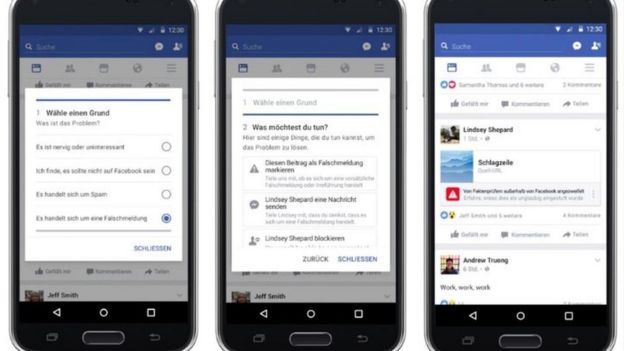
Facebook released screenshots of the German reporting tools
Under the new measures, users in Germany will be able to select "It's a fake news story" as an option when reporting another user's post.
They can then mark the post as fake news, let the other user know they think it is fake, or block that user.
Facebook will send potentially fake stories to Correctiv, a German non-profit body of investigative journalists, to check the facts.
If they find a story to be false, it will be marked on Facebook as "disputed" and will appear lower in users' news feeds.
Facebook is already testing the system with certain fact-checkers in the US to verify news on its platform.
The fact-checkers must sign up to a code of principles to take part. There are currently 43 signatories, including news organisations in several different countries.
As in the US, Facebook Germany said it was looking into penalising websites, which tried to mimic major publishers or misled readers into thinking they were a well-known news source.
Last week, Facebook announced new training and tools that would be made available for journalists on its platform.
On Thursday, BBC News said it would expand its Reality Check series to target false stories or facts being shared widely on social media.
Latest Stories
-
Diaspora Nasara Caucus congratulates Mohammed Ali Suraj, new NPP executives
1 hour -
Dr Antwi-Boasiako’s cybersecurity book showcased at UN crime prevention congress
1 hour -
We will empower the grassroots and protect every vote – NPP’s 1st Vice Chair Kojo Bamba
1 hour -
I do not see myself as better than anyone – NPP’s 1st Vice Chair Kojo Bamba
2 hours -
Police blur the line between invitations and arrests – Reindorf Twumasi Ankrah
3 hours -
Turning invitations into arrests is making citizens reluctant to assist police – Twumasi Ankrah
3 hours -
The Traffitech-GH SMS spot-fine system: The good, the sad, and the funny – Bright Simons writes
3 hours -
Hawa Koomson pledges experienced and mature leadership of NPP women’s wing
4 hours -
Young woman found dead at Kasoa Peace Town
5 hours -
Playback: The Law examined lawful arrest in Ghana
5 hours -
Mahama urges African governments to treat healthcare as an investment, not budget cost
6 hours -
Bawumia congratulates John Boadu and new NPP executives, pledges support ahead of 2028
6 hours -
Aksa Energy delegation pays courtesy call on GRA Commissioner-General
6 hours -
‘No talent should be left out’ – Bawumia pledges inclusive NPP campaign for 2028
6 hours -
Prof. Mike Oquaye recounts how he blocked the Special Prosecutor’s attempt to arrest Bawku Central MP
6 hours