

Audio By Carbonatix
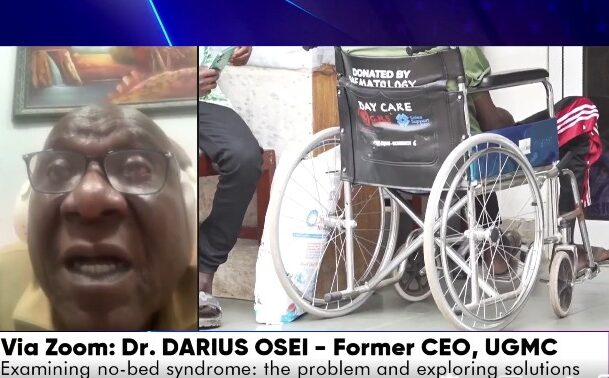
The former Chief Executive Officer of the University of Ghana Medical Centre (UGMC), Dr Darius Osei, has revealed how he watched helplessly as his niece died due to chronic gaps in the country's emergency care system.
Speaking during a high-stakes JoyNews dialogue on national emergency care delivery on Thursday, 2nd April 2026, Dr Osei laid bare the agonising reality of a healthcare system where even the highest-ranking medical administrators are not immune to the consequences of dysfunctional hospital systems.
Dr Osei recounted the final moments of his niece, a university student, whose life was cut short despite being under supervision in one of Ghana’s top hospitals.
He described a chaotic four-hour ordeal in the emergency ward, where his medical expertise could not save his own relative, who had been rushed to a different hospital.
“I realised, and I lost a patient, that is my niece, who was in the university,” Dr Osei shared with a visible sense of grief. “I stood by her in the emergency; we spent four hours. I was sent to go to the lab to bring the bottle, and I brought it and then, you know, up and down. And so finally, I lost my niece.”
The former CEO’s account highlights a recurring nightmare for many Ghanaians, where the system requires relatives or others to act as errand runners for basic laboratory consumables while their loved ones are in critical condition.
The tragedy serves as a damning indictment of the current emergency protocols.
If a former CEO of a multi-million-dollar medical facility like UGMC was reduced to chasing lab bottles while his niece’s life ebbed away, it raises harrowing questions about the fate of ordinary citizens without such connections.
The "up and down" movement described by Dr Osei refers to the fragmented nature of Ghanaian emergency care, where patients are often held in limbo while families or friends navigate the procurement of a hospital card, folder, medication and other essentials, as well as upfront payment for services before health officials deliver care.
Dr Osei’s testimony aligns with broader calls from emergency specialists for a "One-Stop-Shop" ER model.
Under this model, all essential services, including laboratory work, imaging, and pharmacy, are situated within the emergency department to eliminate the time-wasting "up and down" movements that often prove fatal during the golden hour.
Additionally, Dr Osei has called for the elimination of instant payments before service delivery, highlighting the importance of saving lives instead of chasing cash.
Latest Stories
-
Power restoration fault suspected in Kumasi Central Market fire
5 hours -
The 7-foot giant of Ngleshie Amanfro: Seven-foot Ghanaian Ephraim Saawa dreams of joining the national basketball team
6 hours -
Government promises support for Kumasi Central Market fire victims
6 hours -
Vibes The Movie: Big Ghun’s Ghanaian film earns five nominations at 2026 REFFA
6 hours -
‘I’m a fulfilled man’—Justice Korbieh on missing out on Supreme Court despite two nominations
7 hours -
MamaCare CEO warns unresolved conflicts among health workers could undermine maternal and neonatal care
7 hours -
Health professionals urged to translate medical knowledge into practice to save mothers
7 hours -
Retired judge Justice Francis Korbieh charges 1,568 new lawyers to uphold integrity
8 hours -
Conflicts among care providers linked to maternal, neonatal deaths – Expert
9 hours -
GIS marks 10th TIME conference, champions improved teaching practices
9 hours -
BRICS Or Balance? What Ghana’s bid really means
9 hours -
Adamus Resources launches breast cancer awareness campaign in Nzema
9 hours -
GPRTU wants full TRAFFITECH-GH implementation to start in 2027
9 hours -
How 10-mile walks for basic education birthed a 50-year legal career for Justice Korbieh
9 hours -
Mahama announces plans to import electric wheelchairs for PWDs
9 hours