

Audio By Carbonatix
There is no doubt there is an increase in all forms of waste occasioned by Covid-19 particularly biomedical waste as a result of the manufacturing of billions of PPEs, laboratory test equipment, etc.
In May 2016, IMANI conducted a study on the state of biomedical waste treatment in Ghana and urging the then government to not only fast track legislation, but implementation as well.
Some of the introductory highlights of the report from the study was that;
"It is widely understood that municipal solid waste, if not managed correctly, can be an environmental and health hazard."
However, medical waste, by its very nature poses a significantly higher risk to both the environment and especially to the community.
In addition, it is estimated that 15% of waste created by health-care activities are classified as hazardous waste, which includes biomedical waste.
Biomedical waste is waste generated from biological and medical sources including medical laboratories, hospitals and clinics.
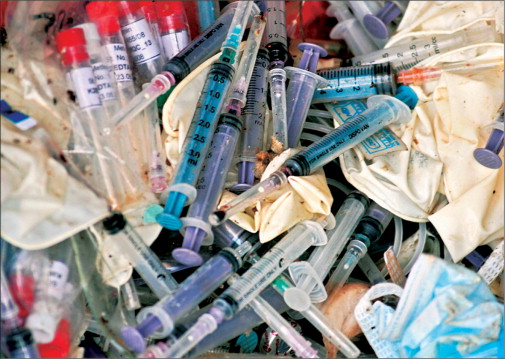
This classification of waste includes discarded blood, tissue from surgery or birth, gloves, used bandages, and sharps such as syringes, needles, and blades.
An estimated 16 billion injections are administered worldwide annually. In Africa, and specifically Ghana, a large proportion of the needles and syringes are discarded as general solid waste and not treated as medical waste.
Biomedical waste has a higher risk of injury or infection compared to ordinary waste, therefore, safe and reliable methods for its management are crucial.
Inadequate and inappropriate handling of biomedical waste is likely to have serious public health ramifications through direct contact or indirectly through the environment.
An example of the indirect impact is observed when farmers irrigate their crops with the same source of water from drains that are used to dispose of the biomedical waste.
In 2012, this allegedly occurred in Accra, when liquid medical waste from the 37 Military Hospital flowed freely into the main gutters of the capital city for over a year, affecting the health especially of those living close to the hospital.
Imagine, what could be happening with Covid-19 related waste? The International Solid Waste Association reports a 20% increase in solid waste generation as of May 2020. Thankfully, there now exist the following legislation to guide the treatment of medical waste.
Hazardous and Electronic Waste Control and Management Act 917 (2016), passed in part due to IMANI advocacy in 2016 and also policies and guidelines on Healthcare Waste Management in Ghana (2018) but what is missing is total enforcement of the above.
Out of the estimated 500 hospitals and clinics in Accra alone, only 200 actually dispose of bio-medical waste professionally. They all use the only ONE bio-medical waste facility in Ghana built by a private entrepreneur.
How do the remaining 300+ health facilities in Accra deal with their medical waste? How do the hundreds of public and private health facilities across the 15 regions treat medical waste?
It would seem, that Covid-19 indeed has exposed our inadequacies, but at the same time opened up opportunities for maximising our industrial capability to intentionally target the establishment of state-of-the-art bio-medical waste treatment plants in each region.
And the government doesn't need to commit public funds to it. Just reasonably and transparently calculated tax breaks on imported equipment.
The government can simply announce this tomorrow and get private actors already in the space with demonstrable financial and operational capacity to get to work at once. It can add that to its achievements in time for election 2020.
The contents of the 2016 IMANI report titled " Biomedical Waste in Ghana: the Need for Urgent Attention and Legislation"can be accessed at http://imaniafrica.org/2016/05/19/biomedical-waste-management-ghana-need-urgent-attention-legislation/
____
Franklin Cudjoe is the Founding President and Chief Executive Officer of IMANI Centre for Policy and Education, a think tank of global repute dedicated to the promotion of the institutions of a free society across Africa.
Latest Stories
-
Gov’t to establish Prison Industrial Hub to equip inmates with income-generating skills – Prison Service boss
18 minutes -
Alhassan Tampuli donates cement, roofing sheets to support storm victims in Gushegu
19 minutes -
Alhassan Tampuli appeals for urgent support for storm victims in Gushegu
22 minutes -
The hypocrisy must stop; pass Anti-LGBTQ+ Bill now – Alhassan Tampuli to Mahama
26 minutes -
Imprisonment should be rehabilitative, not punitive – Ghana Prisons boss at UNGA
47 minutes -
Ga Adangbe traditional priests petition Mahama over McDan aviation licence revocation
59 minutes -
Anti-LGBTQ Bill: NDC’s arrogance is worrying – Hassan Tampuli
1 hour -
Let’s give OSP time to mature, not to scrap it – Hassan Tampuli
1 hour -
Nigeria convicts 386 Islamist militants in mass trials
1 hour -
Djibouti president wins election with 97.8% of vote, state media says
1 hour -
We don’t have mandate to deduct tax from rent allowance of security services personnel – Interior Ministry clarifies
2 hours -
Ablakwa receives Presidential Special Envoy on Reparations to advance global agenda
2 hours -
Christina Koch becomes first woman to travel around the moon on Artemis II
2 hours -
Epstein survivors’ calls to meet King Charles and Queen harder to ignore as US visit approaches
2 hours -
UN Secretary-General names Ghana’s Anita Kiki Gbeho as South Sudan envoy
2 hours