

Audio By Carbonatix
The Minister for Communication, Digital Technology and Innovations, Samuel Nartey George (MP), has declared that while a free press remains a foundational pillar of democratic governance, the state will draw an uncompromising line against the weaponisation of fake news.
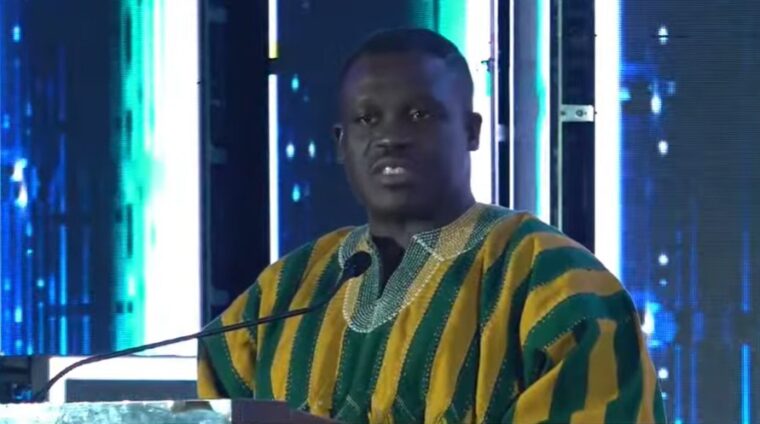
Delivering a speech on behalf of President John Mahama at the 2nd Ghana Journalists Association (GJA) World Press Freedom Day Honours Night on Saturday, June 6, 2026, the minister made it clear that press freedom must never be used as a shield to protect individuals manufacturing deliberate falsehoods to destabilise the country.
Speaking to an audience of media executives, diplomats, and civil society leaders at the Alisa Hotel in North Ridge, Mr. George highlighted an administration completely at peace with aggressive investigative journalism but heavily prepared to enforce legal order against systemic disinformation.
The Fight Against Digital Poison
The minister turned his attention directly to the growing threat of unverified, malicious reports spreading across domestic digital channels. He maintained that propagating fabricated stories under the guise of editorial independence undermines real journalism and directly threatens national security, public health, and communal harmony.
“Let us be honest with ourselves: not everything published or broadcast in Ghana today is journalism. Some of what circulates on our airwaves and digital platforms is deliberate falsehood, designed to inflame rather than inform... This is not journalism, but a threat to the public good. The state has the right and responsibility to address it,” he said.
Rejecting claims that the government is trying to restrict free speech, the minister defended state oversight as a necessary measure to protect the public interest rather than an attempt to control independent thought.
“The regulatory and legal frameworks in this country are not instruments of censorship. They are instruments of order,” the minister insisted. “A responsible government must enforce them, proportionately and transparently, when the national interest demands it.”
A Record of Total Political Tolerance
To demonstrate the government's commitment to protecting genuine journalism, the minister pointed to the state's clean safety record under the current administration. He noted that no media practitioner has suffered state-sponsored execution, forced exile, or arbitrary closure of media facilities for exposing corruption or challenging the executive branch.
He explained that despite facing intense, often hostile public commentary, President Mahama treats rigorous media scrutiny as a basic requirement for political legitimacy.
“Instead, he responds with the quiet confidence of a leader who knows that criticism is the price of democratic leadership. A government that fears scrutiny is a government that has reason to hide. We are not such a government,” Mr. George stated.
Digital Printing Presses and Economic Security
This policy of openness has yielded significant international results.
The Minister highlighted Ghana's impressive climb in the Reporters Without Borders World Press Freedom Index, where the nation jumped to 39th position globally, ranking among the top tiers in Africa. This progress from 52nd place last year was driven by the resilience of the local media fraternity and state investments in infrastructure.
The Minister connected this progress to nationwide broadband expansion, emphasising that keeping digital spaces open and safe is crucial for modern democracy.
“The internet is today's printing press,” Mr George observed. “Just as freedom of the press was hard-won through centuries of sacrifice, digital freedom must be actively protected and deliberately promoted.”
However, the minister warned that true press freedom cannot survive on law alone; it requires economic security.
He challenged the GJA leadership to aggressively tackle media poverty, noting that poorly paid reporters are highly vulnerable to financial and political manipulation. He reaffirmed that the government is working on structural solutions to foster a self-sustaining, independent media economy.
Latest Stories
-
Cedi will continue to be stable – Deputy Finance Minister
43 seconds -
Minority urges full probe into World Cup visa allegations after Ampofo Ankrah’s removal
49 seconds -
Asiedu Nketiah backs greater church role in running mission schools
3 minutes -
Galamsey activities redirect Mankran Stream, destroy farms, and threaten flooding in Okroase
8 minutes -
WiSTEM Ghana Camp assembles 320 girls to explore STEM education
8 minutes -
Russia launches heavy strikes at Ukraine, killing at least 20
9 minutes -
Freddie Blay accuses government of politically motivated demolitions targeting his family
14 minutes -
Ghana targets rice self-sufficiency by 2028 as government secures $18.8m AfDB grant
18 minutes -
Israelis mark three years since October 7 as Palestinians mourn Gaza’s destruction
21 minutes -
Support constitutional amendment to fix voting day on Tuesday – Asiedu Nketiah urges SDA Church
21 minutes -
‘It’s a systemic problem’ – All Black PRO dismisses Kurt’s resignation calls
27 minutes -
Vance says Iran must cut enrichment to end war
28 minutes -
Mahama orders sanctions for officials who fail to enforce building safety rules
29 minutes -
Court grants bail to banker accused of stealing GH¢1 million
33 minutes -
We have a winning team for 2028 – NPP Atwima Nwabiagya South Secretary
35 minutes