

Audio By Carbonatix
Fellow Ghanaians, members of the media, ladies and gentlemen — good morning.
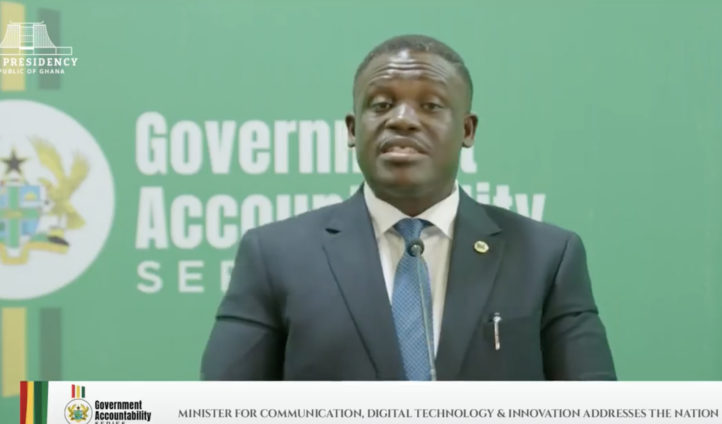
I am grateful for this Government Accountability Series, a platform built on a simple conviction: that public office is a public trust, and that citizens deserve a clear, honest account of what their Government is doing with their mandate.
On behalf of the Ministry of Communication, Digital Technology and Innovations and the Agencies under it, I present today our account of the work done between January and August 2026, and our commitments for the rest of the year.
Our mandate spans ten broad fronts: digital skills and the One Million Coders Programme; connectivity and infrastructure; the safety of our digital space and the protection of citizens' data; the growth of our digital economy; the modernisation of government through digital platforms; the strengthening of our legal and regulatory framework; our meteorological and climate services; the advancement of artificial intelligence; and reliable postal and logistics services to every corner of this country.
I will take you through what has been achieved on each. I will be candid about the pressures our network is under, because a Ministry that hides from its challenges cannot be trusted with its successes. And I will be equally clear about what remains outstanding.
PUTTING MONEY BACK IN THE POCKETS OF GHANAIANS
Let me start where it matters most to the ordinary Ghanaian: the cost and value of the digital services they use every single day.
When Ghanaians told us that pay-television had become unaffordable, we did not simply issue a statement — we acted. I established and chaired a Stakeholder Committee that brought together this Ministry, the National Communications Authority, MultiChoice and the Cyber Security Authority.
That engagement delivered enhanced-value DStv packages that took effect on 1 October 2025, and I can report today, before this forum, that those improved packages remain fully in force.
Despite predictions that the gains would be quietly reversed, prices have held, value has been sustained, and Ghanaian households have kept the benefit of that negotiation.
That is what accountability looks like: a promise made, and a promise kept.
We did the same on data. In 2025, I engaged directly with the Chief Executives of our mobile network operators, and that engagement bore fruit: MTN increased data volumes on its bundles by 15 per cent, while Telecel and AirtelTigo each increased theirs by 10 per cent — meaning every cedi a Ghanaian spends on mobile data now buys significantly more.
We did not stop at mobile. Following further engagement with industry this year, MTN cut its fibre broadband prices by up to 70 per cent — its 100 Mbps unlimited package fell from GH¢987 to GH¢299 a month — while introducing new 300 Mbps and 500 Mbps tiers for homes and businesses that need more.
Telecel also announced major revisions to fixed data prices earlier this year to benefit its customers.
Ghanaian families and enterprises are today getting more data dramatically, on both their phones and their fixed lines, for less money than they paid a year ago.
This is the return of a Ministry that understands this industry from the inside and negotiates on behalf of the Ghanaian consumer, not on behalf of the operators.
EXPANDING CONNECTIVITY AND DIGITAL INFRASTRUCTURE
None of our digital ambitions are possible without connectivity, and we have been candid that many Ghanaians still experience network congestion and coverage gaps — the legacy of nearly a decade in which policy and regulation failed to keep pace with the country's shift from a voice-driven market to a data-driven economy.
For almost ten years, next to little was demanded of operators by way of policy or regulation to match that shift with investment.
We are correcting that.
This year, the National Communications Authority undertook the most significant reform of Ghana's 5G policy in recent years.
Following comprehensive regulatory, economic and legal assessments, the Authority's Board approved, on 15 July 2026, the removal of the wholesale 5G exclusivity framework that had constrained competition in high-speed mobile broadband.
Requests for Applications for spectrum in the 700 MHz, 2.3 GHz and 3 GHz bands followed shortly after, opening the sector to new investment.
Meanwhile, adoption of Voice over LTE, which delivers clearer calls and better data performance, has nearly tripled — from about 7 per cent to 22.43 per cent of total traffic — and now reaches more than 8.4 million subscribers.
At the regional level, our free-roaming agreement with Gambia is fully operational, our Memorandum of Understanding with Liberia and Sierra Leone has been signed, and technical testing is under way with Burkina Faso, extending a borderless, more affordable communications space across West Africa.
This regulatory push has unlocked serious private capital.
MTN Ghana has committed more than US$1.1 billion over the next three years, including roughly US$380 million this year, to expand coverage, deploy new sites and support 5G rollout — 800 new cell sites in total, the highest annual build the company has undertaken in a decade, targeted particularly at the rural and peri-urban communities where network challenges have been most pronounced.
I personally worked with Members of Parliament to map the specific locations most affected in their constituencies — the first time such an exercise has been done at this scale — and 180 of those sites are already active and carrying traffic today.
Telecel Ghana, for its part, has raised its capital investment by 60 per cent over the 2023–2026 period compared with the four years before it, expanding to roughly 9,000 sites nationwide under a 2026 plan targeting 2,698 sites, of which 1,890 are already live.
Alongside network build-out, national smartphone penetration has climbed to 71.8 per cent as of June 2026, up from just 27.5 per cent a decade ago — proof that more Ghanaians than ever are relying on this network for work, business, and daily life, and a clear signal of why continued investment in capacity cannot let up.
Nowhere is this challenge more visible than in rural telephony.
A significant number of the cell sites serving our rural and remote communities still run on legacy 2G and 3G technology.
That older network adequately carries voice calls and text messages. Still, it cannot support mobile money transactions, digital agricultural extension advice, e-learning platforms, or telemedicine consultations that increasingly define full participation in Ghana's digital economy.
A farmer in a 2G-only community can call the market to ask about prices; she cannot, on that same connection, list her produce on a digital marketplace, receive a real-time weather advisory, or draw down a mobile banking loan.
That gap between having a signal and having genuine digital access is one this Ministry is determined to close.
This is why, alongside the network expansion I have already described, we are placing deliberate emphasis on modernising the technology itself, not simply extending its footprint.
Working with the National Communications Authority, the Ghana Investment Fund for Electronic Communications, and the mobile network operators, we are prioritising the upgrade of ageing 2G and 3G masts in rural districts to 4G-capable infrastructure, together with the fibre and microwave backhaul needed to carry that signal at real broadband speeds rather than in name only.
The constituency-level mapping exercise I referenced earlier is guiding this modernisation as much as it is guiding new coverage, so that communities we identify as underserved are not merely connected, but connected to a standard that supports the services Ghanaians actually need today.
We have accordingly asked operators to ensure that new rural sites are built 4G-ready from the outset, and to accelerate the retirement of legacy-only equipment wherever traffic and terrain allow.
This matters because rural Ghana should not be made to wait a generation behind the rest of the country for tools that are transforming how citizens learn, trade, farm, bank and access healthcare.
A modernised, 4G-capable network in our rural communities means a farmer using a smartphone-based advisory service instead of guesswork, a trader accepting mobile money at the point of sale, a student in a rural school reaching the same learning content as one in Accra, and a patient at a rural clinic being connected to a specialist many kilometres away.
This is not a distant ambition; it is work already under way, and my Ministry will continue to report on it, community by community, alongside the coverage figures I have set out today.
On digital infrastructure, our flagship US$50 million Ghana Digital Acceleration Project, backed by the World Bank, has moved from design into active procurement, advancing last-mile connectivity to 270 government facilities — including 170 Community ICT Centres — to the financial evaluation stage.
Procurement for the National Data Exchange Hub, a truly integrated one-stop government services platform, and the modernisation of our National Data Centres in Accra and Kumasi is progressing through international review.
And to bring regulation itself closer to the people, the National Communications Authority has secured new office premises in Cape Coast and Wa, both of which are expected to be fully operational by October 2026.
NETWORK STABILITY: THE CHALLENGES WE MUST CONFRONT
Ladies and gentlemen, accountability also means speaking plainly about what threatens the very gains I have just described.
As the data compiled for this briefing shows, Ghana's network today faces three compounding pressures: physical damage to our fibre backbone, instability in our national power grid, and a rate of subscriber growth outpacing even our accelerated rollout.
Fibre cuts are the most persistent of these threats.
Industry projections put the number of fibre cuts nationwide in 2026 at 8,578, with 4,289 already recorded in the first half of the year alone, at an average repair cost of roughly US$2,045 per cut — more than US$20 million spent on repairs in 2025 alone.
The single largest cause, by a wide margin, is uncoordinated excavation connected to road construction, and in particular to the Government's own "Big Push" road programme, which accounts for roughly half of all road-related fibre cuts each month, driven principally by the absence of approved excavation drawings and site coordination with operators before works begin.
Major corridors have absorbed an average of 72 cuts a month since the start of the year.
The consequences are not abstract: a single incident on the Winneba–Mankessim corridor knocked out service for more than 17 hours across the middle belt; the Ho–Ziope corridor lost more than 19 hours of connectivity, degrading internet resilience nationwide; and the Hwediem–Goaso corridor suffered a 9-hour-plus outage that degraded quality of service across Brong Ahafo, North and Western North.
These are just recent examples of network degradation and denial incidents caused entirely by activities outside the MNOs' control.
This has led to a joint Cabinet Memo between my Ministry and the Ministry of Roads on the Dig Once Policy, which will go a long way toward addressing indiscriminate fibre cuts and reducing the overall cost of laying fibre in Ghana.
I expect Cabinet to consider and approve the Memo at its next sitting.
Compounding this is the occasional instability on the national power grid, on which every cell site ultimately depends.
This year alone, the Akosombo transmission fire of 23 April, flooding across Greater Accra in the second quarter, and two further nationwide grid outages — on 29 July and again on 20 August — each traced by GRIDCo to faults on the Akosombo–Volta transmission corridor, have all struck our network's power supply.
Taken together, these incidents drove up to a 30 per cent increase in daily cell site outages during the periods in which they occurred.
And all of this is happening even as demand keeps climbing: smartphone penetration has reached 71.8 per cent nationally, Telecel alone has seen its own subscriber base's smartphone penetration rise from 38 per cent in 2019 to 66 per cent in 2025, and every additional device on the network adds load to infrastructure that is still being expanded to meet it.
To put the scale of that expansion in context, MTN built just 134 new sites in 2016; this year's plan of 800 — 500 originally scheduled plus 300 additional builds — is its largest single-year rollout in a decade, following a deliberate two-year pause in 2024 and 2025 for capacity consolidation before this acceleration.
I raise these figures not to make excuses, but because I said at the outset that this Ministry would be as candid about its challenges as it is about its achievements.
We anticipated this threat: in November 2025, well before this reporting period, I announced Ghana's "Dig Once" policy at the Africa Tech Festival in Cape Town, mandating that fibre-optic conduits and access chambers be embedded in every new road-construction project, at standardised, protected depths, so that the roads we build to connect Ghana stop being the roads that disconnect it.
This year, we have gone further.
The National Communications Authority is finalising a coordination framework that will require road agencies and their contractors to interface formally with telecom operators before any excavation begins.
We are introducing enforceable cost-recovery penalties for third-party damage to telecommunications infrastructure.
And we are updating our Quality-of-Service guidance to properly classify fibre-related outages caused by third parties, so that operators are held to fair standards rather than penalised for damage inflicted on them.
Industry itself is investing in resilience: Telecel Ghana alone has committed GH¢39.1 million between 2024 and 2026 to alternate fibre routing and network relocation, a model I want to see replicated across the sector.
On power, my Ministry continues to engage the Ministry of Energy and GRIDCo directly, because a communications network is only as stable as the grid beneath it, and Ghanaians should not have to choose between a growing economy and a stable dial tone.
SKILLS, THE DIGITAL ECONOMY, AND ARTIFICIAL INTELLIGENCE
Our One Million Coders Programme has become a genuine national movement.
As at 2 August 2026, the programme database held 141,954 registered accounts, with 27,782 admitted learners actively engaged in study and 5,812 course-completion records already logged.
Admissions span several pathways — 30,444 learners through Coursera, 10,143 through StartoCode, 1,692 through NetAcad, and additional learners through our DPC, Digital Literacy, CNST, and Data Analytics tracks — with 24,394 pursuing self-paced study and a further 6,050 requiring centre-based support.
Enrolment is concentrated in the skills our labour market is demanding most: cybersecurity leads with 8,570 learners, followed by data analytics, AI essentials, AI professional, and project management.
We have signed Memoranda of Understanding with eleven of Ghana's leading universities — including the University of Ghana, KNUST, UENR, GCTU and UCC among others — to embed these certifications into degree and diploma programmes.
We are now working with the Ministry of Education and the Ghana Education Service to expand access to foundational digital skills for students aged 13 to 19.
Delivery on the ground has kept pace with demand: centre-monitoring data between 1 June and 15 August recorded 11,683 cumulative attendances across 118 reporting centres, with Twifo Praso, Daffiama, Sagnarigu, Yendi and Wamanafo among our highest-performing sites, and the Northern, Greater Accra and Upper West regions leading nationwide participation.
In support of inclusion, the National Council on Persons with Disability has submitted a list of centres to be prioritised for accessibility onboarding, and our focus for the rest of the year is converting registrations into completions while closing the gender gap in participation, since men still outnumber women on the programme by a wide margin.
On artificial intelligence, Cabinet approved Ghana's National Artificial Intelligence Strategy 2025–2035 in April, built around eight strategic pillars and developed with GIZ FAIR Forward, the British High Commission, the KNUST Responsible AI Lab, UNDP and UNESCO.
This was followed in June by the publication, with UNESCO and the European Union, of Ghana's AI Readiness Assessment Methodology report.
We have already trained 240 civil servants in AI literacy.
In August, in partnership with the National Communications Authority, Ghana International School, and MakersPlace, we ran a five-day AI and Robotics Summer Bootcamp for 100 basic school students, 40 per cent of whom were girls.
Between now and December, and with support from UNDP, the Government of Japan and the UK Foreign, Commonwealth and Development Office, we will extend this capacity-building to 50 Digital Champions and to Chief Directors and Directors across the Civil Service, and finalise a National AI Delivery Framework with clear indicators through to 2035.
Our digital economy is also growing in ways Ghanaians can see and touch.
GI-KACE's UNDP-funded MSME Gateway and eCommerce platform, now run through the Ghana Enterprise Authority, has enrolled more than 350 small businesses and is supported by 110 trained Digital Champions from Business Advisory Centres nationwide.
Ghana Post, meanwhile, has completed its transformation from a traditional postal operator into a modern logistics and e-commerce enabler, building on courier, EMS, parcels, secure-document delivery and last-mile logistics as five pillars of a diversified revenue base: between January and July, it delivered 85,638 passports directly to citizens nationwide, bringing cumulative doorstep deliveries since May 2025 to 190,781, while securing new institutional logistics arrangements with COTVET and Telecel Ghana, procuring 41 motorbikes and 5 pick-up vehicles to strengthen last-mile delivery, and earning EMS Silver Performance status — Ghana is the only African country in that category — along with an EMS Customer Care award from the Universal Postal Union.
MODERNISING GOVERNMENT THROUGH DIGITAL PLATFORMS
Government itself must lead by example.
The National Information Technology Agency institutionalised its Technical Clearance Framework this year, issuing Technical Clearance to six Government institutions and projects — for the first time giving Government an operating gate that screens out duplicative and non-conforming IT investments before public funds are committed.
NITA also provided direct technical assurance to several state institutions, correcting weaknesses in the Registrar of Companies' Electronic Business Registration System, guiding the Ministry of Employment and Labour Relations on its Labour Market Information System, and conducting technical assessments of the NHIE and GHIMS digital health platforms as the first phase of a nationwide Government IT infrastructure review.
Under the Ghana Digital Acceleration Project, the digitisation of Ghana's Public Records and Archives Administration Department reached a major milestone with the signing, on 13 August, of the contract to digitise 3.5 million archival records, while our Electronic Document Wallet — which will let citizens and businesses hold and verify Government-issued credentials digitally — has completed stakeholder engagement and Governing Board approval, and moves into pilot in the fourth quarter.
SECURING OUR DIGITAL SPACE, PROTECTING DATA, AND STRENGTHENING OUR LAWS
A digital nation must also be a safe and well-governed one.
Between January and June, the Cyber Security Authority's CERT-GH responded to 3,363 cybersecurity incidents, while vulnerability assessments were completed for 25 Critical Information Infrastructure institutions across education, health, public administration, security, and utilities.
Since the start of the year, 479 Cybersecurity Service Providers, 116 Establishments, and 2,685 Professionals have been licensed or accredited, and more than 84,000 children and young people, along with 427 university ICT leaders and roughly 8,800 citizens, have received cybersecurity awareness training.
The newly operationalised Ghana Cybersecurity Industry Forum already counts more than 300 registered members.
On data protection, the Data Protection Commission recorded a 51.5 per cent increase in regulatory activity and a 98.4 per cent increase in newly registered data controllers in the first half of the year, while its "Privacy is Personal" campaign reached an estimated 25 million people nationwide.
We have matched this with legislative reform.
Under the Ghana Digital Acceleration Project, our review of fifteen pieces of ICT legislation is roughly half complete, with stakeholder consultation already finished on ten priority Bills — including the Data Harmonisation Bill, the Cybersecurity Authority Bill, the Ghana Innovation and Startup Bill, and the National Communications Authority Bill — now before Cabinet, alongside five further Bills in preparation.
The Legislative Instrument on SIM registration has been laid before Parliament and successfully passed.
I expect the Regulator to begin biometrically verified SIM registration before the end of the year.
And following a comprehensive review of our National Digital Terrestrial Television platform completed in July, a Committee has recommended a sustainable cost-sharing framework and a graduated tariff-support mechanism to complement the subsidised national tariff of US$7,000 per channel per month during the initial implementation years; the new arrangements are scheduled to take effect from January 2027, easing the burden on qualifying broadcasters while safeguarding the public's right to information and Government's universal access obligations.
Beyond communications, the Ghana Meteorological Agency launched the country's first Climate Atlas on 25 March, in partnership with the Danish Meteorological Institute, installed a state-of-the-art Automated Weather Observation System at Kotoka International Airport, and has been endorsed to host the World Meteorological Organisation's Regional Association I session in March 2027 — a mark of Ghana's growing standing in global meteorological science.
GHANA ON THE REGIONAL AND GLOBAL STAGE
That standing extends across our sector more broadly.
Ghana has secured a seat on the African Telecommunications Union Council for the 2027–2030 term.
It remains engaged in the campaign for the ITU Council and re-election to the Radio Regulations Board.
This year also marked the National Communications Authority's 30th anniversary, marked with public commemoration of three decades of institutional history.
On cybersecurity, Ghana chaired a round table between the African Network of Cybersecurity Authorities and the Arab Region, participated in the Council of Europe's Cybercrime Convention Committee, and engaged in bilateral cooperation with Italy and the United Kingdom.
At the same time, NITA presented Ghana's digital government experience at the 32nd Americas Conference on Information Systems, drawing on a maturity survey of 167 Ministries, Departments and Agencies.
Ghana is also poised to host the 15th Africa Internet Governance Forum in Accra this November.
I am humbled to have been unanimously confirmed as the next Chair of the African Union's Specialised Technical Committee on Information and Communications Technology, a two-year mandate I take up in October, and one I intend to use to advance Ghana's — and Africa's — digital interests on the world stage.
WHAT THIS MEANS FOR THE ORDINARY GHANAIAN
Strip away the statistics, and this is what our work means in people's lives.
It means paying less for more data on your phone and in your home.
It means a stable DStv bill instead of a rising one.
It means fewer dropped calls because we are fixing the fibre beneath our roads and pressing for a steadier power supply, not just building more towers.
It means a farmer in a previously unserved community getting online for the first time.
It means a small business owner selling nationwide through a digital platform that did not exist a year ago.
It means collecting your passport at your doorstep instead of travelling to a regional office.
It means a young person leaving a coding bootcamp and finding a job.
And it means every Ghanaian having greater confidence that their personal data is protected by law.
WHAT REMAINS: OUR COMMITMENTS TO DECEMBER 2026
Accountability means being just as clear about what is ahead as about what is done.
Before the year closes, the National Communications Authority will complete 5G spectrum assignment and begin deployment, launch its online licensing and payment portal, finalise the road-excavation coordination framework and cost-recovery penalties I outlined earlier, and stand up an Emergency Telecommunications Framework — the rapid completion of network-quality upgrades is mandatory and non-negotiable.
I have tasked the Regulator with preparing a framework for customer remediation and sanctions when operators fall short.
The Ghana Domain Name Registry will conclude the .gh redelegation agreement, preaccredit ten additional local registrars, and convene the Ghana DNS Forum to advance .gh adoption.
The Cyber Security Authority will deliver National Cyber Security Awareness Month under the theme "Securing Ghana's Digital Finance Ecosystem," operationalise the Cybersecurity Fund, and open regional offices in four zones; the Data Protection Commission will complete its five-region decentralisation; GI-KACE will train a further 1,000 participants and integrate its Digital Gateway with a logistics provider; Ghana Post will commercially launch its e-commerce platform and expand its delivery fleet; the National Information Technology Agency will launch TechnicalClearance.GOV, pilot the Electronic Document Wallet, and stand up GovDAP, the Government Digital Assurance Programme, to give Government a single view of the security and reliability of its digital services; the Ghana Digital Acceleration Project will move the National Data Exchange Hub and e-Government portal into implementation; the Ghana Meteorological Agency will commission its renovated forecasting centre and advance amendment of the GMet Act to elevate the Agency to Authority status; and on artificial intelligence, we will finalise our National AI Delivery Framework with the clear milestones I have described.
And on the cost of service and network resilience alike, our engagement does not stop here — we will keep pressing operators for further value from data, continued price stability in pay-television, and the infrastructure protection Ghanaians deserve, because no one should have to choose between a connected Ghana and a reliable one.
CONCLUSION
Fellow Ghanaians, the record I have set before you today is one of a Ministry that knows this sector in its full complexity — its achievements and its vulnerabilities alike — and that negotiates and regulates on your behalf, not on behalf of the operators.
We have kept faith with you on price.
We have expanded what connects you.
We have confronted, honestly and in public, the fibre cuts and power failures that put that connection at risk.
And we have built the foundations — in skills, in artificial intelligence, in security, and in law — for a digital Ghana that works for every citizen, not just the privileged few.
The work is far from finished, and I will not pretend otherwise.
But the direction is unmistakable, the results are measurable, and the resolve of this Ministry is unshaken.
We commit, before this forum and before the people of Ghana, to deliver on every outstanding activity I have outlined, and to return to account for our stewardship.
I thank you for your attention.
Latest Stories
-
Interest payments to average a high 20% of government revenue over next 4 years
1 hour -
Strategy of accumulating foreign reserves, gold carries high fiscal cost – S&P Global
1 hour -
Weak institutional arrangements, high debt servicing constrain Ghana’s rating – S&P
1 hour -
Bond market: Turnover declined by 28% to GH¢1.56bn
2 hours -
Volta Region National Public Speaking contest advances drug prevention conversation
2 hours -
New health training facility at Ampoma-Jema to address admission shortfalls, but Minister flags missing amenities
2 hours -
Black Challenge unveiled with sights set on Amputee World Cup glory
3 hours -
Pay striking teachers before expressway spending, Dr Kingsley Agyemang tells government
4 hours -
Customs intercepts assault rifle, two pistols and 610 rounds of ammunition at Tema Port
4 hours -
PKO boxers secure wins at Odwira Festival
4 hours -
South Tongu Records Rise in Teenage Pregnancy
4 hours -
Cabinet threw out US health compact faster than anything I’ve seen – Mahama
4 hours -
MoFA urges Finance Ministry to reverse World Bank food programme withdrawal over GH¢643m commitments
4 hours -
NAGRAT demands signed timelines before calling off strike
5 hours -
National Investment Quiz: West Africa SHS, St. Louis SHS advance to semi-finals
5 hours