

Audio By Carbonatix
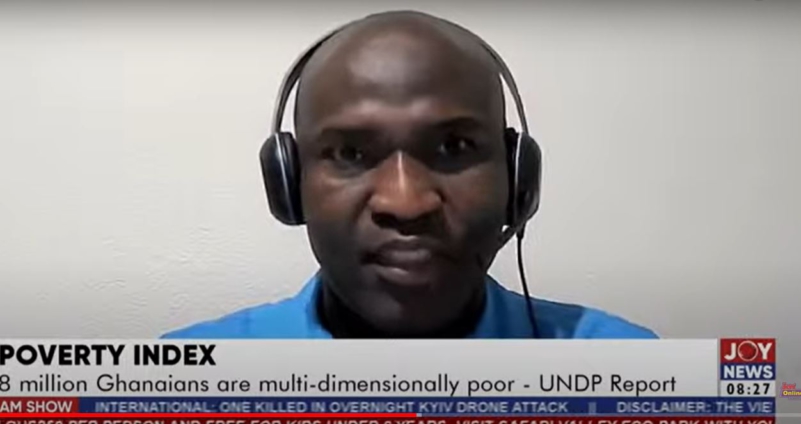
An Economist, Dr Sa-ad Iddrisu, says although Ghana is one of the few countries in Africa to have poverty alleviation programmes, its implementation strategies have always been inefficient.
The expert says implementation strategies have become politicized. As a result, those who are to benefit from it have rather been sidelined.
His comments follow a recent report by the United Nations Development Programme (UNDP) which revealed the high rate of poverty in Ghana.
According to the report, 8 million Ghanaians, are multi-dimensionally poor.
Touching on this, the economist said policies put together can alleviate poverty if there is transparency.
“As a country, we are one of the luckiest in Africa to have poverty alleviation programmes but come to think of it, the implementation has always been a problem in Ghana. It’s not like we don’t have good policies to address the challenges of poverty, but the way we implement it, coupled with our political atmosphere, it turns everything into politics and shifts the benefits away from the people that actually need it,” he said on JoyNews’ AM show on Thursday.
Citing the Livelihood Empowerment Against Poverty (LEAP) policy, the expert said although it is a viable policy, his research on the policy reveals that there is no online portal where one could apply to be enrolled.
This he explained would make it difficult for people of old age and others who evidently need such a programme to survive to be denied the opportunity.
“How can we assist them to get LEAP? There is no online application,” he lamented.
He observed that the policy could be hijacked by politicians who are authorities at the district or constituency level and are responsible for determining who qualifies to be enrolled.
Making a comparison, Dr Iddrisu said the US system is such that anyone who qualifies to be admitted onto a poverty alleviation programme does not have to go around begging authorities but they only apply online after which the government makes provision for such people based on their income qualification.
Speaking also on the country’s National Health Insurance Scheme (NHIS), the economist said politics has rendered the programme quite irrelevant although it could have helped people in the wake of the multi-dimensional poverty case.
According to him, most health institutions nowadays do not regard the scheme anymore; they rely on “cash and carry.”
He concluded that the current resurgence in the poverty rate stems from poor leadership.
Latest Stories
-
No room for another false start as Ghana begin AFCON qualifying campaign
15 minutes -
“We are grateful for what you have achieved” – AGI President tells Finance Minister
24 minutes -
“No Nation is Inferior”: Mahama champions human dignity and security council reform at the UN
46 minutes -
Manhyia South residents, NPP executives fume over botched EOCO arrest of MP
56 minutes -
Mahama unveils new deal with global philanthropy
1 hour -
Daily Insight for CEOs: Building customer-centric leadership
1 hour -
Democracy must deliver food, jobs and healthcare, not just elections – Mahama
1 hour -
Capacity constraints must never be a barrier to restitution – Mahama
1 hour -
COMAC pushes for suspension of sections of Customs Act 2026
1 hour -
Mahama calls for Great African Museum to anchor continent’s heritage revival
1 hour -
Mahama cites return of Mpomponsuo sword as model for restitution
1 hour -
Mahama: Africa must inherit more than the story of what it lost
1 hour -
Mahama pushes for permanent UN system for restitution of African artefacts
1 hour -
Ghana is arguably Africa’s most stable democracy, says Mahama
1 hour -
Mahama calls for investment in Africa’s cultural infrastructure
1 hour