

Audio By Carbonatix
The Ghana Navy has dismantled a large-scale illegal fuel bunkering operation along the Keta-Denu-Aflao coastline.
The midnight interception, which took place on Thursday, January 15, 2026, saw naval personnel seize a fleet of specially engineered shadow vessels designed to bleed the national economy through illicit fuel trade.
The operation, led by sailors aboard the GNS Aflao, was the result of weeks of high-level intelligence gathering.

During a press briefing at the Eastern Naval Command (ENC) in Tema, military officials revealed the sophisticated nature of the criminal syndicate, which utilised a mothership tactic to bypass territorial surveillance.
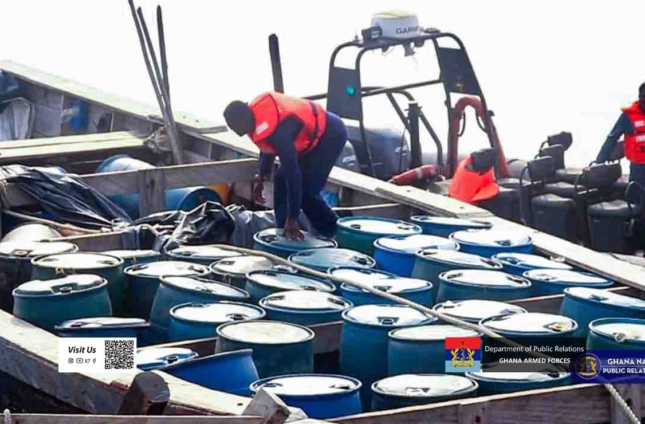
At the centre of the bust were seven massive, modified dugout canoes locally known as "Dendes".
Unlike standard fishing vessels, these craft are purpose-built for high-volume smuggling.
Commodore Solomon Asiedu-Larbi, Flag Officer Commanding (FOC) the ENC, detailed that the intercepted canoes were found carrying approximately 378 empty barrels, each with a 250-litre capacity.
“These are not innocent fishing vessels. They are purpose-built for criminality, specifically illegal fuel bunkering,” Commodore Asiedu-Larbi stressed.
The Commodore praised the naval crew for their professionalism, noting that the suspects fled into the darkness upon sighting the navy ship, abandoning their valuable specialised equipment.

Commander James Dzigbordzi Agrah, the ENC Command Operations Officer, provided a rare look into the tactics used by these maritime cartels.
He explained that a mothership—often a large tanker—anchors just beyond Ghana’s 12-nautical-mile territorial limit.
Under the cover of night, the "Dendes" approach the tanker to receive stolen or unregulated fuel, which is then ferried to secluded coastal landing sites.
This shadow economy has devastating consequences:
- Economic Hemorrhage: Bypassing official channels leads to massive tax evasion, depriving the state of critical revenue.
- Adulterated Markets: The unregulated fuel often fails quality standards, leading to engine damage for unsuspecting motorists.
- Environmental Degradation: Frequent spillages during high-seas transfers contaminate marine ecosystems and destroy fish stocks.
In response to the growing threat in the Eastern Corridor, the Chief of the Naval Staff, Rear Admiral Godwin Livinus Bessing, has ordered an immediate surge in maritime assets.
Reinforcements have been redeployed from the Western Naval Command to ensure a sustained 24-hour presence at sea.
Commodore Asiedu-Larbi concluded by urging coastal residents to view the Navy as a partner in prosperity rather than an adversary.
He emphasized that the "blue economy"—which sustains thousands of Ghanaian fishing families—can only thrive if the seas remain secure from transnational maritime crimes.
Latest Stories
-
Oil hits over 1-week low on hopes of boost to diplomacy in Iran war
7 minutes -
They take GH¢100, sometimes GH¢200 – Okada riders allege police extortion in Accra
16 minutes -
NACOC: We’ve found no presidential escort among suspects in €225m France cocaine case
25 minutes -
Don’t turn students away over trunks and chop boxes – GES
37 minutes -
Italian Apple store employees strike on iPhone 18 Pro launch day
47 minutes -
Apple’s Tim Cook sees Australia’s social media curbs as ‘world-leading’, PM says
56 minutes -
Amazon raises minimum hourly pay by $1 to $20 for US operations workers
1 hour -
Insurance cost has largely remained stable – NPA boss on transport fare pressure
1 hour -
Multiple unions threaten strikes at Barrick’s flagship Mali gold mine, documents show
2 hours -
Infantino invited to African summit as he faces challenge to FIFA leadership
2 hours -
NPA boss flags ‘recalcitrant’ transport operators raising fares arbitrarily
2 hours -
GPRTU fare hike put on ice after talks with government – NPA boss reveals
2 hours -
I’m greatly worried – NPA boss on threat of higher transport fares
3 hours -
We are largely import-dependent – NPA boss on Ghana’s fuel vulnerability
3 hours -
Ghana’s fuel market is built for turbulence – NPA’s Edudzi Tamakloe explains why
3 hours