

Audio By Carbonatix
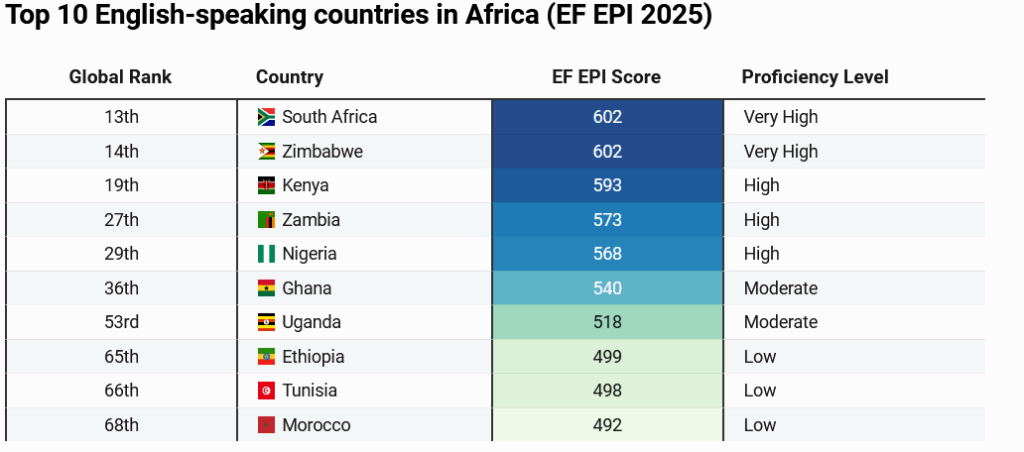
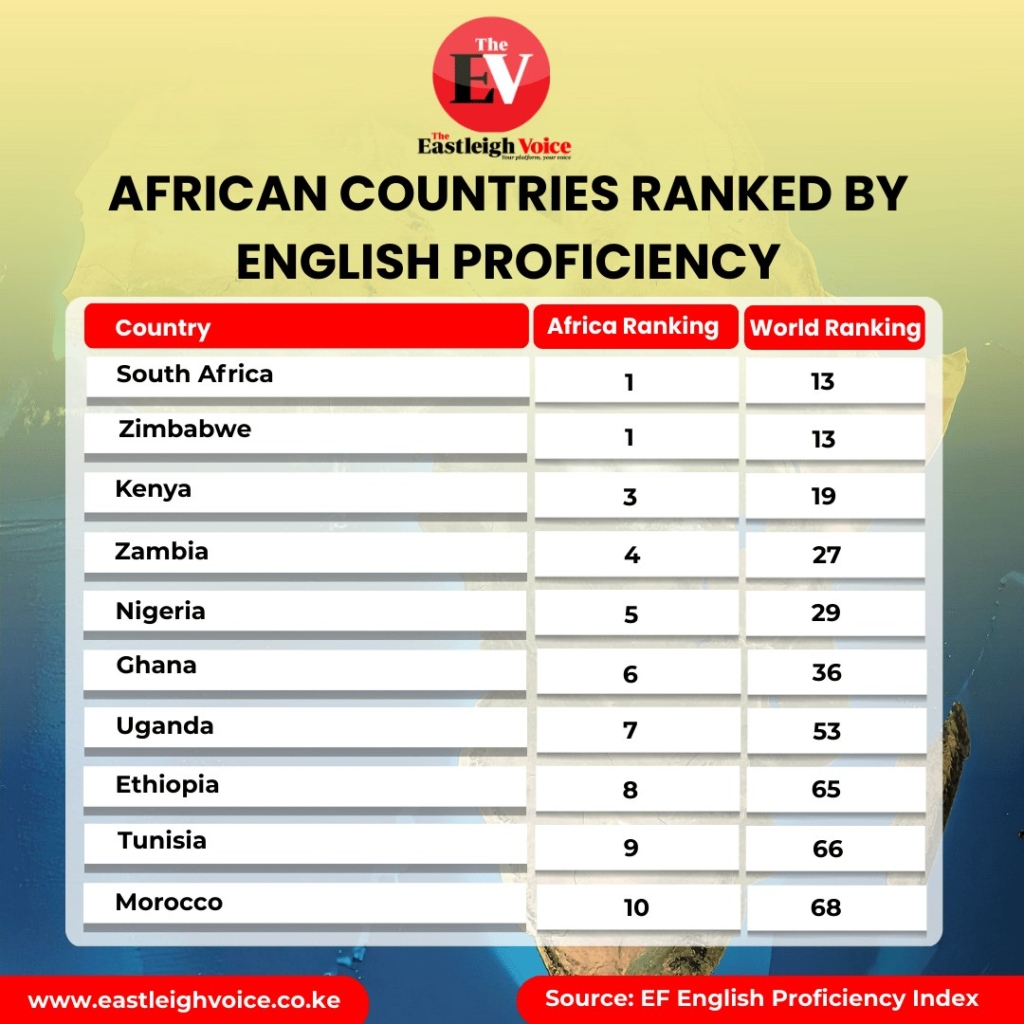
Ghana has been ranked as the sixth best English-speaking country in Africa and 36th globally in the 2025 Education First (EF) English Proficiency Index, reaffirming its position as one of the continent’s strong performers in English language skills.
According to the latest rankings, Ghana placed behind South Africa and Zimbabwe, which jointly topped the continent at 13th globally, as well as Kenya (19th), Zambia (27th) and Nigeria (29th). Ghana’s position places it ahead of several African peers, including Uganda (53rd), Ethiopia (65th), Tunisia (66th), Morocco (68th) and Tanzania (77th).
Africa continues to strengthen its position in the global English-speaking economy, with several countries recording solid proficiency levels in the 2025 English Proficiency Index (EF EPI) released by global education organisation Education First (EF).
The 2025 EF English Proficiency Index analysed English language skills worldwide, assessing data from over 2.2 million participants in 123 regions.
The study ranks countries based on their adult English skills into five proficiency categories, from “Very High” to “Very Low”.
Southern and East African nations, such as South Africa and Zimbabwe, achieved the highest rankings in the “Very High” proficiency tier on the continent.
The index demonstrates the importance of English proficiency in driving business, attracting investment and enhancing global trade connectivity.
The annual index assesses adult English language skills across 123 countries and territories worldwide, drawing on results from more than 2.2 million test takers who completed the EF Standard English Test (EF SET), the world’s largest free standardised English assessment.
EF categorises countries into five proficiency bands: Very High, High, Moderate, Low and Very Low, providing a comparative snapshot of how effectively populations can use English in professional, academic and social contexts.
How EF defines proficiency
Countries with very high proficiency (scores above 600) are typically able to use nuanced language in complex social and business settings, read advanced texts with ease, and negotiate contracts with native speakers.
Those ranked high proficiency (550–599) can confidently deliver workplace presentations, follow television programmes, and read newspapers.
Moderate proficiency (500–549) reflects the ability to participate in professional discussions within one’s field and write formal emails, while low proficiency (450–499) indicates functional but limited English use, such as navigating travel or handling basic workplace communication.
Africa’s top performers
Southern and East Africa dominate the continent’s rankings, reflecting long-standing investments in English-medium education, trade integration and international business exposure.
South Africa and Zimbabwe lead the continent, both recording very high proficiency scores of 602, placing them among the strongest English-speaking countries globally.
Kenya, Zambia and Nigeria follow closely in the high-proficiency category, reinforcing their roles as regional hubs for multinational companies, technology firms and international development agencies.
West Africa’s Ghana and East Africa’s Uganda fall within the moderate-proficiency band, while Ethiopia, Tunisia and Morocco complete the top 10 with low but functional English proficiency.
Why it matters for business
English proficiency remains a key driver of foreign investment, cross-border trade, outsourcing and digital services.
Countries with higher proficiency levels tend to attract more multinational firms, benefit from stronger participation in global value chains and integrate more easily into international labour markets.
As Africa deepens its engagement with global finance, technology and services, EF’s 2025 rankings highlight where language skills are reinforcing competitiveness and where further investment in education and workforce training may be needed.
Latest Stories
-
The 7-foot giant of Ngleshie Amanfro: Seven-foot Ghanaian Ephraim Saawa dreams of joining the national basketball team
32 minutes -
Government promises support for Kumasi Central Market fire victims
38 minutes -
Vibes The Movie: Big Ghun’s Ghanaian film earns five nominations at 2026 REFFA
1 hour -
MamaCare CEO warns unresolved conflicts among health workers could undermine maternal and neonatal care
2 hours -
Health professionals urged to translate medical knowledge into practice to save mothers
2 hours -
Conflicts among care providers linked to maternal, neonatal deaths – Expert
3 hours -
GIS marks 10th TIME conference, champions improved teaching practices
3 hours -
BRICS Or Balance? What Ghana’s bid really means
4 hours -
GPRTU wants full TRAFFITECH-GH implementation to start in 2027
4 hours -
Mahama announces plans to import electric wheelchairs for PWDs
4 hours -
KGL U17 Colts 2026: Western beat Prempeh Elite Academy to set up final final with Greater Accra Region
4 hours -
Late Solanke strike salvages 10-man Spurs draw at Man United
5 hours -
Gender Ministry to monitor welfare of Nana Akua Addo’s children amid domestic violence case
5 hours -
Benedict Okyere Yeboah: Ghana’s football problem goes beyond sacking a coach
5 hours -
GPL 2026/27: Darkwah Wiafe’s winner sees All Blacks beat Kotoko
5 hours