


Audio By Carbonatix
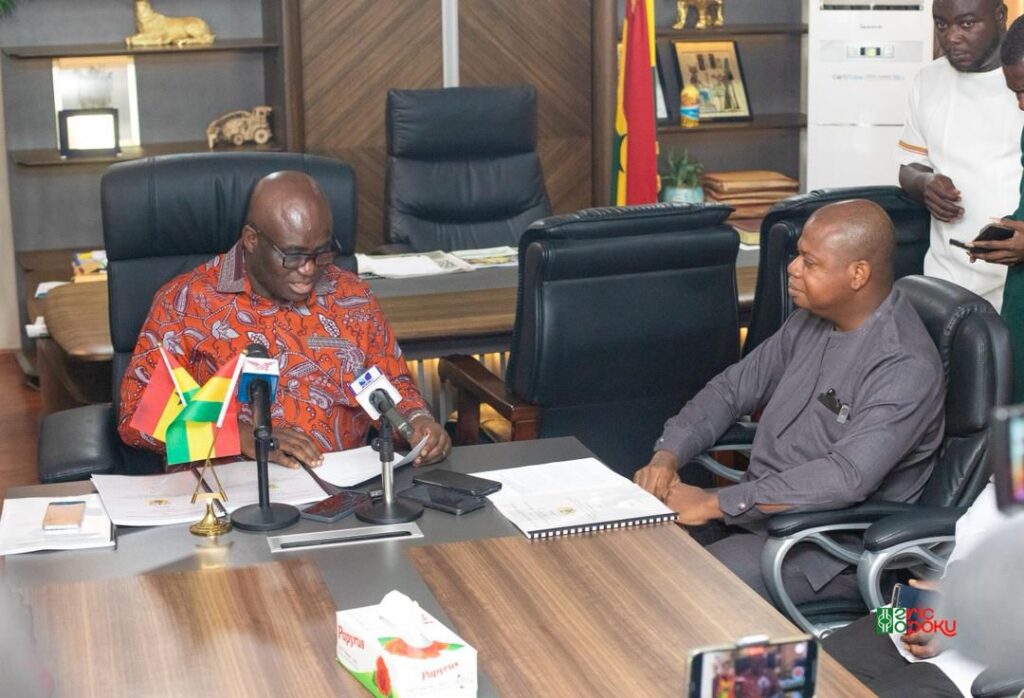
Ghana has taken a decisive step toward achieving tomato self-sufficiency following the signing of a landmark Public-Private Partnership agreement between the Ministry of Food and Agriculture and FarmMate Limited.
The agreement establishes a strategic collaboration in which government provides enabling support and coordination, while FarmMate leads implementation, production, and value chain operations. The model builds on an existing nationwide framework the company has been piloting since 2021, now set to scale significantly.
Minister for Food and Agriculture, Eric Opoku, described the partnership as a major intervention to reduce Ghana’s heavy reliance on tomato imports, which currently cost the country about 500 million dollars annually, while addressing persistent supply gaps and post-harvest losses.
Under the expanded framework, FarmMate will scale operations to 40,000 acres nationwide, targeting the production of approximately 400,000 tonnes of fresh tomatoes each year. This will be supported by processing facilities with a capacity of 20 tonnes per hour, expected to deliver about 200,000 tonnes of tomato puree annually.
Combined, the initiative is projected to generate up to 600,000 tonnes of tomato products annually, significantly narrowing Ghana’s supply deficit and reducing import dependence.
The partnership also introduces critical infrastructure across key production zones, including packhouses, pre-processing centres, and logistics hubs, to improve aggregation, storage, and distribution efficiency across the value chain.
Beyond volume expansion, the initiative is designed to tackle structural inefficiencies in the sector, particularly price volatility driven by seasonal gluts and shortages. By reducing losses during peak harvest periods and ensuring steady supply during lean seasons, the model is expected to stabilise prices and improve market predictability.
At the core of the programme is a structured out-grower system that guarantees off-take for farmers, while providing inputs and technical support. This is expected to improve incomes, boost productivity, and give farmers the confidence to scale production.
The broader economic impact is also significant. The initiative is projected to support tens of thousands of farmers and create over 300,000 direct and indirect jobs across the value chain, from production and aggregation to processing and distribution, with a strong focus on youth training and apprenticeship opportunities.
For traders, processors, and consumers, the model promises consistent access to quality tomato products that meet market standards, helping to build a more efficient and commercially viable agricultural ecosystem.
The partnership comes at a critical time for Ghana’s tomato sector, which has faced supply disruptions and structural inefficiencies despite the country’s strong production potential.
With this agreement, government and the private sector are positioning the initiative as a practical, scalable, and sustainable solution to one of Ghana’s most persistent agricultural challenges, demonstrating the impact of coordinated action in driving food security, industrialisation, and economic growth.
Latest Stories
-
Prime Insight: Making room for meaningful national conversations on Joy Prime
9 minutes -
FABAG commends Ato Forson’s over removal of 20% excise duty on locally manufactured fruit juices
16 minutes -
HIV stigma discourages testing, prevention and treatment in Ghana – Ghana AIDS Commission
18 minutes -
Blocking cocaine probe lends weight to claims of political protection for traffickers – Assin South MP
22 minutes -
NPP Vice Chair race: I may be the youngest, but most experienced – Nana B
24 minutes -
Last UK and US troops leave Iraq as anti-Islamic State mission ends
24 minutes -
Don’t stay home idle, embrace entrepreneurship while awaiting posting – Unemployed nurses urged
36 minutes -
Aayalolo buses not speeding on contra-flow lanes – GAPTE assures commuters
38 minutes -
Effia MP calls for Kurt Okraku’s removal, overhaul of Ghana football structure
39 minutes -
CAS hearing on AFCON final appeal by Senegalese Football Federation set for October 8
40 minutes -
STC fares to go up by up to 8% this week – Deputy MD
41 minutes -
Photos: Accra-Kumasi bypasses get new lease of life as contractors return to site
41 minutes -
Man allegedly swallows five SIM cards to conceal evidence after arrest
42 minutes -
After three finals, Ayikuma Methodist Basic School finally lifts National Juniors Challenge trophy
42 minutes -
Black Stars management ignored players’ health conditions ahead of Gambia game – Ernest Thompson alleges
43 minutes