

Audio By Carbonatix
The Bank of Ghana is to have the first right of refusal for the purchase of all gold mined in Ghana as part of measures to stabilize the country’s currency and ensure macroeconomic stability, Vice President Mahamudu Bawumia has disclosed.
Government is also working to help acquire the necessary certification for refineries in the country as well as help set up more, Dr Bawumia stated on Thursday, July 14, 2022.
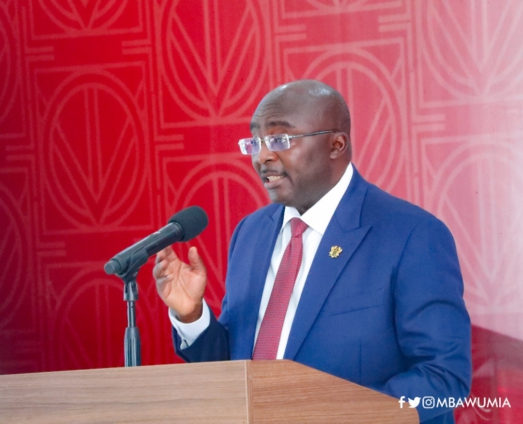
Speaking at the launch of a collaboration between the Accra Business School and South East Technological University, Ireland, Vice President Bawumia said Government has been and will continue to implement forward-looking measures to ensure the country is not buffeted unnecessarily by external economic shocks as is occurring right now across the world, leading to the country engaging the International Monetary Fund for balance of payments assistance.
One of the key measures, the Vice President emphasized is the right of first refusal for the purchase, at world market prices, of all gold mined in the country to build up the country’s gold reserves to ensure stability of the currency.
“Notwithstanding being one of the big gold producers in the world, Ghana’s reserves of gold at the central bank at the end of 2021 was only 8.7 kilograms. It was against this background that the Bank of Ghana started a Gold purchase program from gold producers to build up its foreign exchange reserves.
“To enhance this programme, Government will implement a new policy (which is already backed by law) under which the central bank (Bank of Ghana) will have first right of refusal for all gold mined in Ghana. The central bank will purchase the gold at world market prices and the mining companies will export the portion that is not purchased by the Bank of Ghana.
“Ultimately, once we accumulate enough gold, future borrowing and our currency can be backed by gold. This will stabilize the cedi long term,” Dr Bawumia explained.
Ghana must also increase the benefits she accrues from the mining of her minerals through value-addition, the Vice President insisted, hence the recent commissioning of a National Assay Lab by the Precious Minerals Marketing Company and the ongoing efforts to acquire international certification for existing refineries.
“We must also deepen our industrialization through value addition to gold. Even though Ghana has two gold refineries, none has London Bullion Market Association (LBMA) certification. This limits our full participation in the gold value chain. We will urgently work towards LBMA certification for our refineries in the next few years.
“Value addition to minerals such as lithium and bauxite will similarly be pursued in addition to the One District One Factory (1D1F) programme and the continued implementation of the automotive sector policy.”
Accra Business School
Commending the leadership of the Accra Business School for rolling out programmes designed to meet the needs of today’s Ghana, Dr Bawumia maintained that “the introduction of Information Technology into classrooms is a necessity for the government's digitalisation agenda.”
“It is the perfect match for knowledge-seekers everywhere as the world is brought to them with concision and wit; an opportunity to learn the language of the digital future and the digital economy.
“Information Technology education will help us in powering digital life by rethinking competition, capitalism and the roots of collaboration between the public and private sectors. The widespread adoption of ICT can only be achieved through education. However, none of this can be achieved without a strong strategic centre, making better use of data, and building capability across the state's digitalisation agenda.
“The role of IT education in an increasingly interconnected and interdependent world that transcends geographical boundaries, economies, and sectors,” he emphasised.
“In this era of global integration, ICT becomes indispensable and embedded in everyday activities. The promises it offers seem limitless. It can provide governments, businesses, and citizens with access to relevant information and allow them to communicate to make informed decisions and enable more efficient processes and services to address various economic, social, financial, and educational needs.”
Latest Stories
-
He entered at eight. He is now 16: Ghana’s children growing up in prayer camps
42 minutes -
‘Development must not always begin from Accra’ — Anwelle Foundation launched in Jirapa
44 minutes -
PKO trio eye victories at Odwira Festival
3 hours -
346 Ghana Navy recruits pass out after 26 weeks of intensive training
3 hours -
Newsfile to discuss EOCO-MP arrest, drug trafficking, speech arrests and $235m water debt
4 hours -
JoyNews gets results as listeners raise GH¢40,000 to help 17-year-old student with cerebral palsy attend SHS
4 hours -
Vice President calls for stronger local pharmaceutical production to reduce medicine imports
5 hours -
The brewing tension at KNUST; Beware the Ides of October….
5 hours -
Health Ministry moves to integrate traditional medicine into mainstream healthcare
5 hours -
550 pupils in Kintampo South get educational lifeline as ‘Seeds of Hope’ reaches farming communities
6 hours -
Opoku Mensah urges Christian Council, House of Chiefs to speak up on democratic freedoms
6 hours -
Teacher unions’ strike: Minority demands immediate payment of teacher arrears, 20% deprived area allowance
6 hours -
The Accra-Kumasi Expressway: Building it right
6 hours -
Beyond gold exports: Building value and economic resilience from Ghana’s gold
6 hours -
2027 AFCONQ: Ghana under pressure as Gambia beat Somalia 2-1
7 hours