

Audio By Carbonatix
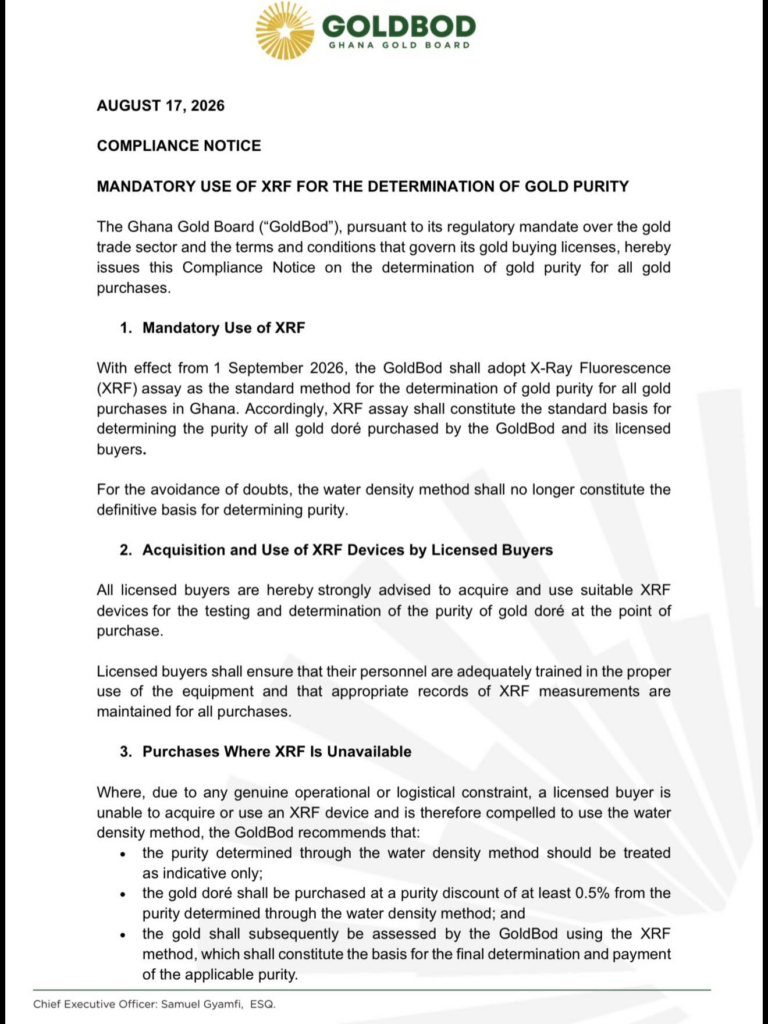
The Ghana Gold Board (GoldBod) has announced a new regulatory framework for determining gold purity, requiring licensed buyers and aggregators to adopt X-Ray Fluorescence (XRF) assay as the standard basis for gold purchases from September 1.
The directive, contained in a compliance notice issued by GoldBod on Monday, August 17, forms part of the regulator’s oversight of Ghana’s gold trade and introduces a uniform approach to the testing of gold doré across the licensed buying chain.
Under the new arrangement, XRF results will serve as the basis for determining the purity of gold purchased by GoldBod and its licensed buyers.
The notice also establishes procedures for cases where XRF equipment is unavailable, sets a tolerance for differences between successive XRF reports and places additional responsibilities on licensed aggregators.
GoldBod said the requirements will become part of the terms and conditions attached to licences issued to aggregators and licensed gold buyers.
From September 1, GoldBod will formally adopt XRF assay as the standard method for determining the purity of gold doré in all gold purchases covered by the regulatory framework.
The change means the water density method will no longer be accepted as the definitive basis for determining gold purity.
The shift establishes XRF as the reference point against which purity is to be assessed, giving licensed operators a common testing standard for gold transactions.
The decision also introduces a clearer distinction between an initial purity indication and a final purity determination, particularly in situations where a buyer does not have access to XRF technology.
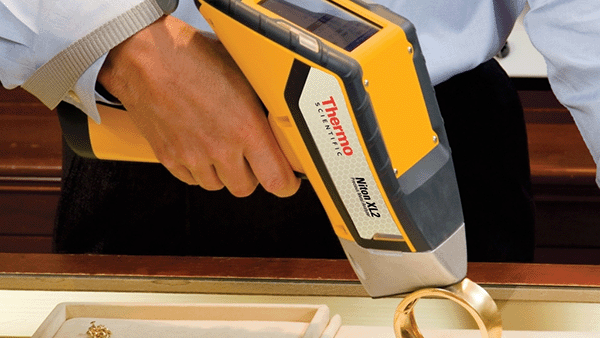
GoldBod has advised all licensed buyers to obtain suitable XRF devices and use them when purchasing gold doré.
The requirement goes beyond acquiring the equipment. Buyers are expected to ensure that employees responsible for testing are properly trained to operate the machines.
They must also keep records of the XRF measurements generated during their purchases.
The record-keeping requirement will provide documentation of the purity assessment attached to individual transactions and give buyers a basis for demonstrating how a particular purity figure was established.
GoldBod is consequently urging licensed operators to begin preparing their systems and personnel before the September implementation date.
GoldBod has recognised that some buyers could face genuine operational or logistical difficulties in obtaining or using XRF equipment before the new standard takes effect.
In such circumstances, the regulator has provided a mechanism for transactions to proceed using the water density method, but with important safeguards.
A purity figure obtained through water density testing will be considered indicative rather than final.
The buyer must also purchase the gold at a minimum purity discount of 0.5 per cent from the figure generated by the water density assessment.
The consignment will subsequently undergo XRF assessment by GoldBod. That later XRF result will determine the final purity and the applicable payment.
The arrangement means that reliance on water density testing will not give a buyer a definitive purity figure for the transaction.
GoldBod's preference is for licensed buyers to obtain XRF equipment promptly and avoid potential discrepancies associated with provisional purity measurements.
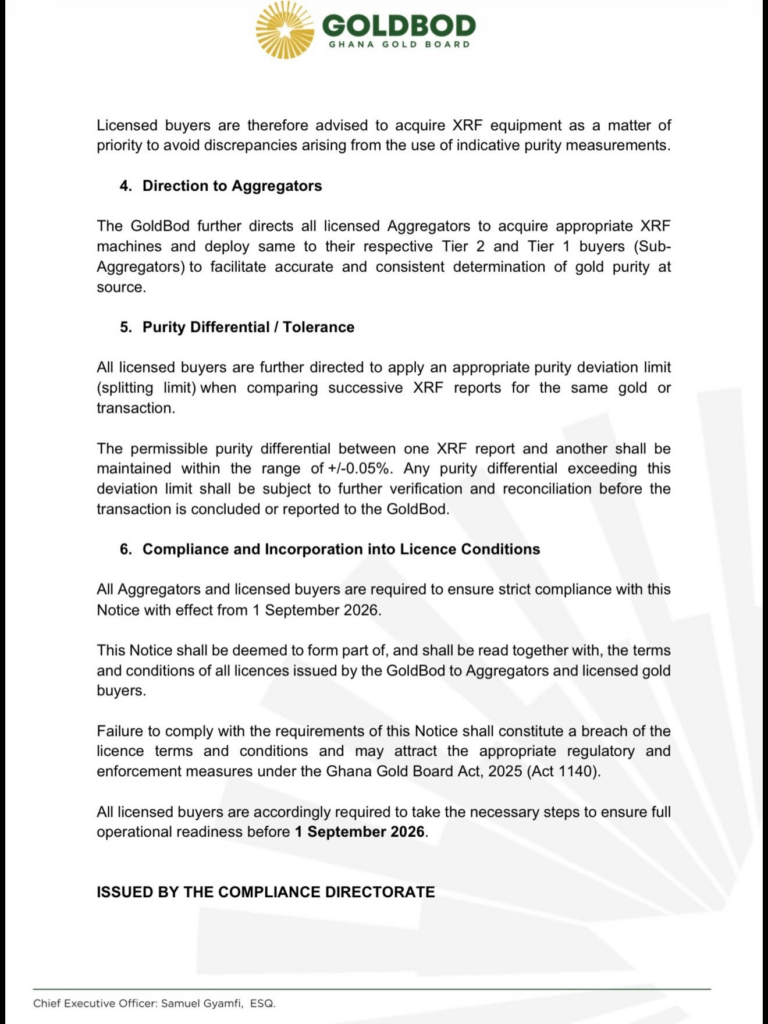
The compliance notice places a particular responsibility on licensed aggregators.
GoldBod has directed aggregators to obtain appropriate XRF machines and deploy them to their Tier 2 and Tier 1 buyers, referred to as sub-aggregators.
The objective is to make reliable purity testing available at the source of the transaction.
This requirement effectively extends the new testing standard through the different levels of the licensed gold-buying network.
Rather than concentrating XRF testing only at higher levels of the supply chain, GoldBod wants the technology to be available where gold enters the formal buying system.
Aggregators will therefore have to consider the equipment needs of their respective sub-aggregators and ensure that the machines are available for use.
The regulator has also introduced a defined tolerance for differences between successive XRF reports covering the same gold or transaction.
Licensed buyers must apply an appropriate purity deviation limit, also referred to as a splitting limit, when comparing XRF results.
The permitted difference has been set at plus or minus 0.05 per cent.
Where successive XRF reports produce a difference beyond that range, the matter must undergo further verification and reconciliation.
The transaction should not simply proceed or be reported to GoldBod on the basis of unexplained conflicting results.
This requirement provides a formal process for dealing with variations between test results and is intended to ensure that significant discrepancies are investigated before a transaction is finalised.
The introduction of the tolerance threshold means licensed buyers will need procedures for comparing XRF results and identifying cases that require additional scrutiny.
A difference that exceeds the permitted range will trigger a verification and reconciliation process.
This adds an additional quality-control stage to gold purchases where successive measurements do not produce sufficiently consistent results.
It also creates a defined point at which a discrepancy becomes a regulatory concern rather than simply a difference between test readings.
For operators, this means internal processes will need to account for the comparison of XRF reports before transactions are concluded or submitted to GoldBod.
GoldBod has made the compliance notice legally significant for licensed operators by incorporating its requirements into the conditions attached to their licences.
All licensed aggregators and buyers are required to comply with the notice from September 1, 2026.
The requirements are to be read alongside the existing terms and conditions governing GoldBod licences.
Consequently, non-compliance will constitute a breach of licence conditions.
GoldBod warned that breaches may result in appropriate regulatory and enforcement measures under the Ghana Gold Board Act, 2025 (Act 1140).
The warning places responsibility on licensed operators to ensure that their businesses are prepared before the new framework comes into force.
The notice gives the gold-buying industry a clear preparation deadline ahead of implementation.
Licensed buyers will need to secure suitable XRF equipment, train personnel and establish systems for recording measurements.
Aggregators, meanwhile, will have the added task of ensuring that their Tier 1 and Tier 2 buyers have access to appropriate machines.
Operators will also need processes for dealing with cases in which XRF results differ by more than the permitted ±0.05 per cent.
These preparations are necessary to avoid disruptions when the new rules become effective.
A central feature of the new framework is the emphasis on determining purity as close as possible to the point where gold is purchased.
The requirement for aggregators to deploy XRF equipment to sub-aggregators is particularly relevant to this objective.
It means purity assessments can be conducted within the buying network rather than relying exclusively on subsequent testing further along the supply chain.
GoldBod's approach is therefore designed to establish a common testing process from the initial purchase through subsequent stages of the licensed market.
For licensed buyers, the new rules create several immediate operational responsibilities.
They will need to:
- obtain suitable XRF equipment;
- ensure staff are properly trained to operate the equipment;
- maintain records of XRF measurements for purchases;
- use XRF as the standard basis for determining gold purity from 1 September;
- apply the prescribed approach where XRF is genuinely unavailable;
- account for the minimum 0.5 per cent purity discount when relying on water density testing;
- compare successive XRF results where applicable; and
- subject differences exceeding ±0.05 per cent to further verification and reconciliation.
Failure to meet these requirements could have consequences for their licences.
Latest Stories
-
Douglas Boateng receives IMM Institute Supply Chain Lifetime Achievement Award
10 seconds -
Pentecost University to host international sustainability conference
31 minutes -
Ampofo Ankrah did not collect World Cup visa money – Lawyer
41 minutes -
Baffour Awuah to spend night in EOCO custody – Atta Akyea
43 minutes -
Torgbiga Wenya III opposes proposed elevation of 36 Anlo chiefs to Paramount status
51 minutes -
The strengthening El Niño and what it could mean for Ghana
54 minutes -
Baffour Awuah formally charged with money laundering, loss of public funds – Lawyer
55 minutes -
Drone flight over EOCO building could attract 30-year jail term – Security consultant
1 hour -
Flying drone over EOCO premises is strictly prohibited – Security consultant
1 hour -
SIC file was surrendered to client, EOCO has no reason to search Manhyia South MP’s firm – Atta Akyea
1 hour -
EOCO search of Baffour Awuah’s law firm raises confidentiality concerns – Atta Akyea
1 hour -
“I will never ignore an invitation from EOCO if I had received one” — Manhyia MP
1 hour -
Baffour Awuah ready to cooperate fully with EOCO investigation – Bosome Freho MP
1 hour -
How a Ghanaian technology is helping fish farmers detect hidden threats before fish die
2 hours -
AI tool helps Ghanaian farmers identify crop threats from field observations
2 hours