

Audio By Carbonatix
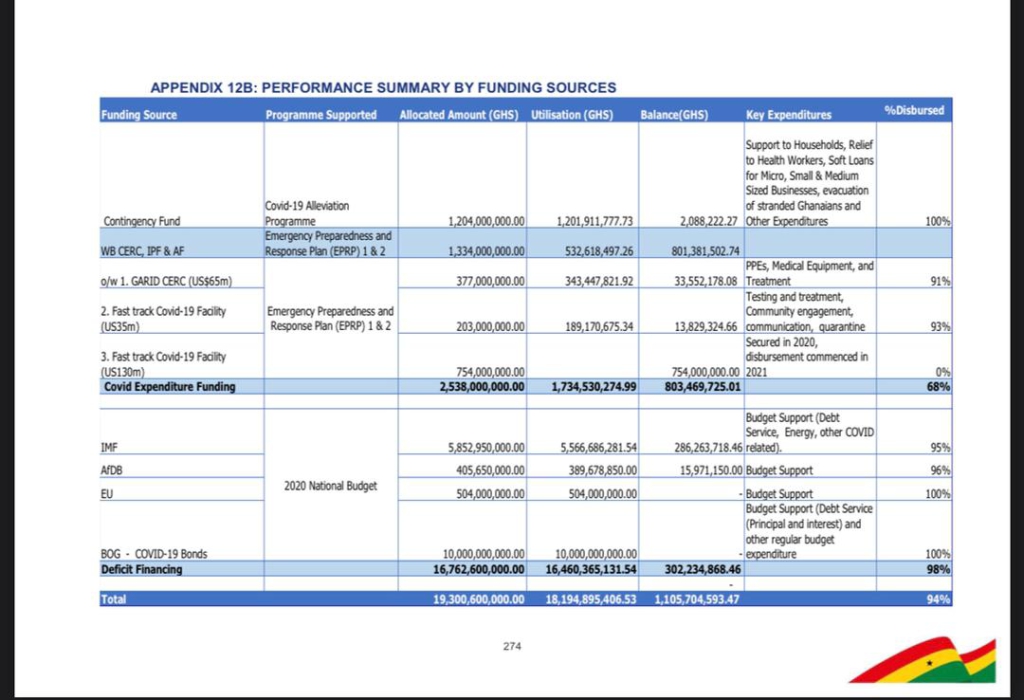
Government says it spent ¢19 billion on the fiscal impact of Covid-19, however, Joy News checks from the 2021 budget have revealed that government spent ¢1.7 billion on the pandemic.
The said amount covered relief to health workers, soft loans for Micro, Small, Medium Enterprises (MSMEs), evacuation of stranded Ghanaians, support to household, and other expenditure.
Appendix 12 A and B of the 2021 budget on Coronavirus Alleviation Program (CAP) shows that even though ¢2.5 billion was approved to support households, relief to health workers, soft loans for micro, small and medium enterprise, ¢1.7 billion was utilised.
The document has further revealed that ¢16.4 billion out of the ¢19 billion (budgeted for Covid-19 expenditure) was spent on deficit financing.
Meanwhile, government has introduced some new levies and taxes to cover up for cost of incentives introduced at the initial stage of the pandemic.
Government through the 2021 budget statement and economic policy proposed new taxes on petroleum products, 1% Covid-19 Health Levy on VAT Flat Rate Scheme and 1% on the National Health Insurance Levy (NHIL) as part of revenue measures to help the economy recover from the effects of the global pandemic.
Information Minister, Kojo Oppong Nkrumah, has explained that the move is to help stabilise the economy without engaging in more borrowing from other countries.
"The reality is that the gap between expenditure and income is widened. That widening has been compounded by Covid-19 and we are at a point where we have to make a choice to either continue to let that gap widen, if we do, we may get to a point where our economy cannot pay for basic services its debt, pay wages and salaries and do things that prior to 2016 we found ourselves doing and so the government has to take a responsible decision that we have to close this gab," he said.
The Ofoase Ayeribi MP added, "We need to get our people to understand that at some point at some point we have to get out of this economic conundrum in which we find ourselves.
"To do that, we cannot instantly borrow our way out of our problems. Domestic Resource mobilisation has to be tweaked and it has to be done in a way that you can raise resources without over burdening the people."
Latest Stories
-
Education Minister Haruna Iddrisu demands merit-based admissions, appointments at Defence University
4 seconds -
National Defence University to strengthen Ghana’s response to emerging security threats – Haruna Iddrisu
3 minutes -
Pupil arrested after two teachers shot at French school
10 minutes -
Lamisi takes ‘Let Us Clap’ tour across five countries and 18 dates
28 minutes -
DVLA cuts roadworthy contract cost from $155.4m to GH¢2m – CEO
29 minutes -
Okyeame Kwame calls for free university education for farmers’ children
33 minutes -
Black Stars: Two decades of coaching triumphs and turmoil (2006–2026)
37 minutes -
DVLA plans simulator-based driving tests to assess prospective drivers in Ghana
44 minutes -
FDA disposes of 40-foot container of non-compliant diapers imported from Spain
47 minutes -
PAC disappointed by Agric Ministry’s failure to present key witnesses in GH¢69bn special audit inquiry
56 minutes -
DVLA to digitise road accident reporting, requiring location coordinates before reports are filed
56 minutes -
GJA accepts Mahama’s request to organise national forum on hate speech
1 hour -
Democratizing the judiciary: Why Judges in Ghana should engage “We the People” through social media platforms.
1 hour -
Bond market: Turnover increases by 47% to GH¢4.07bn
2 hours -
DVLA prepares electronic queue system to reduce congestion
2 hours