

Audio By Carbonatix
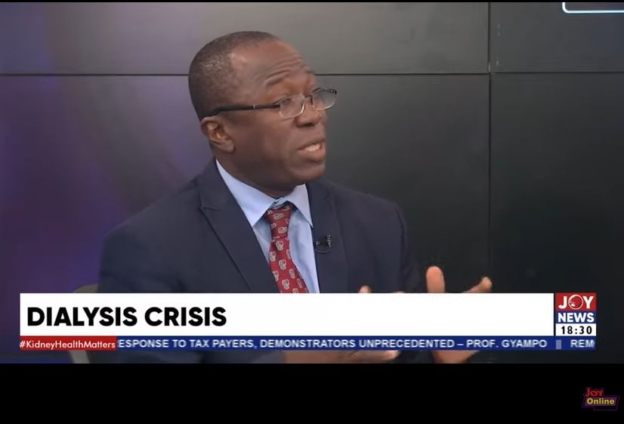
Chief Executive Officer of the Korle Bu Teaching Hospital, Dr. Opoku Ware Ampomah says the government has indicated its willingness to settle the four million cedis arrears at the Korle Bu Renal Centre.
According to him, the debt accumulated during the Covid-19 period when the centre’s largest benefactor, First Sky Group, delayed payment for its coverage of about 80% of all renal patients that seek healthcare at Korle-Bu.
He explained that the cedis' rapid depreciation in the aftermath of the pandemic had worsened the situation leading to a deficit of over four million cedis despite the First Sky Group settling the arrears.
“This is a historical debt. Before we got to this point, the supplier had started withholding supplies of the renal consumables because of this outstanding debt. Now how did we get this debt?
“This debt had arisen because during the covid period because of the financial crunch of course, our main benefactor had some challenges in meeting the payments although he did his best and we really acknowledge that and then we cannot blame him for that, this was something that was beyond him.
“So because of that delay in payment, the commitment has been made in cedis. So due to the fluctuation in the exchange rate, although that amount was paid, in terms of its value, in terms of the foreign exchange component, the value has significantly dropped so this meant that we still had a significant debt to settle in that regard.
“And so that is how come this 4million debt has accumulated which has resulted in the unfolding of some of these critical supplies. So this 4 million will help us settle the old debt which would enable these extra machines and equipment to be released to us to improve the service,” he explained on JoyNews’ Newsfile Saturday.
According to him, the hospital is in discussion with the presidency to settle the debt as soon as possible to enable the release of additional machines and equipment to the centre.
“We are hoping that this will be done within the next few weeks. In fact it can be done earlier but we’re still engaged in discussion. We have been asked to do some work and come back and so once we go back I will keep the people of Ghana updated as to the situation,” he said.
He, however, noted that taking into consideration prevailing circumstances, should the old charges be maintained, the hospital would need a subsidy of 961,000 cedis every month to operate smoothly and deliver quality service.
“But then going forward, in terms of recovery of cost if we are to maintain- because of the number of sessions we do, we actually run about 2000 dialysis sessions every month. So looking at the current charges we’ll be running a deficit of 961,000 cedis every month if we’re to continue with the current prices,” he said.
Latest Stories
-
“US Embassy introduced TRIBE Culture Fest to NSA, GTA” – Kofi Adams
31 minutes -
“NSA did not tell us of any embassy arrangement” – Kofi Adams
55 minutes -
Glasner suffers loss on Selhurst return as Palace beat Forest
3 hours -
WAFU B U17: ‘We won but I expected more from my boys’ – Kassim Ocansey
3 hours -
Man City cruise to statement win over 10-man Liverpool
3 hours -
Be careful with cross-border lending, foreign currency exposures – BoG to financial institutions
5 hours -
GPL 2026/27: Medeama go three clear as Hearts of Oak recover and Bechem stage stunning comeback
5 hours -
Ntiamoah Foundation launches “BEYOND 20” anniversary campaign
6 hours -
Credit Risk Management Directive: BoG to begin implementation for banks, others from July 1, 2027
6 hours -
Ghana Brands Awards 2026: Leading brands, business trailblazers to shine on November 20
6 hours -
T-bills auction: Demand improves as government exceeds target by about 76%; interest rates soften
6 hours -
Ziope undertakes initiative to build a technologically inclined community, commissions self-help ICT lab
7 hours -
ECG announces power outage in parts of Tema, Central Region due to network fault, maintenance
7 hours -
When the Gospel Becomes a Weapon: The church, blackmail and the abuse of faith
7 hours -
JoyNews’ Jacqueline Ansomah Yeboah selected for UK Media Excellence for Emerging Technologies Fellowship
8 hours