

Audio By Carbonatix
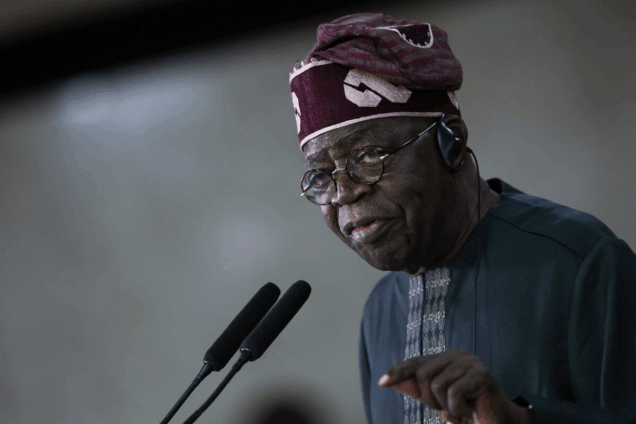
President Bola Tinubu declared a significant shift in Nigeria’s long-running war against insurgency, claiming the country’s security forces killed more than 13,000 insurgents over the past year.
Speaking during a televised national address on Friday to mark Nigeria’s Democracy Day celebrations, the president adopted a victorious tone. He emphasised that the death toll from the country’s jihadist insurgency has dropped 81 per cent since he took power in 2023.
The address comes as Tinubu prepares for a re-election campaign ahead of the January vote. It serves as a progress report for an administration that declared a nationwide security emergency last November to address a wave of mass kidnappings and violence.
Claims of Battlefield Success
The presidency highlighted massive casualties inflicted on armed groups and a surge in surrenders. Nigeria’s military has “neutralised” more than 13,000 “terrorists” in the past year, the president says, as armed groups and criminal gangs continue to carry out mass attacks and kidnappings in the country.
Tinubu did not specify if he meant in 2025 or in the previous 12 months during his remarks.
“Over 13,000 terrorists have been neutralised in the past year,” Tinubu said during the broadcast.
The president also noted that military pressure is forcing thousands of fighters to abandon the conflict entirely. Tinubu added that “124,000 fighters and dependents have laid down their arms since 2023 through Operation Safe Corridor,” a programme aimed at rehabilitating repentant armed group members who voluntarily lay down their arms.
International Interventions and Precision Strikes
Tinubu’s first term in office has also overseen the deployment of US troops to the country as major bouts of violence attracted international scrutiny. The foreign presence marked a deeper level of global involvement in the West African conflict.
The shift toward direct international assistance intensified after political pressure from Washington. Following unfounded allegations of a “Christian genocide” in the country by US President Donald Trump late last year, the United States military has since begun supporting Nigeria in conducting precision strikes on armed group locations. In February, 100 American soldiers were deployed to Nigeria.
Military collaborations with the United States, France, and other European countries that Tinubu did not name have progressed from training to precision targeting. This strategy led to the degradation of the command centre of the Islamic State-affiliated Boko Haram in northeastern Borno state.
High-profile operations have yielded significant results under this joint framework. US and Nigerian forces last month killed Abu-Bilal al-Minuki, an Islamic State commander described as the "most active terrorist" in the world, at a remote village in the northeast of Africa's most populous country. Furthermore, the US Africa Command this week said its joint operations with Nigeria had killed more than 200 IS-linked fighters.
A Persistent and Shifting Threat
Despite official optimism, Africa’s second-biggest economy is in the throes of a spiralling insecurity crisis that has seen armed groups linked to ISIL (ISIS) and al-Qaeda, as well as criminal gangs, abduct citizens for ransom money. The conflict remains deeply complex.
The insurgency has spawned multiple armed groups, killed tens of thousands, and displaced millions since it began in 2009 with an uprising by the jihadist group Boko Haram. The crisis has also been compounded by violent farmer-herder clashes in parts of the northeast and central regions, while secessionist agitation rumbles on in the southeast, and rampant kidnappings for ransom plague the country's northwest and central regions.
Soft targets, including schools, churches and mosques, particularly in vulnerable rural communities with limited state security presence, have been particularly at risk. Scores of people have been abducted since January alone, including teachers and pupils as young as four years old.
The geographical boundaries of the threat are also expanding. While armed groups initially limited their operations to the country’s north, they have begun spreading through thick forest corridors to attack targets in the country’s southwest. Officials say the groups are shifting base because of military pressure on their locations.
The unrest is inching closer to the relatively safer southwest. This expansion was underscored in May when an attack on a school in southwest Oyo state resulted in the abduction of 46 people, including more than 40 students and teachers.
However, rescue operations continue to free some captives. On Monday, the Nigerian military said it rescued 360 people kidnapped by ISIL-linked Boko Haram and held in a remote mountain hideout in northern Borno State.
Economic Risks and Fiscal Response
The persistent violence has placed severe strain on Nigeria's society and its broader economic stability. The International Monetary Fund warned on Tuesday that the widespread insecurity from armed groups -- especially in the north, where the bulk of the country's food is grown -- is a "risk to people and economic activity".
In one of the latest attempts to tackle the security crisis, the government launched a recruitment drive for 50,000 police personnel. It has also this year allocated a 5.41 trillion naira ($4 billion) budget to the military. Tinubu stated this funding level represents the biggest for defence in the country's history.
Regional Spillover and the West African Defence Strategy
The shifting dynamics of Nigeria’s internal conflict have triggered urgent security recalibrations across the wider Economic Community of West African States (ECOWAS) bloc. Intelligence networks confirm that Sahel-based militant groups are actively pressing southward, attempting to establish logistics and recovery pipelines through porous borders into coastal states like Ghana, Togo, and Benin. This regional vulnerability has driven new multilateral commitments, including the activation of a specialised 1,650-soldier ECOWAS counterterrorism brigade backed by key coastal contributors.
For neighbouring capitals like Accra, the containment of Nigeria's asymmetric threats remains vital to preserving collective economic security. Speaking at a West African security summit in Ghana, regional diplomats emphasised that uncontained violence directly jeopardises transit corridors, trade routes, and food security infrastructures that sustain more than 400 million citizens across the continent.
Domestic Accountability and Political Stakes
As Nigeria approaches a pivotal election cycle, the true efficacy of these historic defence expenditures remains under intense scrutiny. While the administration points to high insurgent casualties and successful precision strikes as proof of stability, the daily reality of kidnappings keeps local communities on edge. The coming months will test whether military triumphs in remote strongholds can successfully transform into safety for ordinary citizens.
Latest Stories
-
Asantehene plants trees to commence Jimi Watercourse Rehabilitation destroyed by galamsey
17 seconds -
15 arrested, 6 trucks impounded over sandwinning activities on Kumasi-Accra Expressway
25 seconds -
OFFICIAL: Vinicius will miss El Clásico, suspended four games
4 minutes -
Prayer vigil held after four arson attack murders
11 minutes -
GRA fully recovers $154k legacy debt owed by foreign entities between 2022 and 2024
12 minutes -
Kwesi Pratt Jr warns bus preachers are adding to passengers’ stress with accident prophecies
13 minutes -
MTN Ghana to spend $1.1bn in 3 years, build 500 new sites as MoMo hits 44% Growth
15 minutes -
I have no regrets joining Assemblies of God – Mahama
16 minutes -
Starlink restrictions in Ukraine war linked to political situation, Zelensky aide says
19 minutes -
Furniture boost for Techiman North schools as MP donates to 20 institutions
19 minutes -
Assemblies of God to loan 10,000-seater dome for Ghana@70 celebrations
19 minutes -
Government to audit 2,016 community network sites – Communications Minister
20 minutes -
Heritage Series notes: BoG promises more inclusive cedi with improved sizes, tactile features
37 minutes -
‘We want answers’ – Family seeks probe into 14-year-old’s death 12 days after starting SHS
48 minutes -
No preacher has the right to impose beliefs on bus passengers – Kwesi Pratt Jr backs preaching ban
51 minutes