

Audio By Carbonatix
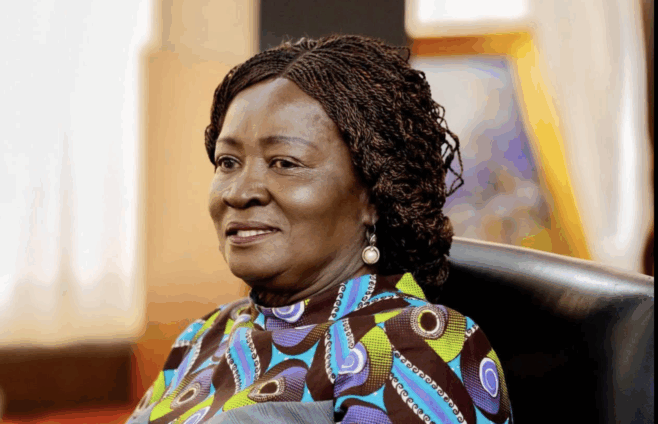
Professor Jane Naana Opoku-Agyemang, the Vice President, has said the government is reshaping Ghana’s tertiary education through the introduction of high-level interventions.
She mentioned the “No Fees Stress” policy, an intervention that removes financial barriers for first-year students in public tertiary institutions, which took effect in the 2025/2026 academic year.
Prof Opoku-Agyemang was speaking at the 59th Congregation of Post-graduate students of the Kwame Nkrumah University of Science and Technology (KNUST) in Kumasi.
The programme, attended by Otumfuo Osei Tutu II, the Asantehene, and the Chancellor of KNUST, conferred Doctor of Philosophy (PhD) certificates on 221 post-graduate students in recognition of their hard work in conducting tangible research.
Prof Opoku-Agyemang also spoke about the introduction of the Free Tertiary Education for Persons with Disability in October this year.
She noted that the intervention widened access to higher education for persons with disabilities who gained admission to accredited public institutions.
This, according to the Vice President, was a clear act of justice by the Government to students with disabilities in the country.
She said both interventions have been designed to ensure efficiency and transparency, giving all persons equal access according to their needs to be admitted to state-accredited tertiary institutions.
“This is an equity-driven intervention, designed to ensure that admissions to our tertiary institutions are determined as much as possible by merit and also by aspiration,” Prof Opoku-Agyemang said.
Additionally, the interventions broadened opportunities and strengthened the long-term development of the country’s human capital.
She emphasised that scholarships must be connected to impacts and not limited to lecture theatres and the laboratories.
Prof Opoku-Agyemang commended the post-graduates for their achievements and charged them to fulfil in their small way the responsibilities that accompanied their certificates.
She stressed that Ghana and the African Continent needed leadership rooted in resourcefulness, data, ethics and public value.
The abilities of the post-graduates to think clearly and act responsibly, she said, would be tested whether they remained in academia, join public service or launch a business.
She, therefore, encouraged them not to forget the contributions made by their families, communities and the nation to see to their success and embrace academic humility in their service delivery.
“Do not forget that your families, communities and nation have not invested in your education for your benefit alone. Remember them and maintain your academic humility,” she advised.
Latest Stories
-
Digital transformation without an ownership culture can digitise poor service
3 minutes -
Fishing communities demand revocation of offshore gold exploration licences over livelihood concerns
6 minutes -
How Ghanaian tycoon Manoj Lakhiani built a water and plastics empire from a $25,000 loan
7 minutes -
GoldBod recovers GH¢38.7m of GH¢55.8m outstanding receivables; remainder subject to legal action – Sammy Gyamfi
14 minutes -
GEXIM Bank donates GH¢200,000 worth of medical equipment to Korle-Bu Child Health Department
17 minutes -
Majority rejects Minority’s claims over GH¢49.7m South Africa evacuation
19 minutes -
GEXIM urges banks to support refurbishment of Korle-Bu Teaching Hospital’s Child Health Department
22 minutes -
Don’t appoint your cheerleader as referee
26 minutes -
Ghana needs stronger international cooperation to fight cybercrime – CSA
29 minutes -
CSA warns of growing cyber threats as Ghana’s digital dependence increases
35 minutes -
USTED dean warns GAUA strike could disrupt Ghana’s restored academic calendar
48 minutes -
Bechem meat processing factory 50% complete, set for March 2027 completion – Kwakye Ofosu
1 hour -
NDC can appoint whoever they want to EC, but Ghanaians will make a decision in 2028 – Titus Glover
1 hour -
GoldBod initiative has created over 1,300 public and private sector jobs – Sammy Gyamfi
1 hour -
Financial wellness key to retaining Ghana’s skilled workforce – Merban Capital CEO, Benjamin Ackah-Nyamike
1 hour