

Audio By Carbonatix
Health experts have raised deep concerns about Ghana’s healthcare system, warning that years of poor prioritisation, weak institutional discipline, political interference and chronic underinvestment are pushing the country closer to what they described as “death care” rather than true healthcare.
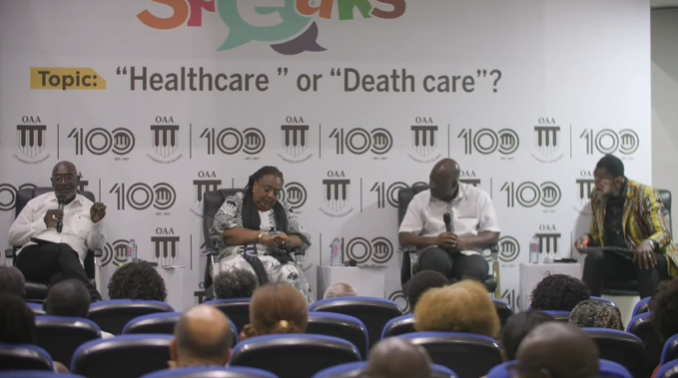
They were speaking at the Achimota Speaks event, where panelists discussed the topic: “Healthcare or Death Care.”
Former NHIA CEO Dr. Lydia Dsane-Selby, dissecting the systemic failures, said Ghana has made progress in reducing infectious diseases but is struggling to manage the growing burden of non-communicable diseases due to inefficiencies and neglect.
She explained that although Ghana has eliminated diseases like measles for years, the health system remains weak in dealing with the new realities.
“Ghana…I think, hasn’t had a measles case for a very long time, and when one turned up in Tamale, they had to bus in student nurses and medical doctors to see the child because we haven’t seen it for so long,” she said.
Dr. Selby raised concerns about the inefficiencies within health service delivery, noting that even with adequate medical expertise, systems below the top tier remain broken.
She stressed that the biggest challenge is equity and prioritisation, recalling her shock at a programme promoting pediatric stents costing $20,000 each, while rural communities struggle for basic healthcare.
“We cannot have policies that are only for the elite. We have to think about the rural areas and fair practice,” she said.
She also warned against blindly copying Western systems.
“There are counties in the US with all their spending, whose maternal mortality rates are worse than Chorkor. So sometimes following America is not always the way to go,” she said.
On financing, she stated that money is important, but it must be used wisely.
“All in all, money is important. But America has shown us that money isn’t everything. The elite get taken care of. Those at the bottom are suffering. They are as bad as we are in Ghana. So there has to be a balance.”
According to her, political interference, failure to follow policies, and collapsing institutions fuel the decline.
On his part, the CEO of Chiron Health Consult, William Delali Ofori, said Ghana’s major problem is not a lack of policies but failure to execute them.
He noted that across the country, health facilities function or collapse depending on the commitment of individuals rather than systems.
“We don’t know how to execute. Our facilities are poorly maintained, poorly resourced, with almost no standard operating procedures. It’s the same story from CHPS compounds to tertiary hospitals.”
He said Ghana’s system often appears like death care because of broken processes, lack of accountability, poor emergency response, and the absence of communication between ambulances and hospitals.
“When you hear an ambulance siren, it doesn’t mean the person has been rescued,” he stressed.
Consultant neurosurgeon at the Accra Medical Center, Dr. Teddy Totimeh, said Ghana must face the reality that improving healthcare requires sustained investment, strong advocacy, and innovative domestic revenue solutions.
“In the long run, it’s all about money…we haven’t spent enough, and we won’t get back.”
He also proposed a "funeral tax", arguing that Ghana spends excessively on funerals while hospitals remain underfunded.
“If we cut down the period bodies are kept in fridges and channelled that money into healthcare, it would make sense.”
Latest Stories
-
UTAG-UG threatens strike on October 19 over unpaid allowance
10 seconds -
Let The Constitution direct Chieftaincy to deliver “All Development Is Local”
1 hour -
John Jinapor outlines renewable energy, nuclear power priorities for 2027
2 hours -
Ghana explores centre of excellence for hearing, communication and cochlear implant care
3 hours -
Schizophrenia-related disorders lead mental health cases recorded in Ghana
3 hours -
Dutch authorities enlist Ghana in hunt for fugitive drug lord Bolle Jos
3 hours -
Ghana housing finance conference adopts communiqué to improve affordable housing access
8 hours -
Special Initiatives Minister urges Wa Technical Institute to enrol more girls as EU-backed solar training lab opens
8 hours -
In the matter of my first year at the Bar
8 hours -
ActionAid Ghana calls for an end to child marriage, greater investment in girls’ rights
8 hours -
Newsfile to tackle World Cup visa scandal, beach demolitions, education strikes, BRICS bid
9 hours -
UK-Ghana Trade & Investment Summit: Trade Resource Centre to help businesses maximise UK-Ghana trade opportunities
9 hours -
Embassy of Denmark celebrates World Maritime Day
9 hours -
Linking LEAP to productive inclusion could cut extreme poverty by 2030 – UNICEF
10 hours -
Trade Ministry backs use of creative arts to rehabilitate prison inmates
10 hours