

Audio By Carbonatix
Loharano's effortless grace belies the hard work that she is doing to stave off the tragedy that is unfolding in parts of her region of Madagascar.
A prolonged drought in the deep south of the island has left 1.3 million people struggling to find food and 28,000 facing starvation. Some have called it the world's first famine caused by climate change, though this has been disputed.
But Loharano's village, Tsimanananda, where she is a community leader, has been spared the worst.
It is a tough 45-minute drive from Ambovombe, the regional capital of Androy, one of the regions hardest hit by the sharp drop in rainfall in recent years.
The 4x4 vehicle can barely find a grip on the sandy roads. The view through the dusty windscreen reveals a desert-like dune landscape, stripped of trees and exposed to harsh winds.
It is hard to imagine anything growing here. But Tsimanananda stands out in the landscape.
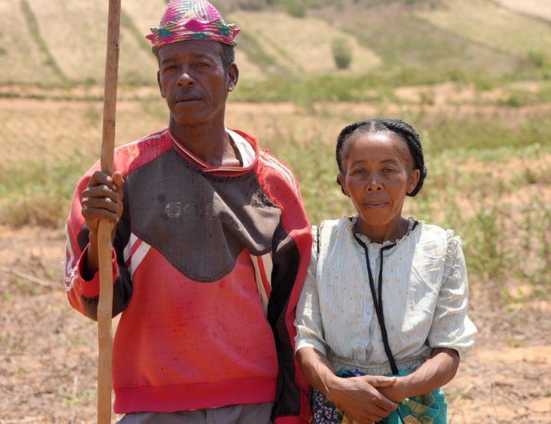
Loharano's smile lights up the space around her. She is short and gentle - not the first person you would pick out as the leader in her neighbourhood.
But she quickly invites me into her compound, making me feel at home.
"We suffered a lot from hunger. We planted but it failed every time," the 43-year-old says, reflecting on a previous drought that started in 2013. But with the help of a local charity, the Agro-ecological Centre of the South (CTAS), this time things are very different.
Shortly after I arrive, Loharano leads a short class under the shade of a tree.
Armed with a poster illustrating farming techniques, she talks to her neighbours, and her husband Mandilimana, about drought-resistant crops and techniques to revitalise the soil.
'We have breakfast, lunch and dinner'
Over the past seven years, CTAS has helped introduce grains like millet and sorghum and local legume varieties, which grow well in the sandy conditions and improve the soil's fertility.
The villagers were also taught how to plant natural windbreaks to help protect the crops from the ravages of the elements.
"Now, we have breakfast, lunch and dinner," Loharano says proudly as she shows off her plot of land where she and Mandilimana have grown an impressive range of crops.
On one end there are rows of millet, then beans, peas and sweet potatoes.
"We eat the husk from the ground millet with sugar and this is the favourite food of the children, their bellies are always full of millet."
CTAS has replicated this work in 14 other villages in the south of Madagascar helping some 10,000 households, the charity says.
But the small organisation cannot reach everyone and there is clearly enormous need.
Back in the regional capital, Ambovombe, is a sight reminiscent of a war zone.
In a small dusty field, dozens of families have erected makeshift tents - a patchwork of torn mosquito nets, rice sacks and plastic sheets.
But these people, around 400, have fled hunger, not conflict.
Unlike Loharano, they were not able to grow any food and had to sell their farms and cattle just to survive.
'My four children died'
However, it is more than just possessions that people have lost.
Mahosoa, who lives here with one of his wives and 12 children, tells me four of his youngest children died at the start of the drought three years ago.
"They died of hunger in the village. They died one by one, day by day. We didn't eat for one week. Nothing to eat, nothing to drink."
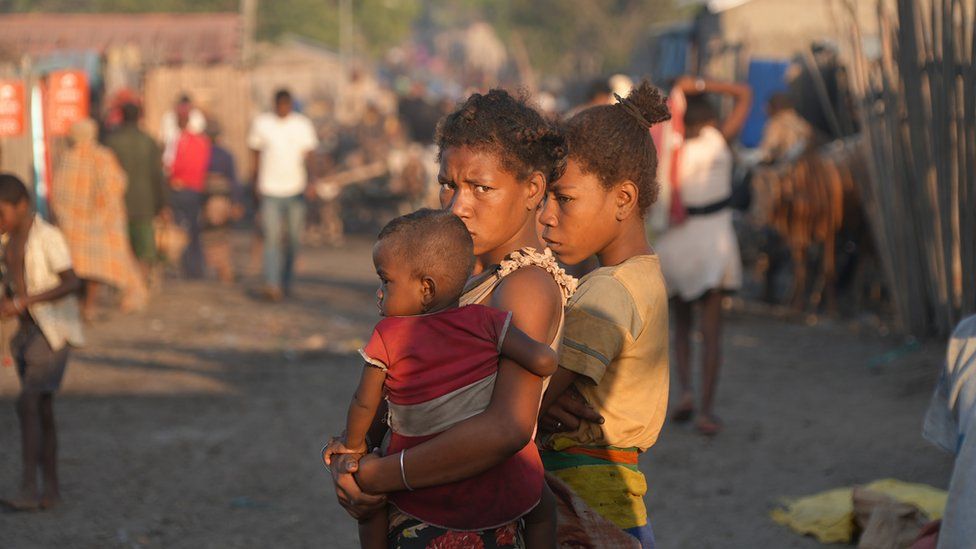
Mahosoa tells me some of his children go out to beg in the town so they can buy food or water.
Promises of aid from the government have not materialised for them, he says.
The government has distributed food aid in the affected area and has announced dozens of long-term infrastructure projects that could transform the area's prospects.
Nevertheless, President Andry Rajoelina has been criticised for failing to respond quickly enough to the crisis as the impact of the successive years of drought became more obvious.
Some locals put this down to the historical marginalisation of the region.
"During the war against the French colonialist army, the Antandroy [people from the Androy region] were able to fight against the French colonisers, they were able to use guerrilla tactics," university lecturer Dr Tsimihole Tovondrafale says.
Because of this, he says the French were not interested in developing the region.
"They didn't think about how to make roads, dig wells for example, and that's still the politics of Madagascar since independence up to now."
Many political commentators blame what they see as the government's slowness to react for exacerbating the hunger crisis in the south, but Madagascar's environment minister sees things very differently.
Dr Baomiavotse Vahinala Raharinirina says that the famine is "climactic in its origin". This chimes with the view of the World Food Programme, which says that the crisis is being driven by climate change.
The recent influential World Weather Attribution report on the drought in Madagascar, which included work from Dr Rondro Barimalala, a Malagasy climate scientist, disputed this.
Researchers found that though the recent rains have been poor and the probability of future droughts may be on the rise, the change in rainfall cannot be attributed to human impact on the climate.
Regardless of the exact cause of the lack of rain, there is no doubt that hundreds of thousands of people will be living with its impact for years to come.
Through her work to improve her village, Loharano is happy her community has avoided the disaster many are facing right now.
But it hurts her to see many more cannot be helped.
"I feel sad for them because they could die of hunger. One day, somebody had nothing and I asked her why.
"She said that they hadn't eaten since the day before. So I told her to take some of my peas and feed her kids."
Latest Stories
-
Imagination Africa, Mentors Chess Academy to host second African Genius Chess Championship at Ghud Park
21 minutes -
Nana B passport claims a diversionary tactic — Abu Jinapor
1 hour -
Pope Leo diagnosed with cancer as doctors remove lobe of lung, Vatican says
1 hour -
Legal Aid Commission takes free legal services to Techiman main lorry terminal
1 hour -
Nana B denies seeking passport favour, accuses Ablakwa of failing to account for GH¢16.4m
1 hour -
Young girls demand climate action, stronger protection against child marriage
2 hours -
Ex-gang boss sentenced to 40 years for orchestrating Tupac Shakur’s murder
2 hours -
From near-deferral to three awards: UMaT graduate’s academic journey
2 hours -
Atta Akyea denies seeking presidential pardon for Wontumi in galamsey case
2 hours -
Photos: Mahama commissions 85-bed Police Hospital ward, donates two ambulances
2 hours -
GTEC directs Ghana’s public universities to reopen by October 16 and begin lectures on October 19
2 hours -
Star Oil donates GH¢1million towards construction of new CID facility
3 hours -
Court hands Adjetey Sowah, two others lifetime bans after Amputee Football legal dispute
3 hours -
NDC appoints Julius Kwame Anthony as a Deputy Communications Director
3 hours -
Ghana repatriates 120 Nigerians rescued from suspected cybercrime centres
3 hours