

Audio By Carbonatix
In the cement industry, where production assets run continuously and downtime carries significant financial consequences, attention is increasingly shifting from plant construction to after-market services and operational optimisation. Across Africa’s cement sector, operators are rethinking how maintenance, spare-parts logistics, and service delivery are managed with data and mathematical modelling playing a growing role.
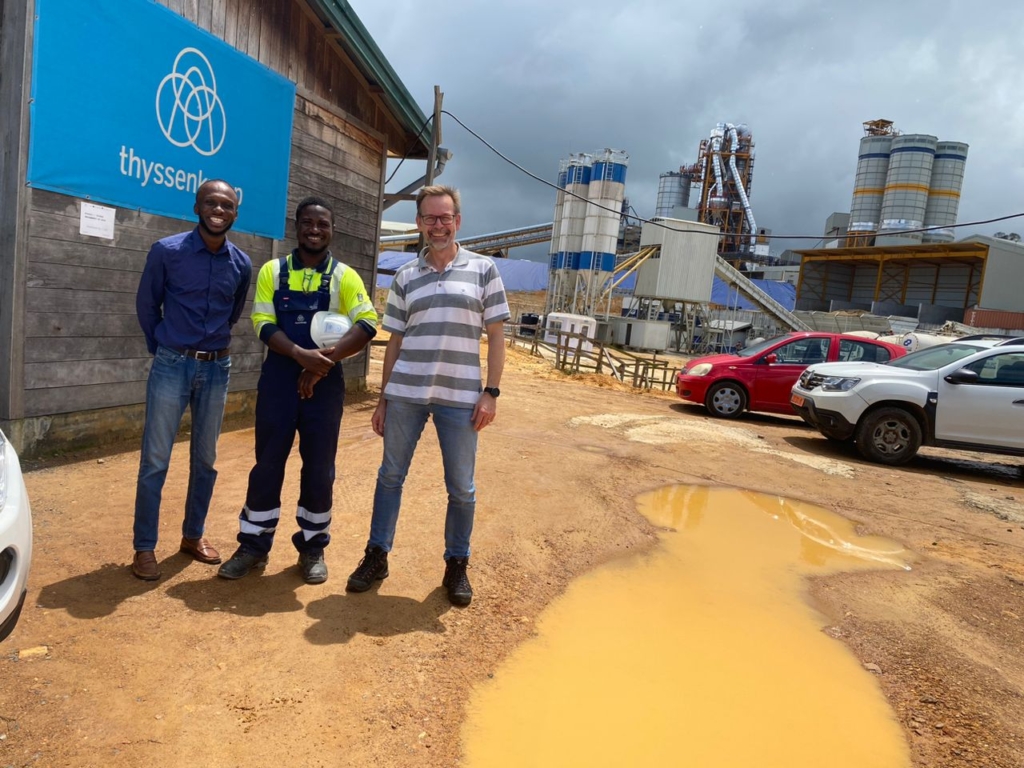
One industrial leader whose work reflects this shift is Seth Afari-Boateng, a Ghanaian professional whose career spans analytical science and heavy industry operations. Mr. Afari-Boateng who is currently the Regional Manager for the Sub-Saharan Africa Region at thyssenkrupp Polysius GmbH (a recognized technology leader in the cement equipment manufacturing sector) focuses on applying mathematical models and data-driven frameworks to improve cement plant after-market services and long-term operational performance.
Why After-Market Services Matter in Cement Production
After-market services, including maintenance planning, equipment reliability management, spare-parts supply, and technical support, account for a significant portion of a cement plant’s lifetime operating costs. Inefficiencies in these areas often result in unplanned shutdowns, delayed repairs, and inflated inventory levels, particularly in emerging markets where supply chains and technical resources are constrained. Rather than relying solely on reactive maintenance or experience-based decision-making, operators are increasingly turning to predictive and optimisation-based approaches to manage these complexities.
Applying Mathematical Models to Industrial Services
Mr. Afari-Boateng’s professional approach is grounded in advanced training in mathematical sciences and analytical modelling, which he has carried into industrial service environments. Instead of treating maintenance and service delivery as isolated technical activities, his work frames them as interconnected systems that can be measured, analysed, and optimised.
In practical terms, this involves using historical operational data to identify patterns in equipment performance, service response times, and spare-parts usage. These insights are then translated into structured planning tools that support more accurate forecasting and resource allocation.
Improving After-Market Performance Through Data
Across cement plant operations in Sub-Saharan Africa, Mr. Afari-Boateng implemented initiatives aimed at improving after-market service effectiveness through data-driven methods. These include:
●Using consumption and failure-rate data to model spare-parts demand, reducing excess inventory while maintaining availability of critical components
●Introducing maintenance planning frameworks aligned with equipment condition and usage patterns rather than fixed schedules
●Tracking service performance metrics to identify bottlenecks and prioritise high-impact operational interventions
These measures are designed to reduce variability in service delivery and improve plant availability over time.
Operational Optimisation Beyond Maintenance
Beyond after-market services, mathematical modelling has also been applied to broader operational optimisation efforts. By consolidating maintenance records, service logs, and production data into integrated performance dashboards, operational teams are better able to monitor trends, detect anomalies, and make informed decisions.
In cement manufacturing, incremental improvements in equipment uptime and service efficiency can translate into meaningful gains in output consistency, cost control, and energy utilisation.
A Data-Driven Approach to Industrial Leadership
Mr. Afari-Boateng’s work reflects a wider transformation underway in heavy industry, where leaders with analytical and quantitative skills are increasingly influencing operational strategy. As cement producers face rising cost pressures and higher performance expectations, the ability to translate data into actionable operational insights is becoming a key competitive factor.
While much of this work occurs behind the scenes i.e. in service models, maintenance plans, and optimization tools, its impact is visible in how cement plants operate, maintain reliability, and plan for long-term performance.
Mr. Afari-Boateng’s models and initiatives implemented in the after-market cement industry have resulted in improved after-market service, system-based known maintenance intervals of equipment and several spare parts consignment stock agreements with top cement producers such as Dangote Cement, BUA Cement, Lafarge Africa PLC, PPC Africa, Afrisam South Africa, Heidelberg Materials and others across Sub-Saharan Africa.
Latest Stories
-
Gender Ministry supports Harriet Amuzu in ongoing abuse case
13 minutes -
AG joins plaintiff to scrap OSP ?: We should be mindful of the mischief in this – Bobby Banson
19 minutes -
Samson Lardy Anyenini questions willingness of Attorneys-General to prosecute political colleagues
22 minutes -
It is only fair the OSP is heard in Supreme Court case – Bobby Banson
27 minutes -
Asiedu Nketia resumes Ashanti tour, second leg kicks off on Sunday
36 minutes -
NLA denies salary cut claims, threatens legal action over reports
40 minutes -
BoG Governor honoured for stabilising cedi, improve inflation
42 minutes -
Kyebi Easter Homecoming 2026: A resounding success!
1 hour -
Trade Minister applauds GUTA as a pillar of economic growth; Prez Mahama honoured
2 hours -
President’s brother’s takeover of Damang Mines is ‘untidy’ – Alhassan Tampuli
2 hours -
It’s not true that gov’t decided not to renew the lease for Gold Fields – Bobby Banson
2 hours -
Ghana to boost tomato production with 60-hectare irrigated farms and processing initiatives
2 hours -
E&P’s takeover process of Damang Mines was very clean – Inusah Fuseini
2 hours -
Damang takeover: There is not going to be any job loss; it is a lease change – Bobby Banson
3 hours -
Gold Fields didn’t stop mining at Damang mines; such claims are untrue – Bobby Banson
3 hours