

Audio By Carbonatix
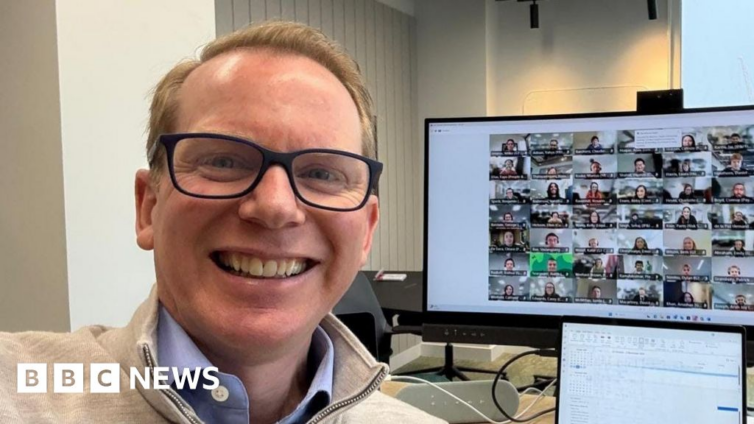
Charlie Nunn is CEO of Lloyds Banking Group - the UK's biggest bank providing one in four current accounts - meaning he has a deep insight into customers' spending, saving and borrowing.
Here are his top tips on how to manage your money from saving to avoiding scams.
1. Automate your savings
Nunn says the key to building up savings is to automate putting money aside.
This means regular saving will stop being a decision or action you have to keep taking - and putting off.
"If you're able to carve out a little bit and put it somewhere else where you won't have access to it and be able to spend it, I think that's the easiest way to start having a saving mindset," he says.
That could mean setting up a direct debit from your current account to a savings account, organising cash into different envelopes or using round-up tools that put spare change aside when you spend.
Nunn recommends "saving little, saving early and saving regularly".
He admits he "hates budgeting and always has" so he says he looks at his current account as soon as he gets paid and decides how much he wants to move into savings. "Do it as soon as you can," he adds.
As well as savings, he recommends having an emergency fund for surprise bills like a broken boiler or car repairs. How much you need in the fund depends on your circumstances but he advises having one to three months' salary set aside if you can.
2. Talk about money in relationships
Nunn and his wife use a joint account and have "complete transparency" over money, he says.
His red flag in a relationship is "someone who isn't careful with money" because he has always been "relatively prudent".
His attitude to money was shaped by childhood - his parents divorced, and his mother raised four children, which meant he grew up thinking carefully about spending.
"We were constantly worrying about what we were spending money on and managing money carefully, which ranged from looking for cheap food in the supermarket to thinking carefully about holidays and what we did in our spare time".
3. Give children pocket money
Nunn says his children "take no advice from me because I'm their dad", but he's tried to make them understand the value of money.
"They have pocket money which helps them budget, and they live within their means," he says.
He adds that two of his children are more comfortable spending, while others are more natural savers, which he says reflects what the bank sees among customers too.
He does not think younger people are generally financially irresponsible but is concerned about the bigger challenge of dealing with the amount of information, misinformation and pressure people now face online.
You can help protect yourself from fraud by "being curious and asking questions" if you're unsure about a transaction or about doing something someone has asked you to do online.
4. Pause before you buy
Nunn's biggest concern is fraud, as many people are targeted through social media platforms and online marketplaces.
"Young people are much more vulnerable to it than older people even though they tend to be pretty savvy with technology," he says.
His advice is to pause before sending money and question whether "you can trust the person on the other end".
"If you have any doubts, there are tools you can go and reference and get advice. You can also always call us to check".
Lloyds has launched a tool which allows people buying things online, such as tickets, to upload a picture and check whether it appears genuine.
"Just lean into those kinds of tools because they are available and they're there to protect people".
5. Beware of finfluencers
Social media can be useful for learning about money, but Nunn is "deeply concerned" about financial influencers pushing risky products.
"They are paid to promote a particular crypto coin, meme coin or investment product rather than helping people choose what is suitable for them," he says.
"Most people who haven't got much money shouldn't be taking the level of risk that means they could lose that money."
Instead, he says people starting out should think carefully about risk and cost, and consider simpler, diversified options.
Latest Stories
-
Hawa Koomson pledges experienced and mature leadership of NPP women’s wing
1 hour -
Young woman found dead at Kasoa Peace Town
2 hours -
Playback: The Law examined lawful arrest in Ghana
2 hours -
Mahama urges African governments to treat healthcare as an investment, not budget cost
3 hours -
Bawumia congratulates John Boadu and new NPP executives, pledges support ahead of 2028
3 hours -
‘No talent should be left out’ – Bawumia pledges inclusive NPP campaign for 2028
3 hours -
Prof. Mike Oquaye recounts how he blocked the Special Prosecutor’s attempt to arrest Bawku Central MP
3 hours -
Make health sovereignty a priority for Africa – Mahama
3 hours -
Dorimon Naa, Wa West DCE lead massive clean-up exercise; threaten sanctions against recalcitrant residents
3 hours -
Photos from Adom FM Y2K Jam
4 hours -
Praye Tiatia steals the show at Adom FM Y2K Jam [Watch]
4 hours -
Boakye Agyarko congratulates John Boadu, pledges support for NPP leadership
4 hours -
Antwi HiMight thrills fans with Antwi ne Antwi hits at Adom FM’s Y2K Jam [Video]
4 hours -
Amb. Edward Boateng congratulates Boadu, Kodua on election wins
5 hours -
John Boadu pledges to rebuild NPP from grassroots and restore ‘winning machinery’
5 hours