

Audio By Carbonatix
The Bank of Ghana (BoG) has clarified that securing a bailout from the International Monetary Fund (IMF) would have been challenging without the implementation of the Domestic Debt Exchange Programme (DDEP).
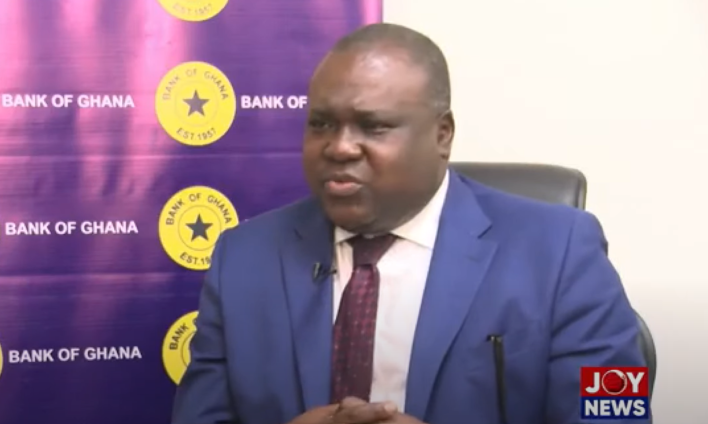
According to the Director of Research at the central bank, Dr Philip Abradu-Otoo, the bank endured significant losses to help stabilise the country’s economy.
To address the economic challenges, the government initiated an IMF programme and introduced the DDEP, which resulted in some bondholders experiencing a reduction in their investments and coupons.
This programme was a critical step in securing the necessary support from the IMF.
In 2022, the BoG reported a loss of GHS 60.9 billion due to impairments that occurred during the domestic debt exchange programme. These impairments were a direct consequence of the financial restructuring efforts aimed at stabilising the economy.
In an interview with Citi TV, Dr. Abradu-Otoo highlighted the obstacles the government would have faced without the DDEP.
He emphasised that without the debt exchange programme, the government would have had to revisit other components of the DDEP, making the process even more challenging.
Dr. Abradu-Otoo attributed the significant losses suffered by the BoG in 2022 to the domestic debt exchange programme.
He insisted that the central bank took the biggest hit for the country, demonstrating its commitment to supporting the government's economic stabilization efforts.
“The biggest one was the impairment we had on the securities that we were holding. Just like any other individual, the BoG was also holding government securities.
"Out of that GHS 60.9 billion, GHS 48 billion of that were impairment. That is the losses that we incurred on our books, as a result of the DDEP.
He emphasised, “For the debt exchange programme, nobody had a haircut on the principal…for the BoG, we had the side haircut, and top haircut and the amount itself was cut into two.
"We had three, we had to do that because we needed that to secure the IMF programme. It would have been tough to move forward very fast. Then we would have come back to the drawing board and relook at the other parts of the DDEP," he said.
Latest Stories
-
Real-Time VAT on cross-border digital services – not a new tax and does not violate double taxation principle
26 minutes -
Digitalisation, AI key to Ghana’s tourism transformation – GHATOF
38 minutes -
Stronger GTA-private sector partnership needed to grow tourism – GHATOF
48 minutes -
Amazon eyes Ghana for broadband expansion after talks with Mahama
2 hours -
National Investment Quiz 2026: Six schools qualify for quarter-finals
2 hours -
‘Do not let Russia pay for its madness with lives of your people’ – Zelensky to Ghana, 46 other countries
2 hours -
6,079 promotion cases fully processed and paid – CAGD says amid nationwide teachers’ strike
2 hours -
Teacher unions to meet government Monday over nationwide strike
3 hours -
Photo story: Republic Bank-JoyNews Habitat Fair clinic wraps up after three days of housing solutions, expert engagement
3 hours -
National Peace Council urges investment in youth to sustain Ghana’s peace
3 hours -
Afenyo-Markin urges youth to speak up against injustice
3 hours -
CAF annuls Edo Queens victory, orders WAFU B final to resume from extra time
4 hours -
Interior Minister urges traditional authorities to enforce anti-bushfire bye-laws
4 hours -
3rd Republic Bank-JoyNews Habitat Fair Clinic ends on a high note after three days of strong patronage
4 hours -
Ten climbers missing after avalanche hits Himalayan base camp
4 hours