


Audio By Carbonatix
An outbreak of avian influenza or bird flu is rapidly spreading across India, causing concern among officials and forcing them to come up with a plan to tackle the emergency.
Even as India prepares to roll out its massive vaccination program as part of the efforts to end the covid pandemic, the country is facing a new health crisis. Over the past few weeks, cases of bird flu have been reported from various states across the South Asian nation, posing a new challenge to authorities.
Officials in several states have stepped up efforts to contain two strains of bird flu — H5N1 and H5N8 — in recent days after the deaths of thousands of migratory birds, ducks, crows and chickens.
Addressing the issue at a virtual meeting held with state governments, Prime Minister Narendra Modi said, "Poultry farms, zoos, water bodies have to be constantly monitored to control the spread of bird flu." He stressed that authorities have put together a plan to tackle the emergency.
The spread of avian influenza has been confirmed in more than ten states so far, including Uttar Pradesh, Kerala, Rajasthan, Delhi and Maharashtra. States that haven't reported cases have also been asked to exercise caution.
Samples from dead birds are being studied at the National Institute of High Security Animal Diseases (NIHSAD), in the central city of Bhopal.
"People who come in direct contact with poultry are most at risk of being infected by the flu. However, human-to-human transmission can also occur," Aravind M, a Bengaluru-based doctor, told DW.
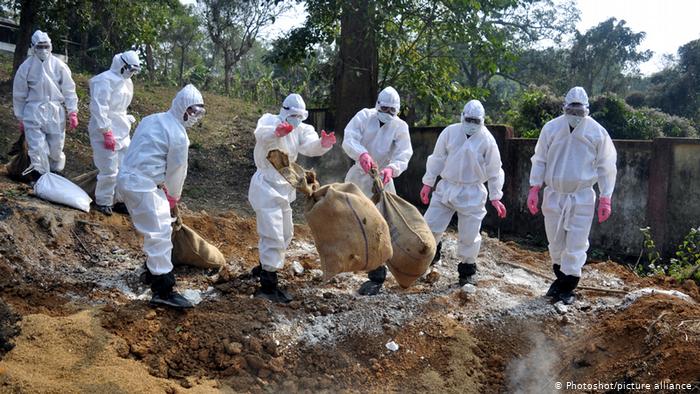
Spread through migratory birds
Officials first detected the H5N8 strain of the virus in January after dead fowl and wild birds were found in several parts of the country.
Most of the dead were Central Asian high-altitude bar-headed geese — one of the world's highest-flying birds — that migrate to South Asia during the winter season.
The H5N8 subtype has spread to different parts of the world since early last year. It has also affected several countries in Europe, including France, where thousands of chicken and other poultry have been culled.
India too has announced the culling of poultry and wild geese. Officials said the flu has spread in India mainly through migratory birds. The virus can spread to cats, dogs and other mammals as well.
India has witnessed bouts of devastating bird flu outbreaks in recent decades, most seriously in 2008, when millions of poultry were culled.
Severe economic impact
The fear of the virus has hit several cities across the country, leading to plummeting prices and sales of chicken, eggs and other fowl. Poultry sales have dropped even in states that have no reported cases of the disease.
While New Delhi announced a ban on the import of live birds, poultry chickens are being culled in Haryana and Madhya Pradesh and ducks in Kerala.
Markets and shops selling poultry have been shut for a week in seven Madhya Pradesh cities and the Uttar Pradesh government has announced a temporary closure of the biggest wholesale poultry market in Ghazipur city.
"We are the ones who are at risk, those dealing with birds on a daily basis. Now, very few people are coming to buy poultry products. This has affected our earnings. Thankfully, people are still buying lamb, so we aren't left high and dry. But if this continues for a long time, we will suffer," said Ashfaq, a meat shop owner in the national capital region.
India's minister for animal husbandry, Giriraj Singh, said that it was safe to consume eggs and chicken that have been cooked up to 70 degrees Celsius (158 degrees Fahrenheit). According to the World Health Organization, the virus does not spread from person to person, and cannot survive at high temperatures.
The first outbreak of bird flu was reported in India in 2006, in the western states of Gujarat and Maharashtra. Subsequently, other states too reported cases of the flu. But there were no cases of human infection. India had previously declared itself free of bird flu in September 2019.
Latest Stories
-
Ghana’s ocean is not land under water: Why the Fisheries Commission is right to demand a proper assessment of offshore gold exploration
1 minute -
Teacher unions maintain strike as FWSC, GES negotiations yield no deal
3 minutes -
Photos: Mahama Ayariga engages World Bank on sustainable cities development
9 minutes -
Foreign Affairs Minister warns embassies over long queues, ‘inhumane’ conditions for visa applicants
11 minutes -
Photos: AMA steps up enforcement to clear traders from BRT shelters
11 minutes -
Shortage of health information officers threatens quality of healthcare data – GHIMA
12 minutes -
Ghana’s National Chess Team, The Golden Knights return from Samarkand with gold and seven new international titles
14 minutes -
Northern Births and Deaths Director to face PAC over GH¢71k withdrawals
22 minutes -
Djokovic claims 102nd title of career with China Open win
26 minutes -
Desire FC teams up with Hellas Verona to develop emerging talent in Ghana
30 minutes -
Labone robbery case adjourned to October 22 as prosecution prepares supplementary statements
32 minutes -
BoG must come again on Cedi bouquets; people can use their money as gifts once they don’t deface it – Ayariga
33 minutes -
Mahama Cares administrator calls for stronger financial support for chronic illness patients
36 minutes -
Wontumi not yet confirmed among Mahama’s pardoned convicts – Palgrave
38 minutes -
6 Ghanaian victims of human trafficking arrested in Zambia cybercrime raid – Foreign Affairs Ministry
40 minutes