

Audio By Carbonatix
In the end, cooler heads prevailed – at least for now.
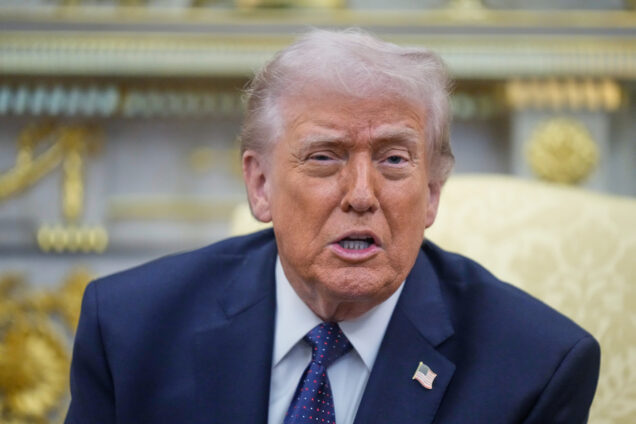
At 18:32 Washington time, President Donald Trump posted on his social media website that the US and Iran were "very far along" with a "definitive" peace agreement and that he had agreed to a two-week ceasefire to allow negotiations to proceed.
It wasn't exactly the last minute, but with Trump's looming 20:00 EDT (00:00 GMT on Wednesday) deadline to reach a deal or the US would launch massive strikes against Iranian energy and transportation infrastructure, it came pretty close.
All of this is contingent on Iran also suspending hostilities and fully opening the Strait of Hormuz to commercial shipping traffic, which the regime says it will do, while insisting it still exerts "dominion" over the waterway.
The deal allowed Trump to extricate himself from what was shaping up to be a treacherous choice – either escalating with his promise that a "whole civilisation will die tonight" or backing down and undermining his credibility. The US president may have only bought himself a temporary reprieve, however.
The US and Iran will now engage in negotiations over the next two weeks, buying some time to try to reach a permanent settlement. It is likely to be a bumpy ride, but in after-hours trading, the price of a barrel of oil dropped below the $100 mark for the first time in days and US stock futures soared. There appears to be a sense of optimism that the worst is over.
Even this kind of progress was far from certain as recently as Tuesday morning, when Trump threatened the death of Iranian civilisation, "never to be brought back again".
Whether such a jaw-dropping threat from an American president pressured Iran to agree to the kind of ceasefire they had previously rejected is uncertain. What is clear is that Trump's astounding, inflammatory declaration – just two days after a similar obscenity-laced Truth Social demand – is unlike anything a modern US president has ever levelled or hinted at.
And even if the two-week ceasefire does result in a permanent peace, the Iran war – and Trump's recent words – may have fundamentally altered the way the rest of the world views the US.
A nation that once styled itself as a force for stability around the globe is now shaking the foundations of the international order. A president who has seemingly relished shattering norms and traditions in domestic politics is now doing the same on the world stage.
Democrats were quick to condemn Trump's words on Tuesday, with some going so far as to call for his removal.
"It is clear that the president has continued to decline and is not fit to lead," wrote Congressman Joaquin Castro on X.
Chuck Schumer, the top Democrat in the US Senate, said any Republican who did not join in voting to end the Iran war "owns every consequence of whatever the hell this is".
While many in Trump's own party stood by their president, it was far from the near-universal support he often enjoys.
Austin Scott, Republican congressman from Georgia and senior member of the House Armed Services Committee, strongly criticised Trump's threats about a civilisation dying.
"The president's comments are counter-productive," he told the BBC, "and I do not agree with them."
Wisconsin Senator Ron Johnson, usually a Trump loyalist, said it would be a "huge mistake" if Trump followed through with his bombing campaign. Congressman Nathaniel Moran of Texas wrote on social media that he did not support "the destruction of a 'whole civilisation'".
"This is not who we are," he wrote, "and it is not consistent with the principles that have long guided America."
Senator Lisa Murkowski of Alaska, who has frequently broken with the president, was equally direct, writing that the president's threat "cannot be excused away as an attempt to gain leverage in negotiations with Iran".
The White House is likely to counter that the leverage worked, however. And for a president who has faced declining poll numbers, a growing number of critics within his own party and an economy that is struggling over higher energy prices, any off-ramp in the conflict is likely to come as a relief.
In his Truth Social post announcing the ceasefire, Trump said that the US had "met and exceeded" all its military objectives.
Iran's military has been significantly degraded. Although its Islamic fundamentalist regime is still in power, many of its top leaders have been killed in bombing strikes.
At the moment, however, many of the stated American objectives are still in doubt. The disposition of Iran's enriched uranium – the foundation of its nuclear weapons programme – is unknown. The nation still has influence over regional proxies, such as the Houthi rebels in Yemen.
And even if Iran does fully open Hormuz – without conditioning passage on tolls or other payments – its ability to control the key geopolitical chokepoint is more clear now than ever.
In a statement after Trump's ceasefire message, Iranian foreign minister Seyed Aragchi said that Iran would halt its "defensive operations" and allow safe passage through the Hormuz "via coordination with Iran's armed forces". He added that the US had accepted the "general framework" of the Iranian 10-point plan.
That plan includes the US withdrawing its military forces from the region, lifting economic sanctions on Iran, paying compensation for war damages and allowing Iran to maintain control over Hormuz. It is hard to imagine Trump actually agreeing to any of those conditions – a sign that the next two weeks of negotiations could be treacherous.
For the moment, however, this is a partial political victory for Trump. He made a dramatic threat and achieved the desired result. But the ceasefire is a reprieve, not a permanent settlement.
The long-term cost of the president's words and actions, and of the war overall, has yet to be fully assessed.
Latest Stories
-
Council of State urges sustained dialogue, negotiations as teachers resume work
5 minutes -
We are committed to leaving a legacy in Mandari – Bole-Bamboi MP
8 minutes -
Greater Accra teachers resume work after strike suspension
17 minutes -
Education Minister assures teachers of salary adjustments by October 16
22 minutes -
Abass Osabutey declares bid for NDC Deputy National Organiser position
23 minutes -
Education Minister inaugurates NDU Governing Council, announces $25m seed funding
32 minutes -
THE LAW 101: La Beach Demolitions – The State’s own documents, the courts’ orders – and the bulldozers
35 minutes -
DVLA contributes GH¢17.7m to Consolidated Fund in 2025
38 minutes -
Why disaster risk reduction must connect early warnings, preparedness and financial protection to household-level resilience
45 minutes -
Fentuo Tahiru narrates how 2018 Commonwealth Games visa scandal became an international embarrassment
1 hour -
The AI Gold Rush: Who strikes gold and who gets left behind?
1 hour -
Australia visa scandal: Pius Hadzide says failed checks left him carrying the blame
1 hour -
Pius Hadzide rejects blame for journalists’ visas in 2018 Australia scandal
2 hours -
What Is Wrong With Us: We queue for the Colosseum while our own Castles crumble
2 hours -
Dangote IPO fever could deepen Africa’s capital markets, Citi Bank executive says
2 hours