


Audio By Carbonatix
Headed goals by Harry Kane and Harry Maguire were among those which propelled England to their best World Cup performance since 1990.
But can repetitive heading cause damage to the brain and lead to long-term health problems?
A new study of 300 former professional players aims to answer the question.
The plan is to put the ex-players, aged between 50 and 85, through a series of tests designed to assess their physical and cognitive capabilities.
There will be clinical examinations and data will be gathered on the players' career in the game and lifestyle factors.
This will allow comparisons between defenders and centre forwards and other players who tend to head the ball less often.
The study will be carried out by the London School of Hygiene and Tropical Medicine (LSHTM), Queen Mary University of London and the Institute of Occupational Medicine.
The test results will be compared with those from a general population study known as the 1946 Birth Cohort which has monitored the ageing process in a group born in that year.
The new study will be similar to one which the Rugby Football Union embarked on in 2016 to assess the long-term impact of concussions experienced by former players in England.
Both are funded by the Drake Foundation, a not-for-profit organisation focusing on research on concussion injuries in sport.
Lead researcher Prof Neil Pearce, from LSHTM, said: "We know that there are increased risks of neurological disorders from head injury in sports such as boxing. However, we don't know much about the risks from concussion in football, and we know almost nothing about the long-term effects from heading the ball repeatedly.
"This study will provide, for the first time, persuasive evidence of the long-term effects on cognitive function from professional football."
News of the latest study follows increasing debate about the link between repetitive heading and concussion injuries and brain diseases such as dementia and Parkinson's.
In February 2017, researchers from University College London and Cardiff University published a study based on post-mortem examinations of the brains of six former players which found signs of brain injury in four cases.
Last year, former England player and BBC pundit Alan Shearer fronted a BBC documentary on the subject.
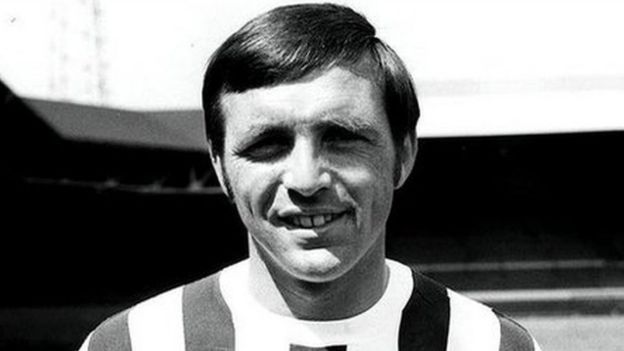
He highlighted the case of Jeff Astle who played for West Brom and England and developed dementia before dying at the age of 59 in 2002. A coroner ruled that Mr Astle's brain had been damaged by years of heading a football.
Alan Shearer concluded that "very little has been done to investigate the effects of heading a ball. I find that staggering."
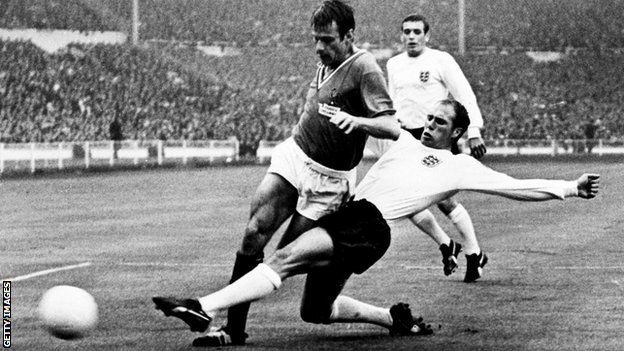 Image copyrightGETTY IMAGES
Image captionWorld Cup winner Ray Wilson died earlier this year of dementia
In November 2017, the Football Association and Professional Footballers' Association announced they were funding a study run by the University of Glasgow and the Hampden Sports Clinic looking at physical and mental health outcomes in former players, based on analysis of medical records.
The team, headed by neuropathologist Dr Willie Stewart, will address the question: "Is the incidence of degenerative neuro-cognitive disease more common in ex-professional footballers than in the normal population?"
The new research is understood to be the first of its kind in the UK to involve interviews and tests on former players.
James Drake, chairman of the Drake Foundation, said: "Many people have waited many years for a study like this - the Drake Foundation is proud to be funding this work and to be a part of this important step forwards in our understanding of sports-related concussion and its long-term effects."
Gordon Taylor, of the Professional Footballers' Association, welcomed the announcement: "For the last two decades the issue of head impacts, head injuries, concussions and neurodegenerative disease in former players has been of much concern to all at the PFA and our duty of care to our members."
Latest Stories
-
Man City not ‘above the rules’, says No 10 after backlash to Burnham remarks
9 minutes -
Real Madrid submit ‘substantial’ dossier in Barca payments case
11 minutes -
Messi completes purchase of second Spanish club
19 minutes -
Government must engage horticulturists on tomato crisis – GhIH
22 minutes -
King Promise’s ‘Can’t Tame Us’ becomes official Chelsea anthem
27 minutes -
Afenyo-Markin demands Baffour Awuah’s release from EOCO’s custody, end to alleged political intimidation
31 minutes -
Rapper Rick Ross arrested on domestic violence charges
41 minutes -
Minority demands security review of Ghana-Colombia visa waiver and port deals
51 minutes -
Pursue drug kingpins, not persecute political opponents – Afenyo-Markin tells EOCO
1 hour -
‘I am disappointed’ – Yaw Ampofo Ankrah breaks silence after NSA suspension
1 hour -
UK in talks with EU partners to release strategic fuel reserves if needed, BBC understands
1 hour -
I don’t think EOCO has legitimate basis to investigate SIC transaction – Atta Akyea
1 hour -
Douglas Boateng receives IMM Institute Supply Chain Lifetime Achievement Award
1 hour -
From small beginnings in Navrongo to Doctor of Pharmacy: Theobald Kambonga’s scholarship story
2 hours -
Pentecost University to host international sustainability conference
2 hours