

Audio By Carbonatix
The Minister of Health, Dr Bernard Okoe-Boye, has called on stakeholders and development partners to join hands with the government to tackle the viral hepatitis burden in the country decisively.
He said this would enable the country to overcome hepatitis and achieve elimination by 2030.
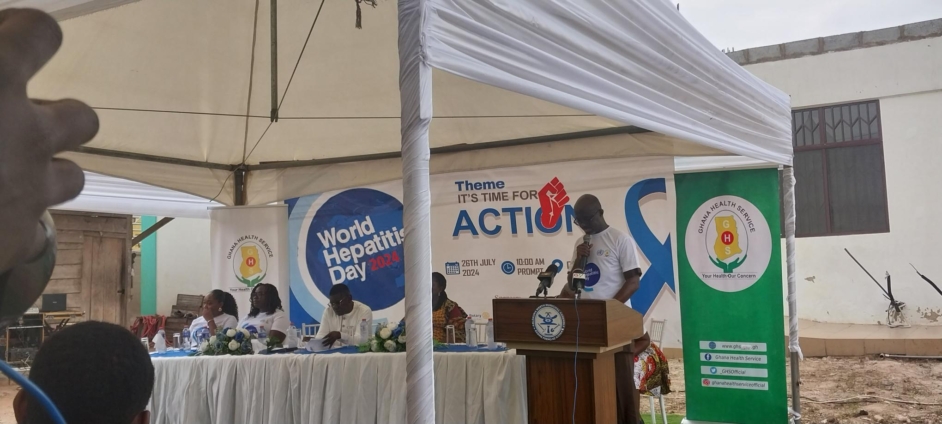
Dr Okoe-Boye made the call in a speech read on his behalf by Dr Hafiz Adams, to commemorate the 2024 World Hepatitis Day celebration on the theme “It’s Time for Action”.
Despite the technical and funding support Ghana was receiving from the Government of Egypt, the French Government, and the African Centres for Disease Control and Prevention, there was still much work to be done, the Minister said.

Hepatitis is an inflammation of the liver that can cause a range of health problems and can be fatal. It may be caused by viral infection, alcohol consumption, several health conditions, or even some medications.
World Hepatitis Day celebrated annually on July 28 seeks to draw attention and create awareness to the epidemic of hepatitis among policy makers and the population across the world.
A 2022 estimate puts about 2.8 million Ghanaians in the hepatitis B infection bracket, while over 442,000 have active hepatitis C infection.
Sadly, many Ghanaians who are infected with the hepatitis B and C virus are not aware they are infected.
The Minister of Health said it was for this reason that the Ministry of Health (MoH) was teaming up with the Ministry of Local Government and Metropolitan and Municipal District Assemblies (MMDAs) to work towards achieving a "Viral Hepatitis Free District" all over the country.

This, he said, would enhance awareness creation, promotion of testing and linkage to care.
Dr Okoe-Boye assured that the MoH under this initiative would work with the Africa Medical Supplies Platform of the Africa Union and partners to facilitate access to bulk procurement of hepatitis kits and medicines in support of government efforts.
"With decentralised ownership of the fight to eliminate viral hepatitis, Ghana can leapfrog and make substantial progress in a short time,” he added.
The Programme Manager of the Extended Programme on Immunization, Dr Kwame Achiano-Amponsah, on behalf of the Director-General of the Ghana Health Service, said viral hepatitis B and C were preventable, adding that anyone who tested negative could receive the necessary education to avoid getting infected.
Hepatitis B infection could be prevented in susceptible adolescents and adults with vaccination, research has shown that people who are fully vaccinated for hepatitis B as children or adults did not need re-vaccination every ten years as purported.
He said to reduce the risk of mother-to-child transmission of the hepatitis B virus, the Government with the support of its partners, is working assiduously to introduce a hepatitis B birth dose vaccine shortly.
"The full benefit of birth dose hepatitis B vaccination to the country, in preventing new infections can be realised when it is given at birth or soon after as the name suggests. Thus, the full potential of the vaccine will be realised if the overwhelming majority of babies are born in health facilities," he added.
He thus urged pregnant women to give birth in health facilities so that their babies benefit when the birth dose is introduced.
He also advised every adult of 20 years and above to visit appropriate health facilities and tests to know their status, and testing facilities are obliged to use approved kits for quality results.
Dr Frank Lule, representing the WHO Regional Director for Africa, Dr Matshidiso Moeti, urged Ghana to accelerate the introduction of the Hep B birth dose by taking advantage of the current opportunity to apply to the GAVI support in the September window.
"It is time for political commitment at the highest level, working towards fulfilling our agreed targets towards hepatitis elimination.” Dr Lule added.
He also encouraged civil society organisations to sustain their efforts in ending viral hepatitis by reaching the most vulnerable and tackling social stigma.
"I recommend that the private sector explore new initiatives and investment opportunities with our Member States to increase the local production of medicines for hepatitis B and C in African countries, strengthening the regional manufacturing sector,” he stated.
Latest Stories
-
2026/2027 GPL: Kelvin Nkrumah strike sends Medeama top of league table
2 minutes -
Emmanuel City crowned champions of maiden Global Game Scouting Tournament
11 minutes -
Thomas Partey loses father Jacob Teye Partey
24 minutes -
Martin Kpebu explains when EOCO can arrest Manhyia South MP after securing court warrant
42 minutes -
EOCO’s reasons for seeking Manhyia South MP arrest warrant not justified – Kpebu
45 minutes -
MTN Ghana warns SMEs against sharing PINs amid digital fraud risks
47 minutes -
Yendi nursing students warn restricted access to skills lab could affect their training
47 minutes -
Minority awaits formal notice of arrest warrant for Manhyia South MP – Annoh-Dompreh
50 minutes -
LTIF announces 2026 Pan-African edition in Accra from October 6-7
50 minutes -
Mfantsipim needs broader funding partnerships to bridge infrastructure gap – Prof Baiden
51 minutes -
MP status must not shield anyone from law enforcement – Kwakye Ofosu
60 minutes -
EOCO had tactical team ready to arrest Baffour Awuah – Felix Kwakye Ofosu
1 hour -
Afoko can unite NPP’s factions, says Charles Owusu Juanah
2 hours -
Guardiola backing Man City after guilty verdicts
2 hours -
Annoh-Dompreh questions EOCO’s claim that Manhyia South MP was unavailable for questioning
2 hours