

Audio By Carbonatix
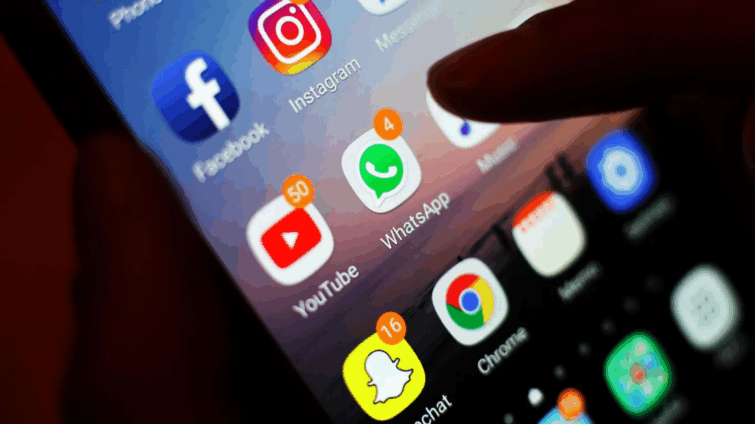
London Mayor Sir Sadiq Khan is supporting a ban on under-16s from social media, casting it as the only realistic way to tackle the harms children already face online.
Speaking to engineers, founders and investors in London on Tuesday, he will also warn that the growing influence of the manosphere risks creating a "lost generation of young men".
"From food to pharmaceuticals, almost every company has to prove that its products are safe before they're sold. I see no reason why social media firms shouldn't do the same," he says.
"Until they can prove that their platforms are safe for kids, a ban is the only way to stem the harms we know are happening right now."
The position puts the mayor ahead of Prime Minister Sir Keir Starmer, who has promised "game-changer" action on children's online safety and vowed to move quickly, but has not committed to an outright ban.
Sir Sadiq had previously urged that the impact of Australia's equivalent measure be monitored first, but he is now backing it.
The government's consultation on children's online experiences, covering app curfews, limits on addictive features and a possible under-16 ban, closed last week.
Launched on 2 March, it sought views from parents, children and experts on a range of possible measures, including a minimum age for social media, restrictions on addictive features like infinite scrolling and autoplay, tighter age checks and whether to raise the digital age of consent.
It will help ministers decide their next steps under new powers in the Children's Wellbeing and Schools Act 2026.
Misogyny 'spreads like wildfire'
The mayor says that restriction alone is not enough. "Rather than just restricting access to social media, we must reimagine it," he will say, calling for platforms that "prioritise people, not just profit."
He has also challenged firms to explain how misogyny "spreads like wildfire" on their services and to set out how they will change their algorithms to stop it, warning that "if they refuse to act, then the state must step up."
In the speech at the London music, film and technology festival SXSW, Sir Sadiq will also say: "'Toxic masculinity' is all too real. But I worry that, in our embrace of this type of language, we have too often alienated young men rather than engaging them — leaving them looking for validation elsewhere."
Announcing a £1m package for boys and young men, including support for vulnerable pupils, a father's programme and community football mentors, he will warn that online misogyny, peddled by "snake oil salesmen," risks "a lost generation of young men."
Not everyone backs a social media ban.
Ian Russell, who chairs the Molly Rose Foundation after his daughter Molly's death at 14, warns bans "treat the symptoms, not the problem" and let platforms "off the hook".
He said: "Bans are the wrong answer to a vital question. They risk unintended consequences that could leave children at greater risk of harm by treating the symptoms, not the problem.
"They let social media platforms off the hook by weakening the requirement for them to offer safe and high-quality experiences as a precondition for operating in the UK.
"Instead of listening to populist and simplistic calls for bans, the Prime Minister must do what his party promised and strengthen the Online Safety Act, relying on evidence on what's best for children rather than well-intentioned experiments."
A joint statement in January of 42 child protection charities (including the NSPCC, Molly Rose Foundation and 5Rights Foundation), said a blunt response fails to address the successive shortcomings of tech companies and governments, urging stronger enforcement of the Online Safety Act instead.
It is unclear which platforms have responded to the UK consultation. Globally, the industry is split on how age checks should work.
Meta, which owns Facebook, Instagram and WhatsApp, argues the app stores should verify users' ages, so parents approve which apps a child downloads, rather than each app doing its own checks. Snap and X take a similar view.
Apple opposes that model, arguing responsibility should rest with individual developers and warning that store-level checks could force adults to hand over personal data simply to download an app. These arguments have so far centred on US legislation rather than the UK.
A spokesperson for the Department for Science, Innovation and Technology said following the consultation, the government would "act quickly" on children's use of social media "in a way that is effective, enforceable and genuinely keeps children safe".
Latest Stories
-
SSNIT says La Beach clearance was to protect hotel investments, beaches to remain public
7 minutes -
APSU congratulates St Augustine’s College after back-to-back National Investment Quiz wins
11 minutes -
Renewed flood intervention at Mallam Junction raises hopes among residents, businesses
52 minutes -
St Augustine’s College retain National Investment Quiz title after nail biting grand finale
1 hour -
Education infrastructure investment will drive Banda’s development – Ahmed Ibrahim
1 hour -
Teacher unions strike: Gov’t presents fresh proposals as talks end inconclusively
2 hours -
51,000 teachers’ promotion arrears to be validated for October payment – Education Minister
2 hours -
Kwabena Boamah appointed Board Chair for Impact Investing Ghana
2 hours -
Striking teacher unions to meet Fair Wages and Salaries Commission on October 6
3 hours -
EOCO working with AG to arraign Nana Baffour Awuah before weekend court
3 hours -
Duraplast reassures customers after fire, announces October 5 reopening
3 hours -
Call off strike, gov’t will not renege on promotion arrears pledge – Haruna Iddrisu to teacher unions
3 hours -
Committee set up to validate teachers eligible for 20% deprived-area allowance – Education Minister
3 hours -
Five-member committee to search for new Black Stars coach after Sports Ministry-GFA meeting
4 hours -
Pinktober: Breast cancer survival exceeds 90% when detected early – Breast Society of Ghana
4 hours