

Audio By Carbonatix
Africans continue to rely on both formal and informal justice systems to resolve legal disputes, and many question whether the courts deliver fair, affordable, and timely justice, the latest Afrobarometer Pan-Africa Profile (https://apo-opa.co/3PCQJRy) shows.
The new report, based on 50,961 interviews across 38 African countries in 2024/2025, shows that while many citizens would turn first to the police or local courts to resolve legal problems, about one-quarter prefer traditional leaders, traditional courts, or elders. Confidence in formal justice systems is not strong: Only half of Africans believe ordinary people can obtain justice through the courts. Majorities say people are frequently treated unequally under the law, and almost half think powerful individuals who break the law get off too lightly.
Financial barriers also limit access to justice: Fewer than half of citizens believe they could afford legal assistance or court costs if needed.
Key findings
• Formal and informal justice systems continue to coexist: Across 38 countries, almost half of citizens see the police (41%) or local courts (7%) as their first point of contact for resolving legal problems, but 26% would go first to traditional leaders, traditional courts, or elders (Figure 1).
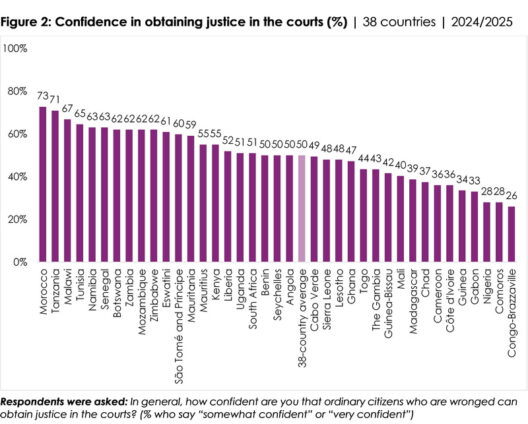
• On average, only half (50%) of Africans express confidence that ordinary citizens can obtain justice in the courts. Perceptions of fairness and timeliness in courts are similarly weak: A bare majority (51%) believe they could obtain a fair court outcome, while only 43% think cases are likely to be resolved in a reasonable time (Figure 2).
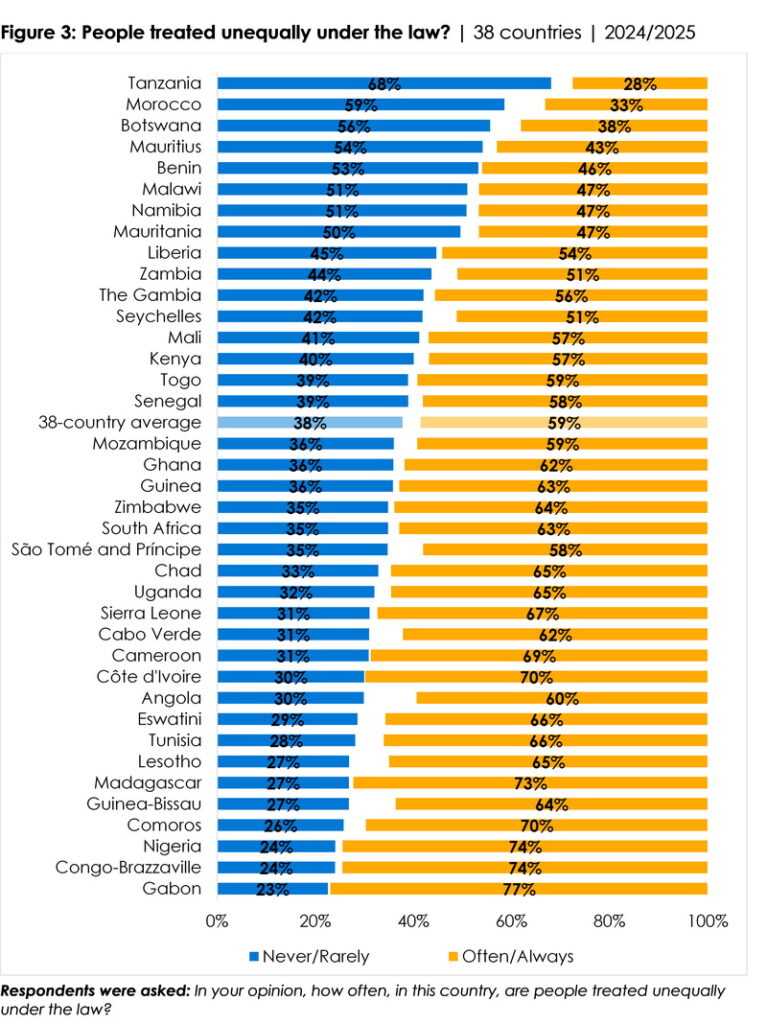
• Perceived inequality in the courts is a widespread problem: A majority (59%) of Africans believe people are “often” or “always” treated unequally under the law (Figure 3).
• Cost presents a significant barrier to using the courts to resolve problems. Only 46% think they could afford legal assistance, and just 44% believe they could afford court costs (Figure 4).
• Concerns about inequality are also widespread when it comes to the penalties imposed by courts: Almost half (48%) of respondents say the powerful get off too lightly, while only 13% say the same is true for ordinary people (Figure 5).
Afrobarometer surveys
Afrobarometer is a pan-African, nonpartisan survey research network that provides reliable data on African experiences and evaluations of democracy, governance, and quality of life. Ten survey rounds in up to 45 countries have been completed since 1999. Round 10 surveys (2024/2025) cover 38 countries.
Afrobarometer’s National Partners conduct face-to-face interviews with nationally representative samples of adults in the language of the respondent’s choice that yield country-level results with margins of error of +/-2 to +/-3 percentage points at a 95% confidence level.
Latest Stories
-
Crowds, deals and home solutions as Republic Bank-JoyNews Habitat Fair enters final day
25 minutes -
Fire Service finds only five functional hydrants in Ministries enclave
40 minutes -
Government to sign 1,200MW gas power deal before end of 2026 – Mahama
40 minutes -
West Mamprusi launches community-led WASH and livelihoods project across 100 communities
41 minutes -
Iran says it will wait for official US response after Trump rejects Strait of Hormuz proposal
56 minutes -
90 Oti communities to benefit from government electrification project
57 minutes -
Floods leave 246 without shelter as 93 houses collapse in North East Gonja
1 hour -
Labour Minister wants SOEs to help shape new public pay system
6 hours -
IPEC will ensure Equity and Sustainability in SOEs Compensation
6 hours -
White House bars CNN from travelling with Trump on Air Force One
7 hours -
Fennis wins second consecutive ITF J60 title in Accra
7 hours -
Spain beat England in thriller after Kane penalty miss
7 hours -
GPL 2026/27: Zaidan’s late goal ends Hearts of Oak unbeaten start
7 hours -
CEOs demand clarity on pay harmonisation, board autonomy as FWSC engages SOEs bosses over IPEC transition
7 hours -
2026 Women’s Super Cup: FC Savannah, Epiphany Warriors maintain top spots ahead of final group games
8 hours