

Audio By Carbonatix
A multi-disciplinary group of experts from Ghana and Switzerland are undertaking a study to develop new methods to address gaps in energy system models for developing countries and cities.
Developing countries, like Ghana, grapple with socio-technical and economic factors rarely represented in conventional energy modeling approaches, which are often developed by and for industrialized nations.
Such factors include the impacts of the informal economy, suppressed energy demand, power sector failures, and climate change on urban energy resilience and planning.
Researchers in this project are working together to represent these issues in energy planning models, and to apply them to the case study of the city of Accra, supporting its sustainable development.
Accra is committed to sustainable urban planning as a signatory city within the C40 Cities and Global Covenant of Mayors for Climate and Energy frameworks. As the focal case study city within this project, the municipality can directly benefit from this work in developing their climate strategy.
However, the outcomes of this study can also help other cities around the world to apply demonstrated models and methods to their own sustainable energy strategy development.
The project, titled, “Energy System Modeling for the Real World: Transforming Model Approaches for Sustainable and Resilient Urban Development (MEASURES)”, is funded by the Swiss National Science Foundation (SNF) and is running from 2020 until the end of 2023.
The project is being led by Dr. Mashael Yazdanie, a research scientist at the Urban Energy Systems Laboratory at Empa in Switzerland.
Ghanaian project partners include; the Department of Economics and The Brew-Hammond Energy Center at the Kwame Nkrumah University of Science and Technology (KNUST), as well as the University of Energy and Natural Resources (UENR).
“One of the interesting things about the MEASURES project is its goal of advancing modeling methods for resilient and sustainable energy planning through international and interdisciplinary collaboration,” said Prof. George Yaw Obeng, Dean of Faculty of Mechanical and Chemical Engineering, KNUST.
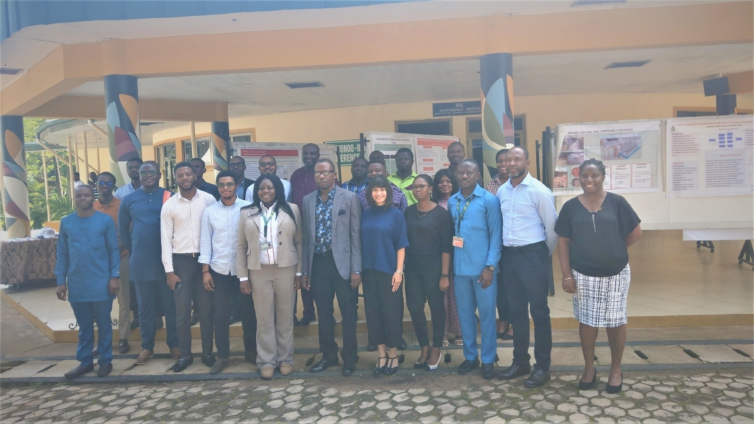
The first conference and workshop of the Swiss-Ghanaian MEASURES project was held at the KNUST in October 2022. The event brought together researchers, practitioners and experts across a wide range of fields.
In addition to the partner institutes (Empa, KNUST and UENR), local attendees included the Accra Metropolitan Assembly, Ministry of Environment Science Technology and Innovation, Environmental Protection Agency, Electricity Company of Ghana, and Digital Earth Africa, amongst others, enabling valuable exchanges and learning opportunities.
"This project presents a unique opportunity to collaborate across disciplines, professions, and boundaries in order to collectively tackle one of the most urgent challenges facing humanity – that of mitigating climate change impacts on society and our planet," said Dr. Yazdanie.
The importance of energy system models
Energy system planning models are vital decision support tools. Developing cities, like Accra, are particularly vulnerable to climate change impacts, such as increased heatwaves, flooding events and rising sea levels, compared to cities in industrialized nations.
Thus, maximizing their resilience is essential, and modeling tools can play a pivotal role in evaluating and developing resilient urban energy plans.
"Our aim is to improve energy planning models and related decision-making processes in order to support cities and nations in developing more effective sustainable and resilient energy system plans, particularly under the threat of climate change," said Dr. Yazdanie.
Multiple experts, including economists, climate change scientists, engineers, and energy system modelers are working together to identify synergies and integration opportunities between modeling methods.
“We will build upon existing open-source optimization/simulation models and demonstrate developed methods using Accra as a case study city. We aim to ensure knowledge transfer, especially to urban energy planners, modelers and researchers by sharing models, data, methods, and findings on open-access, digital platforms and through workshops,” said Dr. Yazdanie.
The research and knowledge generation on modeling approaches for resilient and sustainable energy planning are relevant to the development of decision-support systems that will help build resilient and sustainable energy planning practices in Ghana and beyond.
Latest Stories
-
Association of Small-Scale Industries empowers trade executives in Bono East with a mentorship programme
4 minutes -
AMA evacuates refuse along Graphic Road, warns against indiscriminate dumping
9 minutes -
STC interdicts driver over Pokuase overtaking incident
13 minutes -
Ekumfi: How $6m EXIM participation built a $53m industrial asset — now poised for a 24-Hour Economy breakthrough
14 minutes -
4 arrested, 142 parcels of suspected Indian hemp seized as officers reject GH¢50k bribe
14 minutes -
No MMDCE can say they don’t see galamsey – Local Government Ministry
16 minutes -
Ghana, Germany explore stronger partnership in technical and vocational education
22 minutes -
AMA urges motorists and road users to comply with traffic regulations
23 minutes -
Sam George urges One Million Coders participants to complete all three levels
23 minutes -
Communications Minister announces 2,800-site telecom expansion during Volta visit
25 minutes -
Impunity fuelling sexual abuse in Ghana – Angela Dwamena-Aboagye
26 minutes -
NUGS condemns alleged sexual abuse by Obuasi SHTS headmaster, calls for prosecution
29 minutes -
President Mahama urges investors to employ trained local residents as 1,238-acre industrial park takes off
33 minutes -
Media doing its job, but politicians fuelling insults on social media – NMAG president
35 minutes -
Child protection must be the state’s responsibility, not NGOs’ burden – ARK Foundation Boss
41 minutes