

Audio By Carbonatix
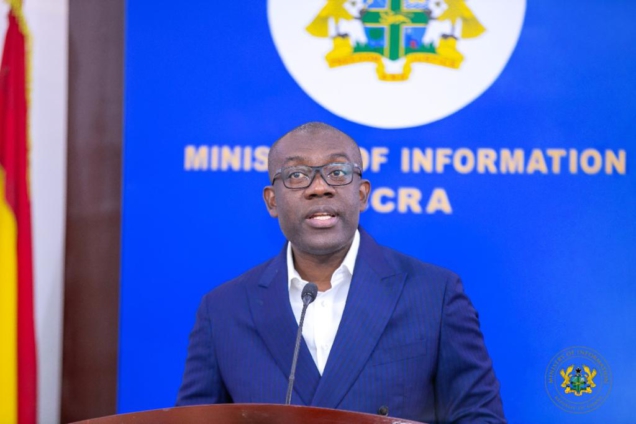
Minister for Information Kojo Oppong Nkrumah has revealed that many agencies operating at the District Assembly level do not report to the Assembly.
He stated that many of these agencies have officers who report directly to officials in the capital, Accra, rather than the District Chief Executive.
Speaking on Joy FM, he mentioned that this causes partial administrative decentralization.
“Therefore, their ability to fit in the local government structure and respond to the issues there is always questioned. That is the administrative decentralisation that he (Dr. Mahamudu Bawumia ) is talking about.”
The comments by the Information Minister follow statements made by the 2024 flagbearer of the NPP during his national address held at the UPSA auditorium in Accra.
While addressing the nation, Dr Bawumia stressed the significance of enhancing the role of the private sector, the need for fiscal and administrative decentralisation, and improving system functionality and institutional performance.
This, he believes, will not only lead to greater efficiency but also ensure value for money in government procurement processes.
“The move towards private sector provision of many public services would create fiscal space of at least 3% of GDP. This represents a major paradigm shift. Additionally, an efficient system of governance will require even fewer ministers,” Dr. Bawumia explained.
He added that his administration plans to reduce the fiscal burden on government by building upon successful initiatives such as the Free SHS and Free TVET introduced during the tenure of Nana Akufo-Addo’s government.
Touching on this, Mr Oppong Nkrumah said the policies which will be implemented by a Bawumia-led administration will help to address the issue of insufficient funding and low revenues recorded at the District Assembly level.
“One of the things I know he has been actively working on is, for example, the remnant of the infrastructure budget and what part of that can be dedicated to lower-level infrastructure.
"It is similar to what in this regime we have tried to do with the Development Authorities which have had its challenges but it circumvents it in a way and ensures that within the national budget, we have had some physical resources allocated for specific district to execute some projects.
“So when he talks about physical and administrative decentralisation, there is a difference between what we are doing now and what he would do if he becomes the leader of the Republic of Ghana on January 7, 2025," Mr Oppong Nkrumah said.
Latest Stories
-
Obuasi SHTS case: Eduwatch calls for sex offenders’ register and mandatory background checks for teachers
1 minute -
GloMeF CEO urges intensified public education on new road traffic regulations
13 minutes -
‘Any tax on ChatGPT is an attack on education and innovation’- Akim Swedru, MP
16 minutes -
Obuasi SHTS sexual abuse scandal exposes systemic failure in child protection – Moving Masculinity
17 minutes -
Hubtel CEO calls for national data-sharing framework to boost AI development
19 minutes -
Twelve Golden Rules of real estate development in Ghana, Africa
24 minutes -
Five new telephony cell sites in Ashanti Region to be activated in October 2026 – Sam George
24 minutes -
Mahama cuts sod for Afienya Industrial Park, targets 120 enterprises
29 minutes -
Rush for fuel from accident tankers is stealing, punishable by law – NPA boss, Edudzi Tamakloe
35 minutes -
GhIG pushes for legislation to regulate geoscientists’ activities
41 minutes -
Mfantsipim @150: Ace Anan Ankomah leads project to preserve school’s musical heritage
45 minutes -
Gov’t launches rCOMSDEP in Ahanta West, Mpohor Fiase to promote responsible community mining
46 minutes -
AI is forcing professionals to rethink how they deliver value – Hubtel CEO
49 minutes -
Daily Insight for CEOs: Strengthening the CEO’s Leadership Legacy
50 minutes -
Jimmy Aglah’s ‘When the River Testified’ approved by NaCCA as Supplementary Reader
59 minutes