


Audio By Carbonatix
Robert Mugabe, Zimbabwe's first post-independence leader, has died aged 95.
His family confirmed his death to the BBC. Mr Mugabe had been receiving treatment in a hospital in Singapore since April.
Mr Mugabe was ousted in a military coup in 2017 after 37 years in power.
Mr Mugabe's early years were praised for broadening access to health and education for the black majority - but his later years were marked by rights abuses and corruption.
He won Zimbabwe's first election after it secured independence from the UK, becoming prime minister in 1980.
He abolished the office in 1987, becoming president instead.
His successor, Zimbabwean President Emmerson Mnangagwa, expressed his "utmost sadness", calling Mr Mugabe "an icon of liberation".
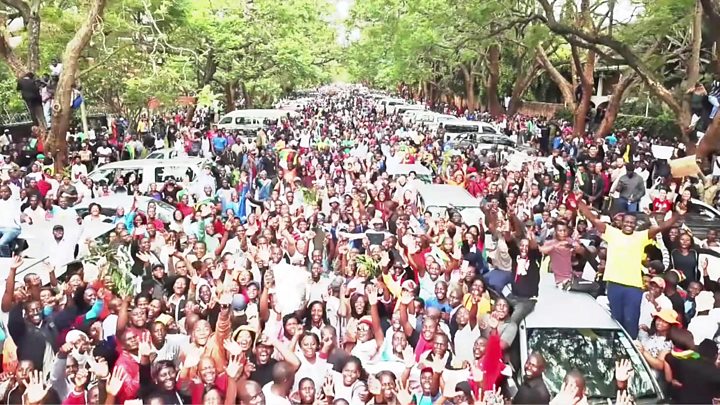 Mr Mugabe, with his high profile in the independence movement, secured an overwhelming victory in the republic's first election.
But over his decades in power that followed, the international perception of Mr Mugabe soured, with an increasing number of critics portraying him as a kind of dictator.
In 2000, facing serious political opposition for the first time, he seized white-owned farms to resettle black farmers on - causing economic disruption but boosting his popularity among his supporters.
Around the same time, pro-Mugabe militias used violence to influence political outcomes. In 2008, when he lost the first round of the presidential election, attacks on the opposition resulted in his rival pulling out of the contest.
He was forced to concede to power-sharing in 2009 amid economic collapse, installing rival Morgan Tsvangirai as prime minister.
But in 2017, amid concerns that he was grooming his wife Grace as his successor, the army - his long-time allies - turned against the president and forced him to step down.
Mr Mugabe, with his high profile in the independence movement, secured an overwhelming victory in the republic's first election.
But over his decades in power that followed, the international perception of Mr Mugabe soured, with an increasing number of critics portraying him as a kind of dictator.
In 2000, facing serious political opposition for the first time, he seized white-owned farms to resettle black farmers on - causing economic disruption but boosting his popularity among his supporters.
Around the same time, pro-Mugabe militias used violence to influence political outcomes. In 2008, when he lost the first round of the presidential election, attacks on the opposition resulted in his rival pulling out of the contest.
He was forced to concede to power-sharing in 2009 amid economic collapse, installing rival Morgan Tsvangirai as prime minister.
But in 2017, amid concerns that he was grooming his wife Grace as his successor, the army - his long-time allies - turned against the president and forced him to step down.
Mr Mnangagwa had been Mr Mugabe's deputy before replacing him.It is with the utmost sadness that I announce the passing on of Zimbabwe's founding father and former President, Cde Robert Mugabe (1/2)
— President of Zimbabwe (@edmnangagwa) September 6, 2019
Liberation 'icon'
Mr Mugabe was born on 21 February 1924 in what was then Rhodesia. The country, once a British colony in Africa, was run by a white minority. He was imprisoned for more than a decade without trial after criticising the government of Rhodesia in 1964. In 1973, while still in prison, he was chosen as president of the Zimbabwe African National Union (Zanu), of which he was a founding member. Once released, he headed to Mozambique, directing guerrilla raids into Rhodesia. But he was also seen as a skilled negotiator. Political agreements to end the crisis resulted in the new independent Republic of Zimbabwe.
Mr Mugabe, with his high profile in the independence movement, secured an overwhelming victory in the republic's first election.
But over his decades in power that followed, the international perception of Mr Mugabe soured, with an increasing number of critics portraying him as a kind of dictator.
In 2000, facing serious political opposition for the first time, he seized white-owned farms to resettle black farmers on - causing economic disruption but boosting his popularity among his supporters.
Around the same time, pro-Mugabe militias used violence to influence political outcomes. In 2008, when he lost the first round of the presidential election, attacks on the opposition resulted in his rival pulling out of the contest.
He was forced to concede to power-sharing in 2009 amid economic collapse, installing rival Morgan Tsvangirai as prime minister.
But in 2017, amid concerns that he was grooming his wife Grace as his successor, the army - his long-time allies - turned against the president and forced him to step down.
What has the reaction been?
Deputy Information Minister Energy Mutodi, of Mr Mugabe's Zanu-PF party, told the BBC it was "very much saddened" by the former leader's death. "As a government, we are very much with the family members of the Mugabe family," he said. "He was a principled man, he could not change easily over his beliefs, he's a man who believed himself, he's a man who believed in what he did and he is a man who was very assertive in whatever he said." "This was a good man."DISCLAIMER: The Views, Comments, Opinions, Contributions and Statements made by Readers and Contributors on this platform do not necessarily represent the views or policy of Multimedia Group Limited.
Tags:
DISCLAIMER: The Views, Comments, Opinions, Contributions and Statements made by Readers and Contributors on this platform do not necessarily represent the views or policy of Multimedia Group Limited.
Latest Stories
-
Education is critical to Ghana’s future and development – Haruna Iddrisu
5 minutes -
Who’s Emelia Affi Agbenyo, the 43-year-old newly sworn-in Deputy EC Chair?
38 minutes -
Haruna Iddrisu calls for limits on annual university accommodation fee increases
1 hour -
Today’s front pages: Tuesday, October 13, 2026
2 hours -
Wealth Over Water: How Galamsey Is Threatening Ghana’s Water Security
3 hours -
LA 2028: Black Queens pumped up for second leg of Mauritius tie
3 hours -
LA 2028: Black Queens hold final training session ahead of second leg against Mauritius
3 hours -
Standards are not Seasonal: What the EC appointments teach both sides
4 hours -
King Mohammed VI urges private sector to create youth jobs and spread benefits of growth
4 hours -
KGL U17 Colts 2026: Greater Accra win title after penalties win over Western Region
4 hours -
UK Investment Roadshow opens in London to advance UK-Ghana growth partnership
4 hours -
Assemblies of God requires pastors to resign before entering partisan politics – Rev. Wengam
4 hours -
Ghana targets 20% annual reduction in maternal deaths – Health Minister
4 hours -
Cyber attacks in Africa grow faster than global rate, report finds
4 hours -
Ghana signs UAE deal to create 5,000 overseas jobs
4 hours