

Audio By Carbonatix
Access to the internet has been restored after it was blocked by Myanmar's new military rulers.
The blackout was the second night in a row and the fourth shutdown since the 1 February coup and came as the junta tries to stifle dissent.
Earlier, the military authorities announced stiff penalties for those opposing the coup leaders.
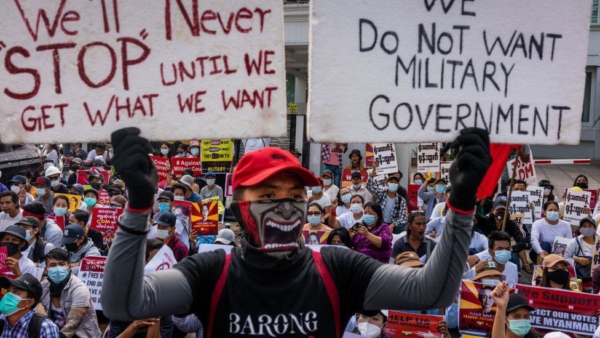
But protesters were out again early on Tuesday, with news agency Reuters reporting small groups gathering.
They have been encouraging civil servants to join the civil disobedience movement in the main city of Yangon.
The United Nations Special Envoy Christine Schraner Burgener reminded the head of the military junta in a phone call that "the right of peaceful assembly must fully be respected", according to a UN spokesman, warning him that "any form of heavy handed response is likely to have severe consequences".
The junta says it overthrew elected leaders, including longtime democracy campaigner, Aung San Suu Kyi, due to alleged voter fraud. It has not provided any evidence to support these claims.
Why are they shutting down the internet?
The latest shutdown follows a pattern aimed at disrupting continuing opposition to the coup and the detention of leaders, including Ms Suu Kyi, whose party won a resounding victory last November.
Access to Facebook, a rallying point for a campaign of civil disobedience, was restricted soon after the coup. Use of Twitter and Instagram was also disrupted.
But activists also fear the blackout may be used to arrest more people.
Major telecoms provider Telenor has said it will no longer be updating a list on its website of internet disruption. It told AFP news agency that the situation was "confused and unclear" and said that employee safety was a "top priority".
What is happening on the streets?
The military's presence is growing. At many strategic locations, soldiers have replaced the police.
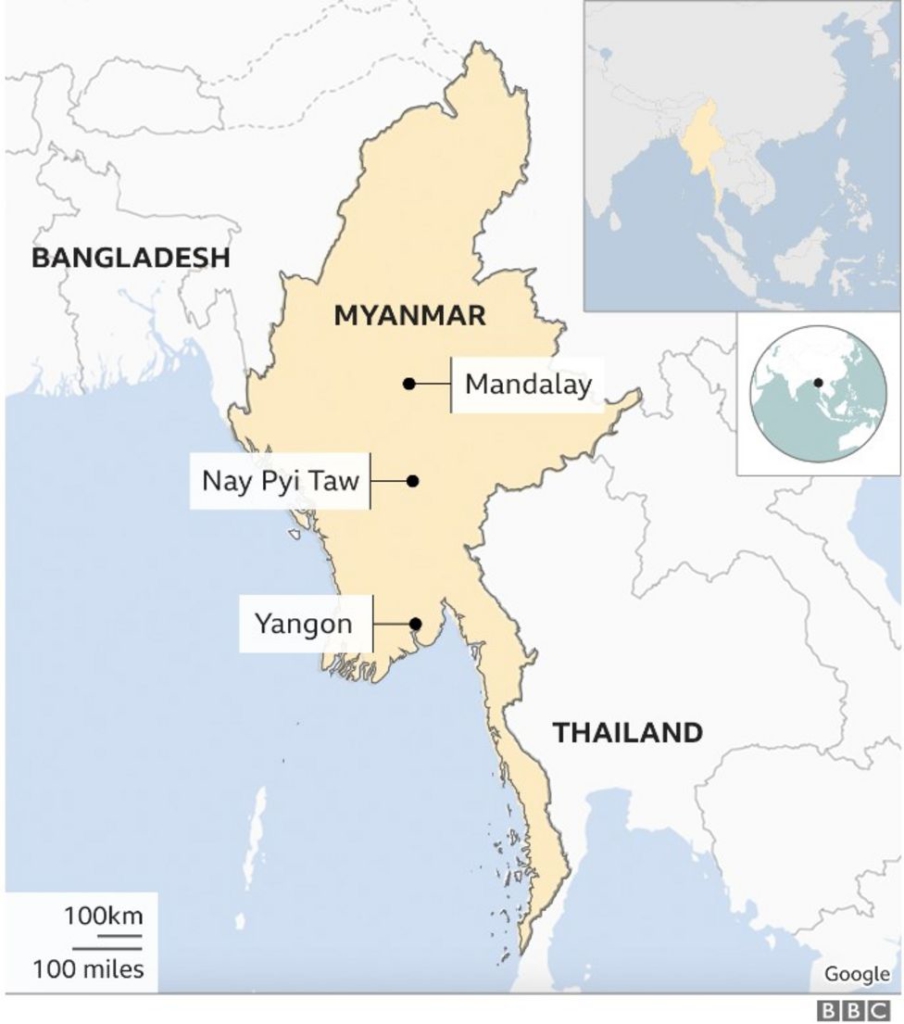
In the main city, Yangon, eight-wheeled armoured vehicles have been seen trying to navigate the rush-hour traffic, sometimes surrounded by cars honking in opposition to the coup.
On Monday, protests focused on the central bank building, the US and Chinese embassies, and the city headquarters of Ms Su Kyi's National League for Democracy.
And as demonstrators gathered in the central city of Mandalay, there were reports of security forces firing rubber bullets to disperse crowds.
In footage posted on social media, the sound of what appears to be gunshots can be heard as crowds flee, with several people later appearing to display injuries.
A leading student activist who has gone into hiding, Myo Ko Ko, told the BBC why he and others were willing to risk their lives.
"We strongly believe in democracy and human rights. We know that it's risky," he said.
"I have to move to another place day by day because of being searched (for) by police. We hope the international community will help us."
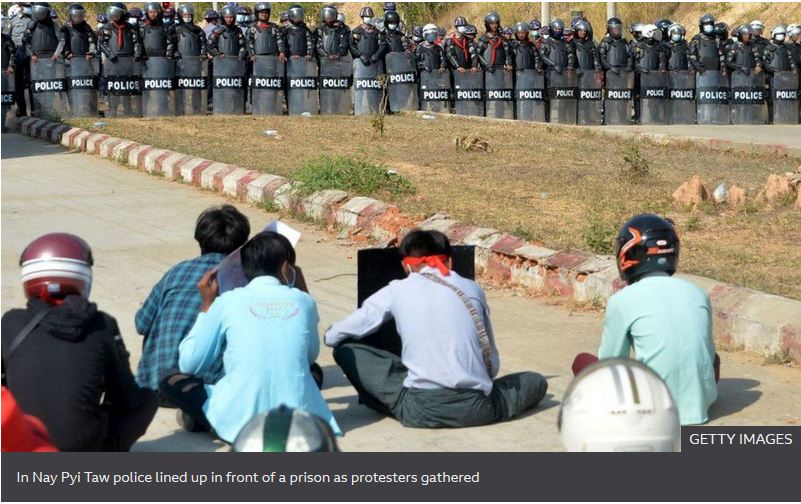
Students also protested in the capital, Nay Pyi Taw. Dozens were arrested and later released.
Residents in several cities are reported to have formed night-watch groups to deter mobs rumoured to have been dispatched by the military to cause unrest.
What are the new punishments protesters face?
The demonstrators are demanding the release from detention of their elected leaders, including Ms Suu Kyi, and the restoration of democracy in Myanmar, also known as Burma.
But the ruling junta has threatened long prison sentences and fines for anyone found to incite hatred towards the military, "by words, either spoken or written, or by signs, or by visible representation".
In a statement posted on a military website on Monday, it said that people preventing the security forces from carrying out their duties could face 20 years in prison, while those found to stir up fear or unrest in public could be imprisoned for terms of three to seven years.
The military government on Saturday gave itself the power to make arrests, carry out searches and hold people for more than 24 hours without a court ruling.
It has also told journalists not to describe the military's takeover as a coup.

Myanmar - the basics
- Myanmar, also known as Burma, was long considered a pariah state while under the rule of an oppressive military junta from 1962 to 2011
- A gradual liberalisation began in 2010, leading to free elections in 2015 and the installation of a government led by veteran opposition leader Aung San Suu Kyi the following year
- In 2017, a deadly crackdown by Myanmar's army on Rohingya Muslims sent more than half a million fleeing across the border into Bangladesh, in what the UN later called a "textbook example of ethnic cleansing"
- Aung San Suu Kyi and her government were overthrown in an army coup on 1 February following a landslide NLD win in November's elections
Latest Stories
-
AFCON 2027Q: ‘Our Black Stars team is gone’ – Former Sports Minister
8 minutes -
Prof. Prempeh calls for public review of draft constitutional reform bills
20 minutes -
AFCON 2027Q: ‘I have never seen a poor performance from Black Stars like against Gambia’ – Nii Lante Vanderpuye
25 minutes -
Nigeria set to launch National Digital Address System 9 years after Ghana showed the way
48 minutes -
Policy rate decision takes time to reflect in lower lending rates – BoG
58 minutes -
Western Regional Minister applauds Karpowership’s role in Ghana’s power sector
1 hour -
Livestream: Road safety crises: Where are we getting it wrong?
1 hour -
Enterprise Life celebrates 25 years of protecting families and building trust
2 hours -
ICC London rules in favor of Ghana against Tullow over $400m tax charge
2 hours -
We are disappointed in ICC’s ruling over our corporate income tax assessment in Ghana – Tullow Oil
2 hours -
Cost of building inflation for August 2026 increases to 4.6% – GSS
2 hours -
Today’s front pages: Wednesday, September 30, 2026
2 hours -
Bawumia highlights agricultural, compulsory insurance reforms in IBAG engagement
2 hours -
Ghana will secure Tullow tax revenues while protecting Jubilee, TEN investments – Ato Forson
3 hours -
Ghana wins $393m Tullow tax arbitration as tribunal upholds GRA assessment
3 hours