


Audio By Carbonatix
Nigerians are heading to the polls to elect state and local representatives, two weeks after the presidential poll.
Ballots are being cast in 29 of the country's 36 states.
In oil-rich Nigeria, some state governors control budgets larger than those of neighbouring countries and so these are often keenly contested.
President Muhammadu Buhari beat his main rival Atiku Abubakar in the 23 February election, securing a second term.
Across the country, Mr Buhari's All Progressives Congress (APC) got 15.2 million votes while Mr Abubakar's People's Democratic Party (PDP) received 11.3 million. There are 73 million registered voters.
The APC won 19 states, while the PDP secured 16 plus the capital Abuja.
Mr Abubakar said the election was a "sham" and was not free and fair. He has since filed a petition challenging President Buhari's win.
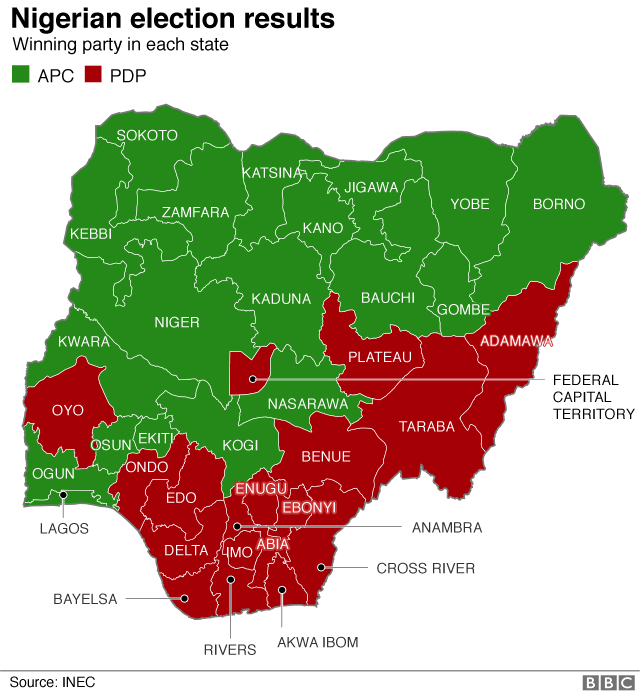
Although turnout for the presidential election was low across the country, it was higher in the northern states - one factor behind Mr Buhari's victory.
Fears of possible election-related violence has led to the massive deployment of security personnel across the country.
Seven states - Kogi, Bayelsa, Ekiti, Osun, Ondo, Edo and Anambra - will not hold elections because their governors have not finished their four-year terms.
The turnout for the state elections is expected to be higher than the 35.5% in last month's presidential election, down from 44% in 2015.
Most Nigerians take state elections seriously because their lives are directly impacted by the governor and representatives in the state legislature.
For instance, in 2000 - Governor Ahmed Sani Yerima introduced sharia law in Zamfara state and some other state governors in the north followed suit, even though the federal government wasn't fully in support of that idea.
The governors also enjoy political influence and control huge budgets.
Lagos, one of the most contested states, has an estimated population of 17.5 million people - this is more than the combined population of Gabon, The Gambia, Liberia, Cape Verde and Sierra Leone.
The state's GDP is more than that of Kenya. In fact, Lagos would be the fifth largest economy in Africa if it were a country.
Other key battle grounds that will be hotly contested between the APC and PDP are Kaduna, Akwa Ibom, Imo, Kano and Kwara.
Latest Stories
-
Labour Minister wants SOEs to help shape new public pay system
4 hours -
IPEC will ensure Equity and Sustainability in SOEs Compensation
4 hours -
White House bars CNN from travelling with Trump on Air Force One
5 hours -
Fennis wins second consecutive ITF J60 title in Accra
5 hours -
Spain beat England in thriller after Kane penalty miss
5 hours -
GPL 2026/27: Zaidan’s late goal ends Hearts of Oak unbeaten start
5 hours -
CEOs demand clarity on pay harmonisation, board autonomy as FWSC engages SOEs bosses over IPEC transition
5 hours -
2026 Women’s Super Cup: FC Savannah, Epiphany Warriors maintain top spots ahead of final group games
5 hours -
‘Is EOCO responsible for determining lawyers’ fees?’ – Baffour Awuah
5 hours -
David Beckles claims second J60 Accra title
6 hours -
No France cocaine suspect linked to Mahama, Vice President’s security details – NACOC
6 hours -
Anwelle Foundation launched in Jirapa to tackle poverty, youth unemployment
6 hours -
Joy Sports Editor Fentuo Tahiru Fentuo to moderate inaugural Music Meets Football Summit in Zambia
6 hours -
Court premises too volatile for Baffour Awuah’s attempted arrest by EOCO – Inusah Fuseini
6 hours -
Drug bust: Under no circumstances will NACOC leadership be compromised – Twum-Barimah
6 hours