

Audio By Carbonatix
Canadian political leaders say "nothing is off the table" when it comes to responding to potential 25% tariffs from the US, days before they could come into force.
But strains are showing in "Team Canada" when it comes to whether energy supply should be a tool in a possible tariff war with the US.
President-elect Donald Trump, who takes office on Monday, has threatened to immediately impose levies on Canadian goods in an effort to force the country to crack down on illegal immigration and drug smuggling into the US.
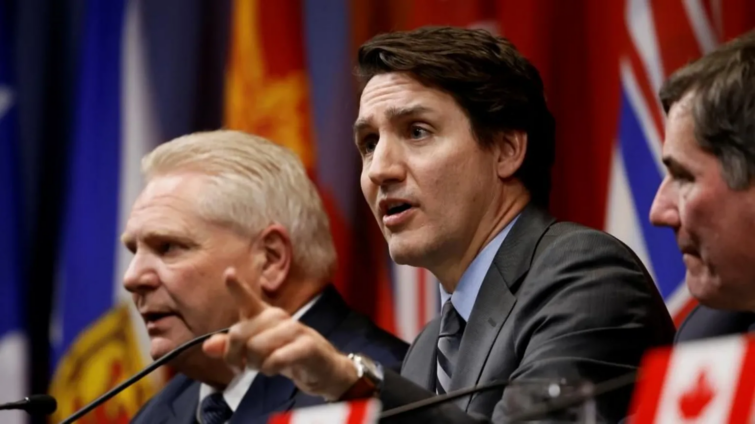
On Wednesday, Canadian Prime Minister Justin Trudeau met provincial and territorial premiers to discuss the country's coordinated response.
"Nothing is off the table," Trudeau said at a news conference with the premiers after the day-long meeting.
"What we've agreed on is we have to respond to the challenge we're facing and that the burden is shared across the country."
"We will stand up for Canada, we will protect Canadians," he added.
The prime minister also said there would "absolutely" be support for sectors affected should the tariffs materialise.
Roughly 75% of Canadian exports go to the US, and economists say the levies would be devastating for the country.
Canada is preparing a number of counter measures should the Trump administration move forward either with a blanket 25% levy on all goods or with a more targeted approach.
Canadian legislators have been lobbying US counterparts in recent weeks in a bid to avoid the tariffs, including personal visits to Trump's Mar-a-Lago resort in Florida.
Ottawa also promised to implement C$1.3bn ($900m; £700m) in sweeping new security measures along the country's nearly 9,000km-long (6,000 miles) border with the US to allay some of Trump's concerns.
But there has been a growing worry that the tariffs - at least in some form - are inevitable.
Trump has long been a proponent of trade tariffs, calling them the "greatest thing ever invented".
They are a central part of his economic vision. He sees them as a way of growing the US economy, protecting jobs and raising tax revenue.
Canadian officials argue they would undermine the US economy, increase inflation for American consumers - including raising prices at the petrol pump - and hamper investment.
They also warn tariffs could undermine national security, given Canada, a US ally, is a key source of energy and critical minerals.
While there has been a push for a unified approach to the threat, cracks in the coalition were apparent on Wednesday.
Alberta Premier Danielle Smith did not sign the joint statement released after the meeting, which she attended virtually.
On social media, she said the oil-rich province will not agree to export tariffs on energy or other products or a ban on their exports.
"We will take whatever actions are needed to protect the livelihoods of Albertans from such destructive federal policies," she said.
Trudeau and the premiers of Ontario, Quebec, and Newfoundland are among those open to either imposing counter-tariffs on energy or cutting off energy exports to the US.
"I see energy as Canada's queen in this game of chess," said Newfoundland and Labrador Premier Andrew Furey prior to the meeting.
"We don't need to expose our queen too early. The opposition does need to know the queen exists but they don't need to know what we do with the queen."
Around 40% of the crude that runs through US oil refineries is imported, and the vast majority of it comes from Canada.
It also supplies the US with natural gas and electricity.
"We're all united in that we have to act in the robust way," said Trudeau when asked about Smith's response.
According to various analyses, Canada's GDP could take a hit of between 1.8% and 3.38% and 2.6% to 5.6% if 25% blanket tariffs are imposed on Canadian goods, depending on how, and whether, Canada retaliates.
The US GDP would be pinched by between 0.9% to 1.6%, according to those reports.
Knowing the pain of responding is not proportional "means that we have to be smarter in how we [Canada] respond - and that's tricky," said Drew Fagan, a professor at the University of Toronto's Munk School of Global Affairs and Public Policy.
"It's hard to be strategic with an administration like this whose thinking is often a little bit more off the cuff."
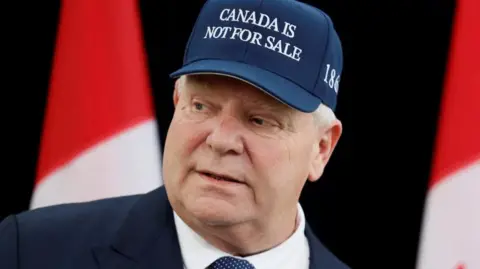
Ontario Premier Doug Ford has suggested up to 500,000 jobs could be lost in his province - which forms core part of the country's auto sector - under the current proposed tariffs.
Alberta could see 50,000 jobs lost, according to financial forecasts.
The expected tariff fight comes as Canada is facing domestic political challenges.
Trudeau will step down as prime minister once his governing Liberal Party selects a new leader in March.
He said on Wednesday he would not run in the next election.
An election will be held this year in Canada, possibly as early as this spring.
Latest Stories
-
WAFU B U17: Ghana top Group A after win over Togo
28 minutes -
Ho Central Mosque reopens amid unresolved leadership dispute that led to closure
2 hours -
Minority caucus questions GH¢16.4m in Ablakwa’s SA evacuation spending, demands independent audit
2 hours -
Gender Ministry meets Nana Akua Addo’s husband over domestic violence after hospital discharge
3 hours -
UG Vice-Chancellor urges swift operationalisation of National Research Fund
3 hours -
Pope Leo to have surgery after lump found in lung
3 hours -
Joseph Cudjoe writes: Ghana must break free from the dangerous mindset that natural resources are the foundation for wealth
4 hours -
Children among 109 dead after boat capsizes off Djibouti, UN says
4 hours -
OmniBSIC Bank’s 11th health walk promotes fitness and business growth
4 hours -
2026 World Maritime Day: Danish Embassy organises “The Gulf of Guinea Speaks”
4 hours -
New Economy will tackle unemployment and restore hope – Ato Forson
4 hours -
IMMILAC president recounts personal losses as security women lead breast cancer awareness campaign in Wa
4 hours -
University of Ghana postpones October 12 reopening as GAUA strike persists
5 hours -
Bahass Foundation launches vocational skills training to support mental health recovery in Wa
5 hours -
NPP orders parliamentary aspirants and their supporters to suspend campaign activities
6 hours