

Audio By Carbonatix
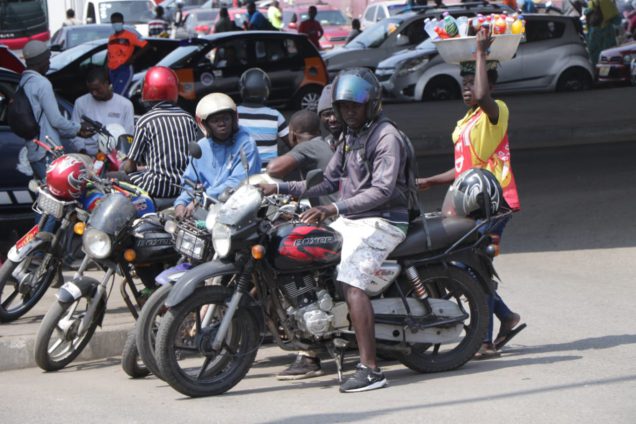
Persons willing to operate a commercial motorcycle or tricycle, popularly known as ‘okada’, can only do so if they belong to a recognised tricycle transport union or are employed by a licensed commercial motorcycle company.
The provision to limit eligibility to membership of a recognised union and the need for riders to be at least 25 years of age is part of the new Legislative Instrument (L.I) being drafted to amend the existing one, Road Traffic Regulations, 2012 (Legislative Instrument 2180).
Speaking at a national stakeholder consultation in Accra on Monday, April 7, 2025, on the draft L.I. 2180, the Minister of Transport, Joseph Bukari Nikpe, said the government was introducing a new licensing regime to enhance the monitoring of commercial motorcycles and tricycles and ensure that operators met the necessary competency standards.
“Our utmost priority is the safety and welfare of the riders and passengers. Therefore, some provisions in the regulations will cover the mandatory use of helmets, periodic inspections and rider training,” Mr Nikpe said at the meeting, which was the first of a nationwide consultation to review L.I 2180 to pave the way for the official operationalisation of okada, a thriving business among the youth.
The consultative meeting brought together representatives from the Motor Traffic and Transport Department (MTTD) of the Ghana Police Service, the Ghana Private Road Transport Union (GPRTU), the association of okada riders, heads of relevant agencies and departments, industry practitioners, civil society organisations and transport operators.
Proposed provisions
“A person shall not ride or operate a commercial motorcycle or tricycle unless that person is employed by or belongs to a licensed commercial motorcycle or tricycle transport union,” the new provisions propose.
Anybody who flouts the provision, when it becomes law, by operating “a motorcycle or tricycle for fare-paying passenger services in contravention of sub-regulation (1) commits an offence and is liable to pay a fine of 100 penalty units or to a term of imprisonment or both”.
Background
Motorcycles and tricycles have become a crucial part of our transport ecosystem over the past decade.
They are especially useful for last-mile journeys and in areas where traditional para-transit vehicles (tro-tro) and taxis find it challenging to go; they do the job.
In some of our urban centres, mostly in the northern part of the country, motorcycles and tricycles have literally replaced traditional public transport vehicles.
However, as their popularity had surged over the years, so had the challenges associated with their use, the Transport Minister said.
“We have witnessed increasing road traffic crashes and fatalities involving motorcycles and tricycles.
There are also concerns over safety regulations, disregard of road traffic laws, and the pressing need for a structured approach to governance in this sector,” Mr Nikpe pointed out.
Committee
Since the 2016 electioneering, President John Dramani Mahama pledged to implement effective regulations of commercial use of motorcycles and tricycles for improved safety, job security and welfare of riders.
Last month, the Minister of Transport constituted a 13-member committee, made up of officers from the Office of the Attorney General and Ministry of Justice, the Ministry of Youth Development and Empowerment, the Ministry of Local Government, Chieftaincy and Religious Affairs, the Driver and Vehicle Licensing Authority (DVLA) and the National Road Safety Authority, chaired by the Ministry of Transport.
The committee was tasked to develop a draft regulatory framework for the use of motorcycles and tricycles for fare-paying passenger services with a focus on safety, inclusivity and innovation.
Following a series of engagements, the committee developed a draft regulatory framework, which was presented to stakeholders on Monday.
Purpose
Mr Nikpe said the stakeholder consultation was to elicit grassroots information to shape the regulations that had been developed.
He urged the participants to discuss the issues dispassionately and recommend practical measures for adoption and consequent implementation.
“Through this dialogue, we hope to develop a comprehensive and robust regulatory framework that will stand the test of time for the consideration of Parliament,” he stated.
Other provisions
The draft regulatory framework proposes that a person is qualified to engage in commercial motorcycle or tricycle operations if that person is incorporated under the Companies Act, 2019 (Act 992) as a limited liability company, partnership, union, society, cooperative, or other similar association.
The Head of Road Transport Services at the Ministry of Transport, Daniel Essel, who presented the draft regulatory framework, said the operator (person or entity) must have a physical presence in at least eight administrative regions and have a minimum fleet size of 50 in each of the regions or as may be determined by the regulatory authority in consultation with the Minister of Transport (the Minister).
The operators must also have a standard union dress code as approved by the regulatory authority and meet other conditions as the regulatory authority may prescribe in collaboration with the DVLA and the district assembly.
While the riders are required to obtain a licence and renew it every two years, a commercial motorcycle or tricycle union shall renew its licence annually by paying a prescribed fee and satisfying the conditions determined by the regulatory authority.
The unions would also be enjoined to comply with the code of conduct approved by the Minister.
A commercial motorcycle/tricycle union is also enjoined to organise re-training or refresher courses for its riders at least once a year in consultation with the regulatory authority.
All permitted members of the union shall be enrolled in an electronic database as prescribed by the regulatory authority.
District assemblies
The regulation also gives a district assembly the right to grant a commercial motorcycle or tricycle union a permit to operate in the locality upon the payment of a prescribed fee and satisfaction of the conditions determined by the assembly in consultation with the regulatory authority.
With that permit, the district assembly must designate or approve areas as terminals and stands in the locality.
Mr Essel said a commercial motorcycle or tricycle union shall promptly investigate and keep on file a record of any circumstances in which the Code of Conduct was violated, as such breaches would attract penalties.
Riders
The riders would also be enjoined to have a valid commercial rider’s licence issued by the DVLA and the applicant shall be at least 25 years of age and must possess a valid National Identification Card.
They must also pass a commercial motorcycle/tricycle riding proficiency test, an oral test, a theoretical test and an eye test.
After completing training on the riders' syllabus and manual, they shall be assigned and registered with an identification mark – a distinctive yellow licence plate with black lettering.
They will also wear a certified protective helmet with a unique number affixed on the back of the helmet. The riders must always make available a certified protective helmet for use by the pillion rider, and they must adhere to all traffic laws and speed limits, among others.
Latest Stories
-
Turning invitations into arrests is making citizens reluctant to assist police – Twumasi Ankrah
8 minutes -
The Traffitech-GH SMS spot-fine system: The good, the sad, and the funny – Bright Simons writes
20 minutes -
Hawa Koomson pledges experienced and mature leadership of NPP women’s wing
1 hour -
Young woman found dead at Kasoa Peace Town
2 hours -
Playback: The Law examined lawful arrest in Ghana
2 hours -
Mahama urges African governments to treat healthcare as an investment, not budget cost
3 hours -
Bawumia congratulates John Boadu and new NPP executives, pledges support ahead of 2028
3 hours -
‘No talent should be left out’ – Bawumia pledges inclusive NPP campaign for 2028
3 hours -
Prof. Mike Oquaye recounts how he blocked the Special Prosecutor’s attempt to arrest Bawku Central MP
3 hours -
Make health sovereignty a priority for Africa – Mahama
4 hours -
Dorimon Naa, Wa West DCE lead massive clean-up exercise; threaten sanctions against recalcitrant residents
4 hours -
Photos from Adom FM Y2K Jam
4 hours -
Praye Tiatia steals the show at Adom FM Y2K Jam [Watch]
4 hours -
Boakye Agyarko congratulates John Boadu, pledges support for NPP leadership
4 hours -
Antwi HiMight thrills fans with Antwi ne Antwi hits at Adom FM’s Y2K Jam [Video]
4 hours