


Audio By Carbonatix
A Technical Policy and Thought-Leadership Article for National Publication
GMCxA or GOLDBOD - Which Path Secures Ghana's Sustainable Fiscal, Industrial, Employment and Monetary Future?
Executive Summary
Ghana sits on an extraordinary, under-monetised endowment: gold, manganese, bauxite, diamonds, industrial minerals, oil and gas, cocoa, timber, cash crops and horticultural produce that together define the structural spine of the national economy. Yet the institutional architecture governing how this endowment reaches global markets remains fragmented, informally intermediated and fiscally leaky. The 2025 establishment of the Ghana Gold Board (GOLDBOD) - a bold and commendable first step - proves that Ghana can restructure a commodity value chain rapidly and profitably when the political will exists. GOLDBOD's audited 2025 results, which show non-tax revenue rising from roughly GH¢307.7 million in 2024 to GH¢970.8 million in 2025 and artisanal gold export revenue reaching approximately US$10 billion in its first full year of operation, are a proof of concept, not a finished national strategy.
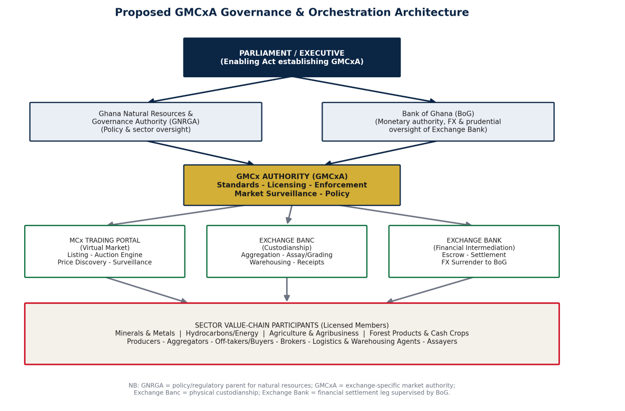
This article argues, with the technical depth the subject demands, that Ghana must now move decisively from a single-commodity intervention (GOLDBOD) to a comprehensive, multi-sector Ghana Minerals & Commodities Exchange Authority (GMCxA) - the institutional evolution of a proposition this author first advanced in a 2020 policy paper and subsequently elaborated in a November 2023 concept note, The Ghana Minerals & Commodities Exchange (GMCx). Where GOLDBOD regulates one mineral, the GMCxA model orchestrates four systemically important value chains simultaneously - minerals and metals, hydrocarbons and energy, agriculture and agribusiness, and forest products and cash crops - under one transparent, technology-enabled trading, custodianship and settlement architecture, anchored institutionally to the Bank of Ghana.
Drawing on the operating experience of the Dubai Multi Commodities Centre (DMCC), the Ethiopian Commodity Exchange (ECX), Bursa Malaysia Derivatives and the London Metal Exchange (LME), the article sets out: the macroeconomic rationale for exchange-based orchestration; a governance architecture separating policy (GNRGA), market authority (GMCxA), custodianship (Exchange Banc) and financial intermediation (Exchange Bank); a technology and auctioning methodology; participation, membership and certification protocols; a fully worked fee and revenue model; delivery and settlement mechanics; a five-year revenue, profitability and GDP-impact scenario benchmarked against GOLDBOD; and a phased, risk-assessed implementation roadmap.
The conclusion is unambiguous: GMCxA does not compete with GOLDBOD - it subsumes and generalises its logic. Ghana does not have to choose between the two in perpetuity; it must choose to scale the GOLDBOD model, through GMCxA, to the entire commodity economy before the current window of high global commodity prices and reform momentum closes.
1. Introduction: From Policy Paper to National Imperative
Ghana's development debate has long been trapped between two unsatisfactory poles: exporting raw natural resources at prices set elsewhere, or waiting indefinitely for the capital-intensive dream of full downstream processing. Between these two poles lies a proven, lower-cost, faster-to-implement instrument that many resource-rich and resource-poor nations alike have used to capture value, formalise trade and stabilise currencies - the regulated commodities exchange.
This author advanced this argument formally in a 2020 policy paper proposing a structured national exchange for Ghana's minerals and commodities value chains, and developed it further in a November 2023 policy concept note - “The Ghana Minerals & Commodities Exchange (GMCx)” - prepared alongside the author's broader Economy Easing & Growth Acceleration policy recommendations. That concept note proposed a mandatory-offload regime in which every enterprise extracting a natural resource for export would be required to trade through a GMCx Trading Portal, supported by a GMCx Authority, an Exchange Banc for custodianship and an Exchange Bank for settlement. (The 2020 paper is referenced throughout this article as a foundational source and should be read as a companion annex to this publication; readers and editors are invited to consult it alongside this article for the original policy derivation.)
Since that proposition was first tabled, events have overtaken deliberation. In March 2025, Parliament passed the GoldBod Act (Act 1140), establishing the Ghana Gold Board as sole aggregator and exporter of artisanal and small-scale mined gold. Its first-year results are genuinely impressive - and they validate, empirically, the central thesis of this article: that centralising a fragmented, high-value, high-leakage commodity trade inside a single, transparent institutional pipe produces an immediate and measurable fiscal and foreign-exchange dividend. The unresolved question is why this logic should stop at gold, when cocoa, bauxite, manganese, timber, oil and gas, and a wide range of agricultural exports face structurally identical problems of informality, under-invoicing, smuggling and price-taking.
This article is deliberately technical. It is written for policymakers, legislators, central bankers, industry players and the informed public who must together decide, within this Parliament's term, whether Ghana consolidates a single-commodity model or scales it into a full Ghana Minerals & Commodities Exchange Authority (GMCxA). It draws on global and continental precedent, situates the Bank of Ghana explicitly within the operating design, and closes with a fully sequenced implementation roadmap.
2. Global and Continental Perspectives: Operating Frameworks Driving GDP, Growth, Employment and Exchange-Rate Stability
2.1 Why Exchange Infrastructure Is Macroeconomic Infrastructure
A commodities exchange is frequently misread as a narrow capital-markets instrument. In resource-dependent economies it is, in fact, macroeconomic infrastructure on the same order of importance as ports, power and payment systems. Four transmission channels connect exchange orchestration to core national indicators:
GDP and growth: formal, price-transparent trade reduces under-invoicing and smuggling, meaning a larger share of true production value is captured in national accounts and tax revenue rather than lost to informal or cross-border leakage.
- Employment: aggregation centres, warehousing, assay laboratories, logistics, brokerage and digital-platform operations create formal jobs across the value chain, including for women and youth in rural mining and farming communities.
- Exchange-rate stability: mandatory surrender of export proceeds through a supervised settlement bank increases the predictability and volume of foreign-exchange inflows available to the central bank, reducing currency volatility that would otherwise stem from informal retention of export earnings offshore.
- Sector development and expansion: transparent price discovery rewards quality and consistency, incentivising producers to invest in better agronomic and mining practices, which in turn expands output and attracts financing.
2.2 Four Reference Operating Models
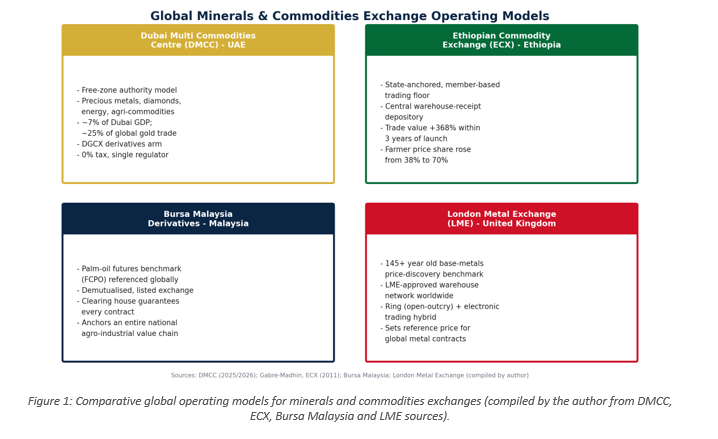
No two national exchanges are identical, but four models offer directly transferable lessons for Ghana's design choices: a free-zone commodity hub (Dubai), a state-anchored agricultural exchange (Ethiopia), a demutualised derivatives exchange underpinning an entire agro-industrial sector (Malaysia), and a benchmark-setting metals exchange with a global warehouse network (London).
2.2.1 Dubai Multi Commodities Centre (DMCC) - the Free-Zone Authority Model
Established in 2002 by royal decree, the DMCC combined a free-zone licensing authority with dedicated commodity infrastructure - the Dubai Gold and Commodities Exchange (DGCX) for derivatives, the Dubai Diamond Exchange, and specialised centres for tea and coffee. Two decades on, DMCC member companies contribute an estimated 7 percent of Dubai's GDP and around 15 percent of its annual foreign direct investment, while the emirate now accounts for roughly a quarter of global physical gold trade. The transferable lesson for Ghana is architectural: a single authority combining regulatory licensing, market infrastructure and investor-facing services, operating a genuinely single-window process, can convert geographic and logistical position into outsized economic contribution.
2.2.2 The Ethiopian Commodity Exchange (ECX) - the State-Anchored Agrarian Model
The ECX, launched in 2008 under the technical leadership of Dr Eleni Gabre-Madhin, is the most instructive continental precedent for Ghana's agricultural and forest-product sectors. It combined a member-based trading floor with a central electronic warehouse-receipt depository, such that a farmer's deposited grain became a bankable, tradable instrument the moment it was graded and warehoused. Within three years, the value of ECX trade had risen by roughly 368 percent to about US$1.1 billion, and the average farmer's share of the final consumer price rose from approximately 38 percent to 70 percent as price discovery displaced exploitative intermediaries. Warehouse-receipt financing, developed jointly with the International Finance Corporation, subsequently allowed producers to use stored crops as loan collateral - directly expanding rural access to finance.
2.2.3 Bursa Malaysia Derivatives - the Sectoral Benchmark Model
Malaysia's palm-oil futures contract (FCPO), traded on Bursa Malaysia Derivatives, is the global reference price for crude palm oil, used by producers, refiners and buyers worldwide to hedge and settle physical trade regardless of where that trade physically occurs. The lesson for Ghana's cocoa, cotton and rubber sectors is that a credible, liquid, rules-based futures benchmark - underwritten by a clearing house that guarantees every contract - can anchor pricing power for an entire national crop, rather than leaving Ghanaian producers as price-takers on exchanges domiciled abroad.
2.2.4 The London Metal Exchange (LME) - the Global Benchmark and Warehouse-Network Model
The LME's 145-year-old ring-and-electronic hybrid trading system, and its worldwide network of LME-approved warehouses, together set the reference price for base metals such as copper, aluminium and zinc. For Ghana's bauxite, manganese and industrial-minerals sub-sector, the LME demonstrates the long-run value of standardised contract specifications, approved-warehouse regimes and daily, publicly reported settlement prices in giving smaller national producers a credible, internationally recognised pricing reference rather than opaque, negotiated off-take pricing.
2.3 What These Models Uplift in Ghana's Construct
Four design principles recur across all four jurisdictions, and each is embedded directly in the GMCxA construct proposed in this article:
- Single authority, layered mandate: policy, market regulation, custodianship and settlement are functionally separated but centrally coordinated - never fused into one unaccountable entity, and never so fragmented that no one is accountable for outcomes.
- Warehouse receipts as the unit of trust: in every successful model, a graded, warehoused, receipted lot - not a verbal assurance - is what changes hands and what banks are willing to lend against.
- Mandatory but graduated formalisation: successful exchanges reach near-universal participation not purely through voluntary incentives but through a credible mandatory regime, phased to avoid displacing activity into informality.
- Direct linkage to the central bank and treasury: value is only fully captured nationally when trade settlement is structurally connected to foreign-exchange surrender and revenue collection, not left to voluntary repatriation.
3. The GMCx Sector Scope and the National Development Stakes
The 2023 GMCx concept note defined four primary operating sectors, and this article retains that scope as the analytically correct segmentation of Ghana's exportable natural-resource base:
- Minerals and Metals: precious metals (gold, silver) and industrial metals (bauxite, manganese, iron ore), spanning both large-scale and artisanal/small-scale production.
- Hydrocarbons, Energy and Power: petroleum, oil and gas, and associated energy commodities, including domestic offtake and export-oriented volumes.
- Agriculture, Agribusiness, Horticulture, Aquaculture and Food Crops: export-oriented and strategic food commodities, from grains and pulses to horticultural and aquaculture products.
- Forest Products and Cash Crops: timber, cocoa, coffee, cotton, rubber and related cash crops, several of which already possess quasi-formal marketing boards (COCOBOD) that can be integrated rather than duplicated.
This is a materially larger and more consequential canvas than gold alone. Ghana's gold exports alone reached roughly US$20 billion in 2025 when artisanal and large-scale output are combined, according to industry reporting following GOLDBOD's first-year results - yet cocoa, bauxite, manganese, timber, oil and gas and diamonds remain largely outside any comparable centralised, transparent trading and settlement architecture. Every one of these sectors exhibits the same structural vulnerabilities that justified GOLDBOD's creation: informal intermediation, under-invoicing, price-taking by producers, and foreign-exchange leakage. The policy question this article poses is direct - if centralised orchestration is right for gold, on what principled basis should it not be right for cocoa, bauxite, timber and hydrocarbons?
The 2023 concept note further proposed that the GNRGA (Ghana Natural Resources and Governance Authority) and the GMCx Authority collaborate on a minerals and commodities refinery strategy in the medium to long term, via a feasible public-private partnership (PPP) model - recognising that trade formalisation is the first stage of a longer value-addition journey, not a substitute for it.
4. Orchestrated Operating Framework, Governance Architecture and Management Protocols
The single most consequential design decision in any national exchange is the separation - and simultaneous coordination - of policy-making, market regulation, physical custodianship and financial settlement. Fusing these functions into one institution (as GOLDBOD currently does, combining regulator, commercial buyer, financier and enforcement agency in a single entity) creates efficiency in the short run but structural conflict-of-interest risk over time, a concern already raised by legal and governance commentators reviewing the GoldBod Act. The GMCxA model corrects this by design.
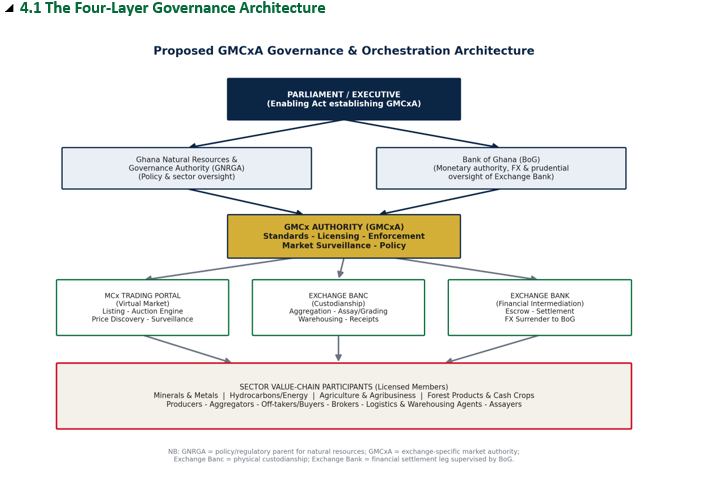

- Layer 1 - Parliament/Executive: enacts the GMCxA Act, defining mandatory-offload obligations, offences (including strict, proportionate administrative and criminal penalties for unauthorised direct export) and institutional powers.
- Layer 2 - GNRGA and Bank of Ghana: GNRGA (Ghana Natural Resources and Governance Authority) retains policy oversight of the underlying natural-resource sectors and their existing agencies (Forestry Commission, Minerals Commission, GOLDBOD, COCOBOD), while the Bank of Ghana exercises monetary, prudential and foreign-exchange oversight of the Exchange Bank leg of the architecture.
- Layer 3 - GMCx Authority (GMCxA): the dedicated market authority responsible for standards, licensing, enforcement, market surveillance and policy specific to the exchange - functionally comparable to a Securities and Exchange Commission for physical commodities.
- Layer 4 - Operating Pillars: the MCx Trading Portal (the virtual market), the Exchange Banc (physical custodianship) and the Exchange Bank (financial intermediation and settlement), each described in detail in later sections of this article.
- 4.2 Global, Continental and Regional Learnings Applied
- Global: the LME and DGCX demonstrate that an independent market-surveillance function, separated from commercial trading operations, is essential to preserve market integrity and investor confidence once volumes and stakes rise.
- Continental: the ECX's experience shows that state anchorship at inception is necessary to achieve the critical mass of mandatory participation, but that long-run credibility depends on professionalising operations and insulating day-to-day market administration from short-term political direction.
- Regional (ECOWAS/AfCFTA): as the African Continental Free Trade Area (AfCFTA) matures, an exchange-listed, warehouse-receipted Ghanaian commodity lot is inherently more tradable across regional borders than an informally traded one, positioning Ghana to become a regional aggregation and re-export hub for landlocked neighbours' minerals and agricultural output, in the manner Dubai has done for East Africa and South Asia.
- National: GOLDBOD itself is the most immediate and relevant learning - it proves the mandatory-offload and centralised-purchase model can be legislated and operationalised within a single budget year in Ghana, and that Ghanaians can staff and manage the necessary institutional capacity. The GMCxA build-out should therefore be measured in a small number of years, not decades.
- 5. Best Industry Practice Standards for Minerals and Commodities Exchanges
- Regulatory credibility is what converts a trading platform into a bankable, internationally trusted market. GMCxA should adopt, from inception, the following best-practice standards drawn from IOSCO principles for commodity markets, LBMA/LME good-delivery standards, and warehouse-receipt system standards used by ECX and UNCTAD-supported exchanges across Africa:
- Good Delivery and Grading Standards: published, commodity-specific specifications (purity, moisture content, defect tolerances, bean/grain size) benchmarked to LBMA (for precious metals), international grading norms for cocoa/coffee, and API/ASTM standards for petroleum products.
- Independent Assay and Quality Certification: accredited, conflict-free assay and testing laboratories, ISO/IEC 17025-accredited, separate from both GMCxA and any single market participant.
- Warehouse Licensing and Accreditation: only GMCxA-accredited warehouses may issue tradable Electronic Warehouse Receipts (EWRs), subject to insurance, bonding, security and periodic independent audit requirements akin to LME-approved warehouse rules.
- Market Surveillance and Anti-Manipulation Rules: position limits, price-movement circuit breakers, related-party disclosure and a whistleblower channel, modelled on IOSCO's Principles for the Regulation and Supervision of Commodity Derivatives Markets.
- Anti-Money-Laundering and Know-Your-Customer (AML/KYC): full compliance with the Financial Action Task Force (FATF) recommendations and Ghana's Anti-Money Laundering Act, particularly given the historical exposure of gold and diamond trade to illicit financial flows.
- Environmental, Social and Governance (ESG) Screening: traceability standards aligned to the OECD Due Diligence Guidance for Responsible Mineral Supply Chains and deforestation-free sourcing commitments, relevant to cocoa and timber exports to markets such as the European Union.
- Data Integrity and Cybersecurity: ISO/IEC 27001-aligned information-security management for the Trading Portal, given that market and settlement data will carry systemic financial significance.
- 6. Technology Platform Orchestration and Commodities Auctioning Methodology
- The 2023 concept note's call for a Ghana “Virtual Market” is technically achievable today at a fraction of the cost it would have required a decade ago, using cloud-native trading infrastructure, mobile-money integration and blockchain-anchored warehouse receipts.
- 6.1 The MCx Trading Portal - Core Technology Components
- Registration and KYC/AML Layer: digital onboarding integrated with the Ghana Card (National Identification Authority) and Ghana Revenue Authority Taxpayer Identification Number (TIN) database for identity and tax verification.
- Electronic Warehouse Receipt (EWR) Registry: a permissioned distributed-ledger (blockchain) registry recording custody, grade, quantity and ownership of every deposited lot, preventing duplicate pledging of the same physical stock - a documented risk in paper-based warehouse-receipt systems elsewhere.
- Auction and Matching Engine: a rules-based electronic engine supporting multiple auction formats (see 6.2), with millisecond-level trade logging for audit and surveillance.
- Mobile and USSD Access Channels: smartphone application and USSD/Interactive Voice Response (IVR) access for rural and ASM participants without reliable internet access, replicating ECX's rural market-information dissemination approach.
- Settlement and FX Interface: Application Programming Interface (API) connectivity between the Exchange Bank's core banking system and the Bank of Ghana's real-time gross settlement (RTGS) and foreign-exchange reporting systems.
- Market Data and Price Dissemination: public, delayed price feeds (for transparency) and subscription real-time feeds (as a revenue line, detailed in Section 8) distributed via web, SMS and radio/community information partnerships.
- 6.2 Auctioning Methodology
- GMCxA should support a small number of well-understood auction formats, matched to commodity characteristics, rather than a single one-size-fits-all mechanism:
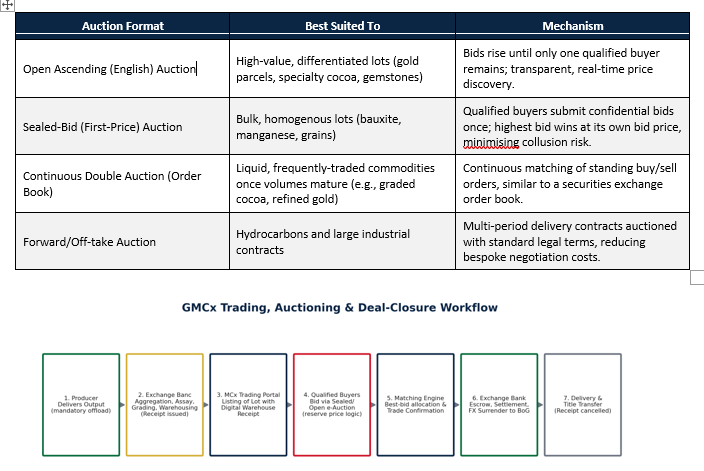
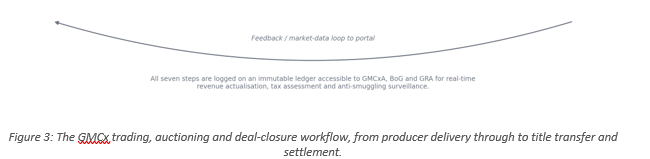
Every auction format converges on the same seven-step workflow illustrated in Figure 3: delivery and mandatory offload; aggregation, assay and warehousing at the Exchange Banc with issuance of a digital receipt; listing on the Trading Portal; competitive bidding by qualified, licensed buyers; automated matching and trade confirmation; escrowed settlement and FX surrender through the Exchange Bank; and finally delivery with title transfer, at which point the digital receipt is cancelled. Logging every step on an auditable, tamper-evident ledger is what allows GMCxA, the Bank of Ghana and the Ghana Revenue Authority (GRA) to actualise revenue and monitor compliance in real time, closing the leakage points that have historically undermined Ghana's natural-resource trade.
7. Participation Protocols, Membership Qualification and Certification Governance
Trust in a commodities exchange rests on who is allowed to participate and how rigorously that eligibility is policed. GMCxA should adopt a tiered membership structure, differentiated by function and risk profile.
7.1 Membership Categories and Qualification Criteria
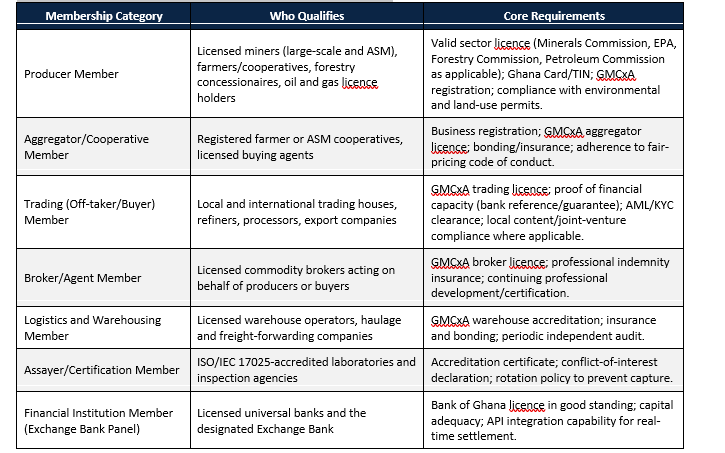
7.2 Certifications and Standards Governance
- Product Certification: commodity-specific grading certificates issued only by GMCxA-accredited assayers, valid for a defined shelf-life before re-inspection is required.
- Member Certification: annual re-certification of all licensed members, including AML/KYC refresh, financial-standing review and compliance-history check.
- Warehouse Certification: physical security, insurance and inventory-control audits conducted at least twice yearly by GMCxA-appointed independent auditors.
- Dispute Resolution and Arbitration: a GMCxA Arbitration Tribunal, modelled on the ECX's internal dispute-resolution mechanism, providing fast, binding resolution of trade and quality disputes without resort to the ordinary courts in the first instance.
- Code of Conduct and Fit-and-Proper Test: all members and their beneficial owners subject to a fit-and-proper assessment, consistent with practice at the Securities and Exchange Commission and Bank of Ghana for regulated financial entities.
8. Comprehensive Fees and Revenue Structure for GMCxA
A credible, transparent, published fee schedule is both a governance safeguard and the foundation of GMCxA's own financial sustainability. The structure below is designed to be broadly comparable to GOLDBOD's existing non-tax revenue lines (aggregation service charges, assay fees, licence fees) while extending the base across all four GMCx sectors.
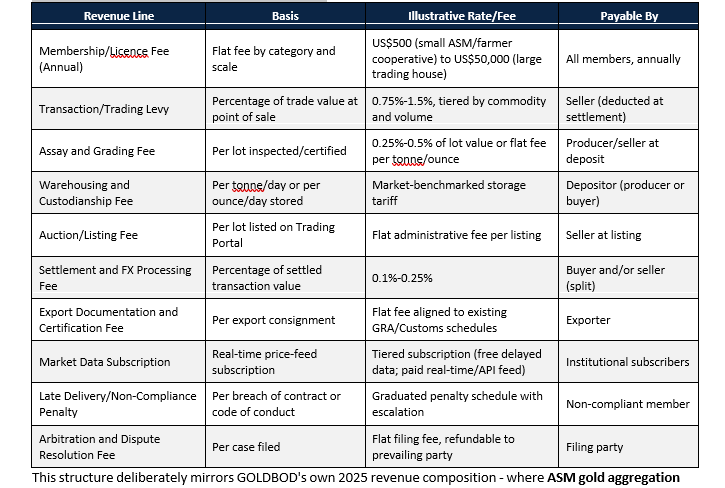
This structure deliberately mirrors GOLDBOD's own 2025 revenue composition - where ASM gold aggregation service charges (GH¢568.3 million) and assay fees (GH¢340.4 million) were its two largest non-tax revenue lines - while generalising the same logic across minerals, hydrocarbons, agriculture and forest products. Under this design, GMCxA revenue funds its own operating costs first (targeting full cost-recovery within 24-36 months of full sector roll-out), with any surplus directed to a Minerals and Commodities Development Fund for warehouse infrastructure, farmer/ASM capacity-building and rural logistics investment, consistent with the ring-fencing approach already used for Ghana's Mineral Development Fund and Ghana Stabilisation and Heritage Funds.
9. Participation in the Exchange: Trading, Auctioning and Delivery/Deal-Closure Mechanism
Beyond the mechanics of the auction itself, deal closure requires a disciplined, time-bound settlement cycle that gives both producers and buyers confidence that a won auction converts reliably into paid, delivered goods.
9.1 The Deal-Closure Sequence
- T+0 (Trade Date): winning bid confirmed electronically; both parties receive an automated, digitally signed trade confirmation.
- T+0 to T+1: buyer's funds (or irrevocable bank guarantee for large forward contracts) lodged in escrow with the Exchange Bank.
- T+1 to T+2: Exchange Banc authorises release/transfer of the physical lot (or, for export, coordinates with Customs/GRA and shipping/logistics agents) upon confirmation of escrowed funds.
- T+2: Exchange Bank disburses net proceeds to the seller (gross sale value less levies, fees and any outstanding advances), and simultaneously processes the mandatory foreign-exchange surrender to the Bank of Ghana for export transactions.
- T+2 onward: the Electronic Warehouse Receipt is cancelled in the registry; the transaction record is closed and archived for audit, tax assessment and statistical reporting to the Ghana Statistical Service, Bank of Ghana and GRA.
This T+2 cycle is deliberately benchmarked to international securities-settlement norms and is markedly faster than the often multi-week payment delays reported by smallholder producers under informal buying arrangements - itself a meaningful, quantifiable improvement in rural cash-flow and welfare.
9.2 Delivery Logistics and Default Management
Failure to deliver (seller default) or failure to pay (buyer default) must be governed by pre-agreed, published rules rather than case-by-case negotiation. GMCxA should require: a seller performance bond or first-loss deposit at the point of listing, forfeited on non-delivery; a buyer pre-funding or guarantee requirement before a bid is accepted into the auction; and a Clearing Guarantee Fund, capitalised from a small levy on all trades, that indemnifies the non-defaulting party up to a defined ceiling while GMCxA pursues recovery - directly modelled on the clearing-guarantee mechanisms that underpin settlement assurance in mature exchanges such as the LME and ECX.
10. Commodities Inventory Custodianship, Logistics Management and the Exchange Banc/Exchange Bank Architecture
The 2023 concept note's distinction between an “Exchange Banc” (custodianship of physical inventory) and an “Exchange Bank” (financial intermediation and settlement) is, in this author's assessment, the single most important structural innovation in the GMCx design, and this article retains and elaborates it as the backbone of the operating model.
10.1 The Exchange Banc - Custodianship and Logistics
- Network of Accredited Warehouses and Assay Centres: regionally distributed to minimise producer transport costs, prioritising existing GOLDBOD, COCOBOD, PMMC and Ghana Ports and Harbours Authority infrastructure before new capital investment.
- Inventory Management System: real-time stock ledger reconciled daily against the Electronic Warehouse Receipt registry, with periodic independent stock counts.
- Logistics and Transport Coordination: GMCxA-accredited haulage and freight-forwarding partners, with a digital consignment-tracking module integrated into the Trading Portal, extending visibility from farm-gate/mine-gate to port of export.
- Insurance and Risk Transfer: mandatory all-risk warehouse and in-transit insurance, with GMCxA maintaining a register of approved underwriters.
10.2 The Exchange Bank - Financial Intermediation and Remittance Management
- Escrow and Settlement Services: holding buyer funds until delivery conditions are satisfied, then disbursing to sellers net of levies.
- Foreign-Exchange Surrender and Repatriation: structured, mandatory surrender of export-linked foreign currency to the Bank of Ghana's reserves management framework, consistent with the domestic gold purchase programme already operated between GOLDBOD and the Bank of Ghana.
- Warehouse-Receipt Financing: using EWRs as eligible collateral for commercial bank lending, replicating the IFC-ECX model, thereby expanding rural and ASM access to formal credit without GMCxA itself carrying credit risk.
- Revenue and Levy Remittance: automated, real-time apportionment of each settled transaction into its constituent parts - producer payout, GMCxA levy, GRA duty, Minerals/Commodities Development Fund contribution - eliminating the manual reconciliation delays that create both leakage risk and producer payment delay.
10.3 Situating the Bank of Ghana in the Design
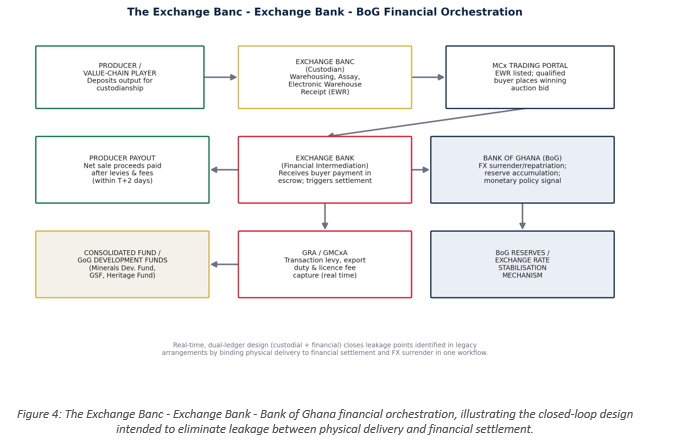
The Bank of Ghana's role in this design is neither peripheral nor merely advisory - it is structural. As Figure 4 illustrates, the BoG performs four distinct functions: prudential supervisor of the Exchange Bank, ensuring it meets capital, liquidity and governance standards appropriate to a systemically significant settlement institution; recipient of mandatory foreign-exchange surrender on export transactions, directly building reserve buffers; monetary-policy beneficiary, since a larger, more predictable, more formally captured foreign-exchange inflow stream reduces exchange-rate volatility and strengthens the transmission of monetary policy; and data partner, receiving real-time transaction-level export data that materially improves the accuracy of balance-of-payments and international reserves reporting. This is precisely the function the BoG already performs, at smaller scale, under the existing GOLDBOD Domestic Gold Purchase Programme - GMCxA generalises and formalises that same relationship across all four sectors.
11. Revenue, Profitability and Balance-Sheet Projections: GMCxA versus the Current GOLDBOD Framework, and the GDP Scenario
A note on methodology: the figures presented in this section are the author's illustrative policy-scenario projections, built on GOLDBOD's published 2025 audited results and reasonable, stated assumptions about phased sector onboarding. They are offered to frame the scale of the opportunity and to structure legislative and Cabinet-level debate - they are not, and should not be read as, official Government of Ghana, Bank of Ghana, IMF or World Bank forecasts.
11.1 GOLDBOD's 2025 Performance as the Baseline
GOLDBOD's audited financial statements for the year ended 31 December 2025 provide the most credible, most recent baseline available for this exercise:
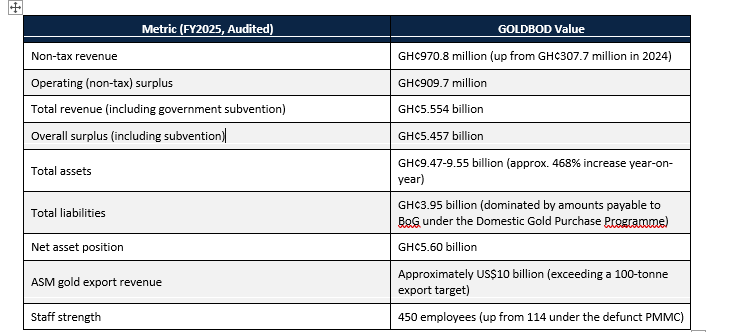
This is, on any measure, a strong first-year performance for a single-commodity intervention. It also illustrates the scale of value that remains uncaptured elsewhere: cocoa, bauxite, manganese, timber, diamonds, oil and gas and diversified agricultural exports currently have no comparably centralised institution capturing equivalent non-tax revenue, assay fees or FX-surrender discipline.
11.2 Illustrative Five-Year Revenue Trajectory: GMCxA versus GOLDBOD-Only
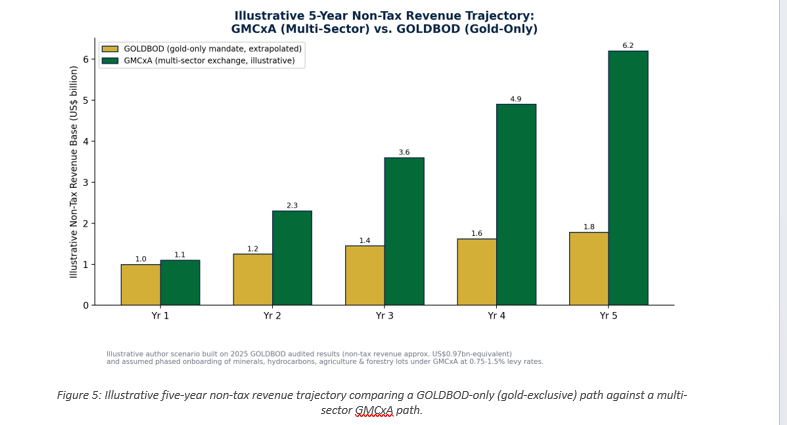
Extrapolating GOLDBOD's own non-tax revenue at a steady organic growth rate (reflecting gold-price appreciation and incremental ASM formalisation) produces a gold-only trajectory rising from roughly US$1.0 billion-equivalent in Year 1 to approximately US$1.8 billion-equivalent by Year 5. By contrast, a phased GMCxA roll-out - onboarding minerals/metals and one pilot agricultural commodity in Year 1-2, hydrocarbons and forest products by Year 3, and reaching full multi-sector maturity by Year 4-5 - plausibly reaches a non-tax revenue base of US$5.5-6.5 billion-equivalent by Year 5, roughly three-and-a-half times the gold-only trajectory, purely from formalising trade that substantially already exists but is currently under-captured.
11.3 Illustrative GDP Contribution Scenario, 2026-2030
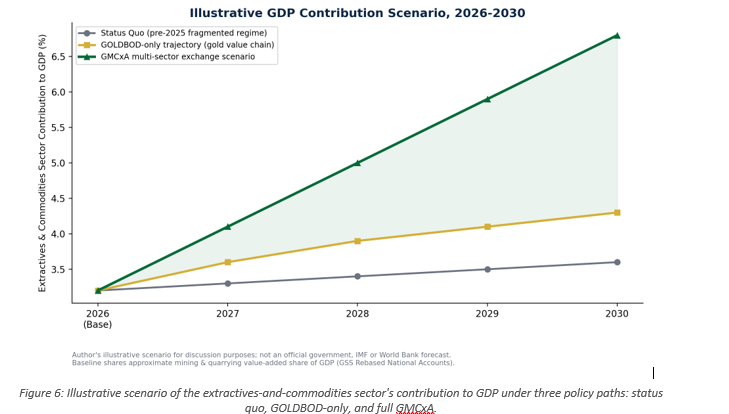
The GDP-contribution scenario in Figure 6 illustrates three policy paths. Under the pre-2025 status quo (fragmented, largely informal trade), the sector's measured contribution to GDP grows only marginally, constrained by persistent under-recording of true output value. Under a GOLDBOD-only path, the formalisation dividend already visible in gold lifts the sector's measured GDP contribution meaningfully but leaves other commodities' informality unaddressed. Under the full GMCxA path, the same formalisation dividend generalised across minerals, hydrocarbons, agriculture and forest products compounds into a materially larger measured GDP contribution by 2030 - not because Ghana produces more, in the first instance, but because a substantially larger share of what is already produced is captured, valued and recorded formally, with output expansion following as producers respond to reliable pricing and access to warehouse-receipt finance.
11.4 Profitability and Balance-Sheet Positioning
GMCxA should be structured, like GOLDBOD, as a statutory corporation with an independent balance sheet, but with a narrower commercial risk profile than GOLDBOD currently carries. Because GMCxA earns fee and levy income on transactions it facilitates, rather than taking outright purchase and resale positions in physical commodities as GOLDBOD does with gold, its balance sheet should be structurally lighter: minimal inventory risk (borne instead by the Exchange Banc's bonded/insured warehouse network and ultimately by buyers/sellers), limited FX exposure (pass-through via the Exchange Bank rather than retained on GMCxA's own books), and a capital structure funded mainly from licence and transaction fees rather than government revolving trade capital. This design choice is deliberate: it avoids replicating GOLDBOD's need for a multi-billion-cedi government revolving fund (GH¢4.55 billion in 2025) for every additional commodity brought under the exchange, since GMCxA is not itself the buyer of first and last resort - it is the market operator, custodian and settlement facilitator. Off-take capital continues to be provided by the qualified trading members themselves, dramatically reducing the fiscal exposure required to scale the model across four sectors compared with replicating GOLDBOD's commercial-buyer model commodity-by-commodity.
11.5 GMCxA or GOLDBOD: The Comparative Verdict
The GDP-contribution scenario in Figure 6 illustrates three policy paths. Under the pre-2025 status quo (fragmented, largely informal trade), the sector's measured contribution to GDP grows only marginally, constrained by persistent under-recording of true output value. Under a GOLDBOD-only path, the formalisation dividend already visible in gold lifts the sector's measured GDP contribution meaningfully but leaves other commodities' informality unaddressed. Under the full GMCxA path, the same formalisation dividend generalised across minerals, hydrocarbons, agriculture and forest products compounds into a materially larger measured GDP contribution by 2030 - not because Ghana produces more, in the first instance, but because a substantially larger share of what is already produced is captured, valued and recorded formally, with output expansion following as producers respond to reliable pricing and access to warehouse-receipt finance.
11.4 Profitability and Balance-Sheet Positioning
GMCxA should be structured, like GOLDBOD, as a statutory corporation with an independent balance sheet, but with a narrower commercial risk profile than GOLDBOD currently carries. Because GMCxA earns fee and levy income on transactions it facilitates, rather than taking outright purchase and resale positions in physical commodities as GOLDBOD does with gold, its balance sheet should be structurally lighter: minimal inventory risk (borne instead by the Exchange Banc's bonded/insured warehouse network and ultimately by buyers/sellers), limited FX exposure (pass-through via the Exchange Bank rather than retained on GMCxA's own books), and a capital structure funded mainly from licence and transaction fees rather than government revolving trade capital. This design choice is deliberate: it avoids replicating GOLDBOD's need for a multi-billion-cedi government revolving fund (GH¢4.55 billion in 2025) for every additional commodity brought under the exchange, since GMCxA is not itself the buyer of first and last resort - it is the market operator, custodian and settlement facilitator. Off-take capital continues to be provided by the qualified trading members themselves, dramatically reducing the fiscal exposure required to scale the model across four sectors compared with replicating GOLDBOD's commercial-buyer model commodity-by-commodity.
11.5 GMCxA or GOLDBOD: The Comparative Verdict
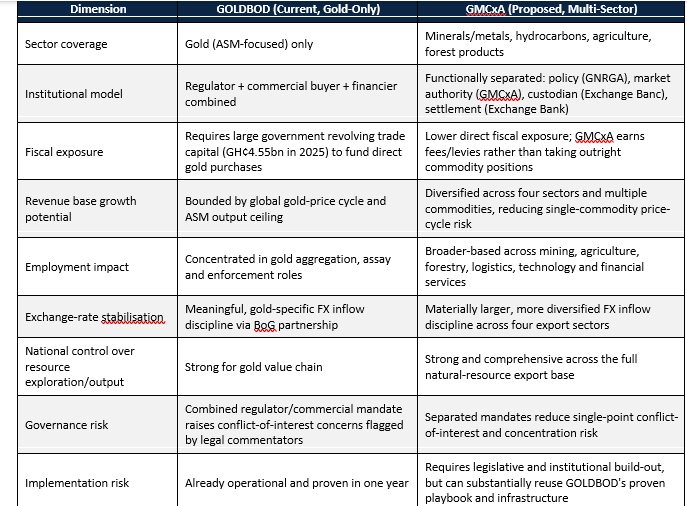
The comparative analysis points to a both/and rather than either/or conclusion: GOLDBOD should not be dismantled - it should be nested inside GMCxA as the minerals/metals sector's specialised operating arm, in the same way COCOBOD could be nested as the cash-crops sector's specialised arm. GMCxA becomes the overarching, multi-sector orchestration layer that generalises GOLDBOD's proven mandatory-offload and centralised-settlement logic, while correcting its governance concentration risk and extending its fiscal and foreign-exchange benefits to the sectors of the economy that today have no equivalent institution at all.
12. Implementation Roadmap: Sequenced Workflow, Success Factors and Risk Remediation
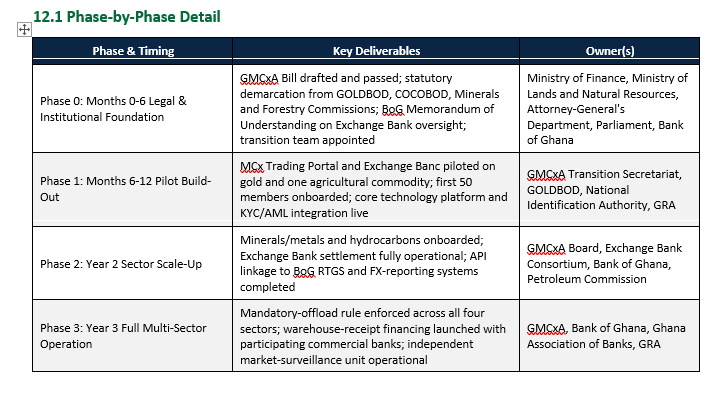
Ghana does not need a decade-long implementation plan. GOLDBOD's own experience shows that legislative passage, institutional stand-up and first-year operational scale can be achieved within roughly twelve months when there is executive commitment. The roadmap below sequences GMCxA's build-out over five years, deliberately front-loading the legal and pilot phases to generate early, visible wins that build the political and public confidence needed for full multi-sector roll-out.
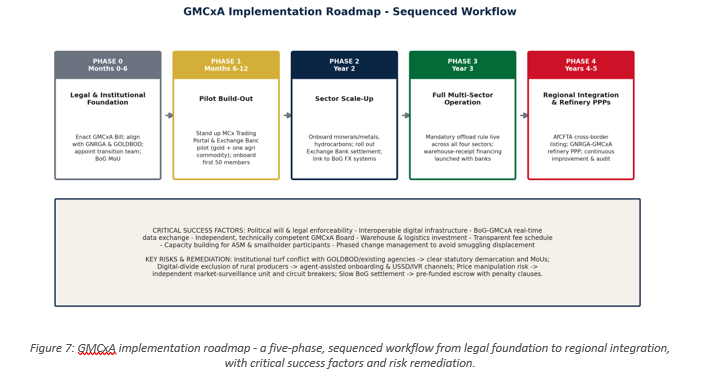

12.2 Critical Success Factors
- Sustained political will and unambiguous legal enforceability of the mandatory-offload provisions.
- Interoperable digital infrastructure, built cloud-native and API-first from inception.
- Real-time data exchange between GMCxA, the Exchange Bank and the Bank of Ghana.
- An independent, technically competent GMCxA Board, insulated from short-term political direction in its day-to-day market-administration functions.
- Early, visible investment in warehouse and logistics infrastructure, prioritising reuse of existing GOLDBOD/COCOBOD/PMMC assets.
- A transparent, published fee schedule communicated clearly to producers before mandatory participation begins.
- Deliberate capacity-building and financial-literacy support for ASM and smallholder participants, including agent-assisted onboarding.
- Phased change management that avoids displacing informal activity into smuggling rather than formal participation.
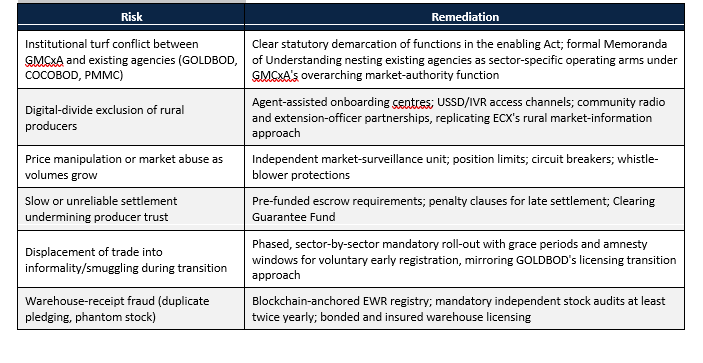
12.3 Key Risks and Remediation

13. Conclusion: A Call to Legislative and Executive Action
Ghana has, in GOLDBOD, already demonstrated the political capacity and administrative competence to build and operationalise a centralised, transparent commodity-trading institution within a single year, delivering a documented, audited fiscal and foreign-exchange dividend. The technical and institutional case set out in this article - drawing on this author's 2020 policy paper and 2023 GMCx concept note, and on the operating experience of the Dubai Multi Commodities Centre, the Ethiopian Commodity Exchange, Bursa Malaysia and the London Metal Exchange - is that this proven logic should now be generalised, not repeated in isolation, across minerals and metals, hydrocarbons, agriculture and forest products, under a single, functionally layered Ghana Minerals & Commodities Exchange Authority.
The choice before Ghana's policymakers is not, therefore, GMCxA or GOLDBOD as competing alternatives. It is whether Ghana scales the GOLDBOD model - through a GMCxA that nests GOLDBOD as its minerals/metals operating arm - into the comprehensive, multi-sector national exchange architecture the country's development stage and global commodity-market environment now permit and, indeed, demand. Every additional budget year without this legislative and institutional step is a year of continued avoidable revenue leakage, informal price exploitation of Ghana's farmers and miners, and foregone exchange-rate stability. The window created by current global commodity prices, reform momentum and demonstrated institutional capability will not remain open indefinitely; the time to act is this legislative term.
References
References are presented in American Psychological Association (APA, 7th edition) style.
Arabian Business. (2025, August 11). Dubai free zone DMCC attracts 1,100 new companies in H1 2025 as tech and trade ecosystems surge. Arabian Business.
Clinton Consultancy. (2025, April 16). Ghana Gold Board (GoldBod) regulatory update: Expert guide for international traders. The Law Office of Clinton Consultancy.
Crowe UAE. (2025). Dubai Multi Commodities Centre. Crowe UAE.
Dubai Multi Commodities Centre. (2026). World's premier business destination. DMCC.
Ecofin Agency. (2025, December). Ghana's GoldBod reports $10bn in ASM gold revenue in 2025. Ecofin Agency.
Gabre-Madhin, E. Z. (2011). Making markets: The story of the Ethiopian Commodity Exchange. African Capital Markets News.
Ghanaian Times. (2026, April 29). GoldBod generates unprecedented overall surplus of GH¢5.46bn in 2025. Ghanaian Times.
Ghana Eye Report. (2026, June). PMMC to GoldBod: Examining the transformation of Ghana's gold sector and the role of Sammy Gyamfi. Ghana Eye Report.
GBC Ghana Online. (2026, April 30). GoldBod triples revenue and records GH¢909.8 million surplus in 2025. GBC Ghana Online.
Ghanamma. (2026, May 1). GoldBod records $970m revenue in 2025. Ghanamma.com.
ICLG.com. (2025, April 29). Ghana Gold Board Act, 2025 [Briefing]. International Comparative Legal Guides.
International Finance Corporation. (2009, September). Ethiopian Commodity Exchange to help finance agricultural trade. African Capital Markets News.
Kpentey, K. (2020). A policy framework for a national minerals and commodities exchange for Ghana [Unpublished policy paper]. (Companion source; to be appended as Annex A.)
Kpentey, K. (2023, November 1). The Ghana Minerals & Commodities Exchange (GMCx): Economy easing & growth acceleration policy recommendation [Concept note].
Meijerink, G., Bulte, E., & Alemu, D. (2014). Formal institutions and social capital in value chains: The case of the Ethiopian commodity exchange. Food Policy, 49, 1-12.
Royal Coffee. (2025, May 5). Exchange is the only constant: The evolution of Ethiopia's commodity marketplace. Royal Coffee.
Tessema, Y. et al. (2025). The impact of warehouse services on spatial and intra-temporal agricultural market integration: The case of the Ethiopian commodity exchange's warehouse services. Agribusiness.
Virtuzone. (2026, May 1). Dubai Multi Commodities Centre Free Zone. Virtuzone.
Wikipedia contributors. (2026, April 4). Ghana GoldBod. In Wikipedia, The Free Encyclopedia.
Wikipedia contributors. (2026, June). Dubai Multi Commodities Centre. In Wikipedia, The Free Encyclopedia.
Latest Stories
-
Dutch authorities enlist Ghana in hunt for fugitive drug lord Bolle Jos
20 minutes -
Ghana housing finance conference adopts communiqué to improve affordable housing access
5 hours -
Special Initiatives Minister urges Wa Technical Institute to enrol more girls as EU-backed solar training lab opens
5 hours -
In the matter of my first year at the Bar
5 hours -
ActionAid Ghana calls for an end to child marriage, greater investment in girls’ rights
5 hours -
Newsfile to tackle World Cup visa scandal, beach demolitions, education strikes, BRICS bid
6 hours -
UK-Ghana Trade & Investment Summit: Trade Resource Centre to help businesses maximise UK-Ghana trade opportunities
6 hours -
Embassy of Denmark celebrates World Maritime Day
6 hours -
Linking LEAP to productive inclusion could cut extreme poverty by 2030 – UNICEF
7 hours -
Trade Ministry backs use of creative arts to rehabilitate prison inmates
7 hours -
Negotiations with government to continue despite strike suspension – GNAT
7 hours -
‘Ghana cannot afford to waste public resources; every cedi has a job’ – Ato Forson
8 hours -
Ghana expects economic boost as World Assemblies of God Congress brings 10,000 delegates to Accra
8 hours -
Joy in Nayilifong as Farouk Aliu Mahama donates 100kVA transformer to improve power supply
8 hours -
Chief Justice urges employers to tackle mental health stigma in workplaces
9 hours