

Audio By Carbonatix
For years, improving access to quality basic education has remained a major priority for successive governments in Ghana. Beyond increasing enrolment, one of the biggest challenges has been ensuring that pupils have access to safe, permanent, and conducive learning environments.
Findings from the 2025 Auditor General’s Report reveal that infrastructure gaps continue to affect basic education delivery across the country, raising concerns about the progress made in addressing the long-standing challenge of inadequate classroom facilities.
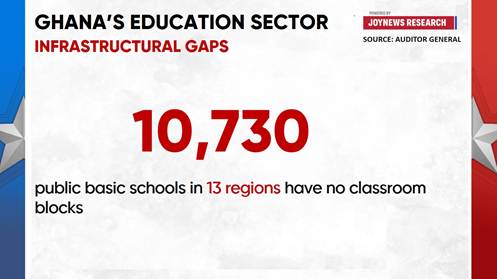
The report highlights a significant infrastructure deficit in public basic schools, noting that 10,730 public basic schools across 13 regions did not have classroom blocks. These schools had a combined enrolment figure of 3,050,808 pupils, meaning millions of children were receiving lessons in environments that were not designed to support effective teaching and learning.
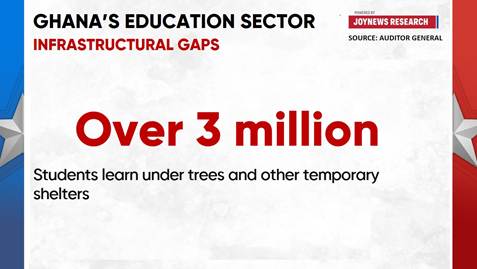
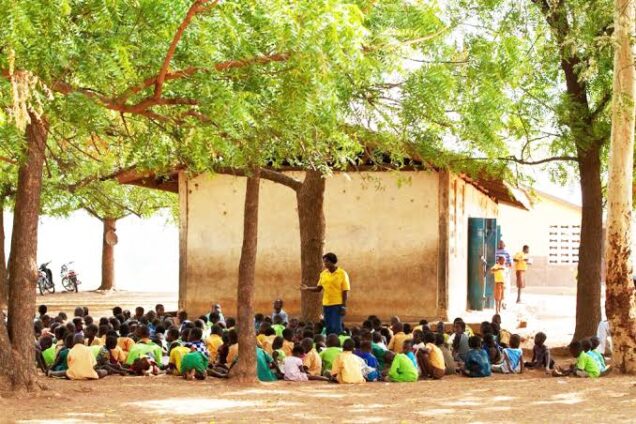
According to the report, the absence of classroom blocks has forced teaching and learning activities to take place under trees, sheds, churches, and other temporary shelters.
The situation, according to the Auditor General's report, was contrary to Section 36 of the Pre-Tertiary Education Act, 2020 (Act 1049), which establishes the responsibility of the Ghana Education Service in providing and maintaining public basic and senior high school infrastructure.
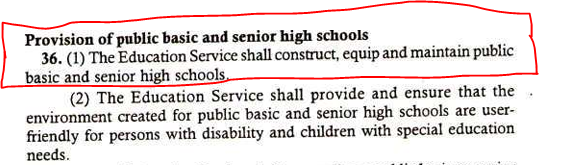
Under Section 36(1) of the Act, “the Education Service shall construct, equip, and maintain public basic and senior high schools.”
The law, therefore, places an obligation on the Education Service to ensure that schools have the necessary physical structures and facilities required for effective teaching and learning. The Act further requires that the environment created for public basic and senior high schools must be user-friendly for persons with disabilities and children with special education needs.
This legal requirement highlights that school infrastructure is not only about providing buildings but also ensuring that learning environments are safe, functional, accessible and suitable for all categories of learners.
The Auditor General subsequently recommended that the Minister for Education and the Director General of Education prioritise the provision of classroom blocks for the affected schools to create an environment that supports effective teaching and learning and improves the overall quality of education delivery.
Classroom Pressure and the Pupil-Classroom Ratio Challenge
The challenge of inadequate classroom infrastructure is not entirely new. Data from the Education Sector Analysis (ESA) 2018 had already highlighted pressure on existing classroom facilities across different levels of basic education.
One of the key indicators used to measure the adequacy of school infrastructure is the Pupil-Classroom Ratio (PCR). This measures the average number of pupils assigned to one classroom and provides an indication of whether available classroom infrastructure is sufficient to accommodate the number of learners in schools.
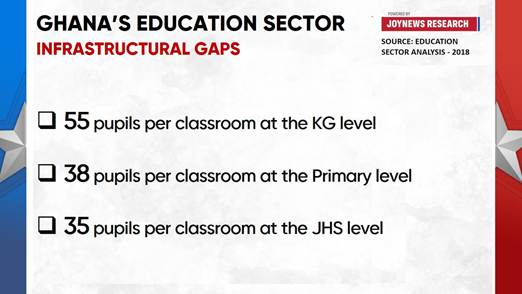
According to the 2018 Education Sector Analysis, in 2016, the national average PCR stood at:
- 55 pupils per classroom at the KG level
- 38 pupils per classroom at the Primary level
- 35 pupils per classroom at the JHS level
While the national averages for primary and JHS appeared to fall within acceptable ranges, the figures masked significant differences across regions.
The report pointed out that some regions experienced much higher levels of classroom pressure, with certain areas recording:
Kindergarten PCRs exceeding 80 pupils per classroom, Primary PCRs exceeding 50 pupils per classroom, JHS PCRs exceeding 45 pupils per classroom.
This means that although national averages suggested a relatively manageable situation, some communities were facing far greater infrastructure challenges, with classrooms having to accommodate far more pupils than the national figures suggested.
The regional variations also highlight that the infrastructure challenge has not been evenly distributed. While some areas may have had relatively adequate classroom facilities, others continued to struggle with overcrowded classrooms and shortages of learning spaces.
The Promise to Eliminate Schools Under Trees
The issue of pupils learning in temporary structures has been a concern within Ghana’s education sector for many years.
The Education Sector Analysis 2018 noted that a major development in school infrastructure provision had been the government’s effort to repair dilapidated school buildings and eliminate schools under trees.
The objective was to ensure that pupils across the country had access to proper learning environments that could support effective teaching and improve educational outcomes.
The initiative reflected a broader recognition that infrastructure is not simply about providing a physical structure but creating conditions where teachers can effectively teach, and pupils can learn in dignity and safety.
However, eight years after the Education Sector Analysis highlighted this effort, findings from the 2025 Auditor General’s Report suggest that the challenge remains significant.
The Auditor General’s findings indicate that 10,730 public basic schools were still operating without classroom blocks, with teaching and learning taking place under trees and other temporary arrangements.
This figure represents a sharp increase compared to the situation captured in 2018, when data from the Ghana Education Service showed that 2,578 schools were operating under trees.
The latest figure is therefore almost five times higher than the number reported in 2018, pointing to the continued difficulty in closing Ghana’s basic education infrastructure gap.
A Continuing Infrastructure Gap Despite Policy Efforts
The figures from the Auditor General’s Report and the Education Sector Analysis reveal a persistent challenge: expanding access to education has not always been matched by the expansion of the physical infrastructure required to support learners.
While Ghana has made significant efforts over the years to improve school access and increase enrolment, the availability of classrooms remains a critical component of ensuring quality education.
A classroom is more than just a physical space. It provides the environment needed for structured learning, teacher engagement, pupil participation, and effective delivery of the curriculum.
For the more than three million pupils, learning under trees, in sheds, churches, and temporary shelters means their educational experience continues to be shaped by conditions outside the traditional classroom environment.
The Auditor General’s recommendation places emphasis on the urgent need for targeted investment in classroom infrastructure, particularly in communities where the shortage remains most severe.
The challenge facing Ghana’s basic education sector is therefore not only about getting children into schools but ensuring that the schools they attend have the facilities necessary to support meaningful learning.
The data present a clear picture: despite years of interventions aimed at addressing schools under trees and improving classroom availability, infrastructure deficits remain a major obstacle to achieving quality basic education for all Ghanaian children.
Latest Stories
-
World Bank maintains Ghana’s growth rate forecast at 4.8% in 2026
59 minutes -
Cedi was worst African currency in quarter 2, 2026 – World Bank
1 hour -
AI gains can lift three times as many people out of poverty in Ghana – World Bank
2 hours -
Police arrest suspect over jewellery theft during fire outbreak
4 hours -
EOCO returns Hanan’s £6,700, GH¢2,750 and devices after defence challenge
4 hours -
Opplift Youth Entrepreneurs Summit 2026 equips entrepreneurs with skills, mentorship and support
4 hours -
Rival clubs want range of punishments for Man City
5 hours -
Tear gas in Paris and Marseille as school protests grow across France
5 hours -
Kane inspires England to win over Czech Republic in UEFA Nations League
5 hours -
Finland orders halt to work on two Google data centres
5 hours -
Substitute Merino scores twice as Spain win in Croatia
5 hours -
Ronaldo wants Portugal ‘punishment’ but not retiring
5 hours -
White House defends Trump comment to let Iran ‘take out’ LA and San Diego
6 hours -
Asos confirms hackers sent ‘unauthorised’ notification to app users
6 hours -
US televangelist Jim Bakker, disgraced from sex scandal and fraud, dies at 86
6 hours