

Audio By Carbonatix
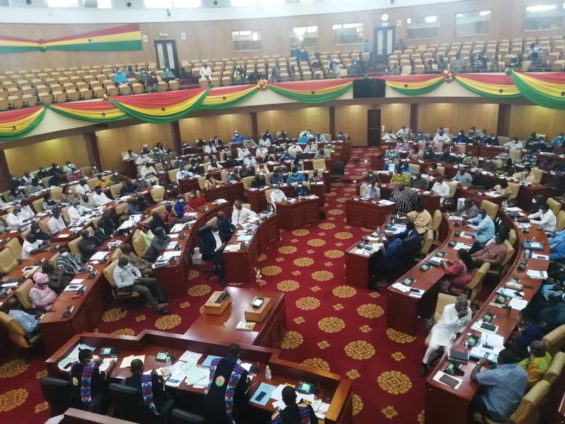
Parliament on Monday approved in Accra, the sum of GH₵ 560.93 million for the Ministry of Sanitation and Water Resources its budget estimate, for the implementation of the sector Ministry’s programmes in the year 2021.
Part of the major proposed programmes of the Ministry to start in the year were the re-engineering of landfill sites at Kpone and Oti, revamping and reconstruction of poorly managed landfill facilities, and construction of more sustainable state-of-the-art treatment plants for both solid and liquid waste in selected location across the country and to construct waste recycling and compost plants across the country.
These are expected to provide more sanitation facilities to accelerate the elimination of open defecation and to as well establish treatment and disposal sites for solid and liquid waste in selected parts of the country.
To generate revenue to finance the programmes, the Government of Ghana in the 2021 Budget Statement proposed a-10 pesewa levy, called Sanitation and Pollution Levy on the purchase petroleum products.
Addressing journalists, at the Parliament House, Osu-Accra, after approval of the budget estimate, Minister of Sanitation, Madam Cecilia Abena Dapaah said the Sanitation and Pollution levy would enable the government to generate the needed resources to improve urban air quality and combat air pollution.
It would support the re-engineering of landfill sites at Kpone and Oti, revamp and reconstruct poorly managed landfill facilities, construct more sustainable state-of-the-art treatment plants for both solid and liquid waste in selected location across the country and to construct waste recycling and compost plants across the country, provide more sanitation facilities to accelerate the elimination of open defecation and to as well establish treatment and disposal sites for solid and liquid waste in elected parts of the country.
“There will be a continuous support for the annual maintenance and management of major landfill sites and other waste treatment plants and facilities across the country,” the Minister said, and added ”we would also construct medical waste treatment facilities to prevent the generation of infectious diseases especially under the Coronavirus Treatment Programme.”
According to a report of the Committee of Works and Housing on the 2021 budget estimate on the Sanitation Ministry on Ghana’s schools of hygiene, the Committee said the Ministry secured financial clearance for the recruitment of the School of Hygiene graduates numbering 1,174.
“It was indicated that these graduates have not been recruited since 2010 and at December 2020, appointment letters have been issued for some while others are going through the process for the issuance of their letters,” the report said.
Also, for the first time since their establishment, the three schools of hygiene have seen a major infrastructure development. In Accra and Ho, a new two-storey, nine-classroom block each, is being provided, while Tamale is benefiting from the rehabilitation of an existing hostel facility.
Madam Cecilia noted that, delivery of Water, Sanitation, and Hygiene services within the country has enhanced due the creation of the Ministry.
“Ghana is on track to attain the Sustainable Development Goal, number 6, on water which is to “Ensure availability and sustainable management of Water and Sanitation for all by 2030,” she said.
Referring from data from the Ghana Statistical Service, the Minister indicated that there was an increase in the number of people with access to at least basic water supply sources from 78 per cent in 2017 to 81 per cent in 2019 according to data from the Ghana Statistical Service, improvement in water quality index of river bodies in Ghana from 51.5 in 2017 to 56 in 2019 (fairly good quality) as a result of collaborative efforts with other state bodies and institutions and increment in people with access to improved sanitation (household toilet) from 14 per cent in 2017 to 21 per cent in 2019 according to data from the Ghana Statistical Service.
The proportion of water bodies with good ambient water quality increased from 56 per cent in 2018 to 57.8 per cent in 2020.
Latest Stories
-
Tyson Fury dominates Makhmudov, calls out Joshua next
17 minutes -
I have supported highway authority financially to fix roads in my constituency – A Plus
1 hour -
US, Iran fail to reach peace agreement after marathon talks in Pakistan
2 hours -
ECG kicks off Phase Two of transformer upgrades at Lashibi; brief outages expected
2 hours -
Port crises loom as 11,000 drivers threaten four-day strike
3 hours -
A source of excellence across generations – Vice President Opoku-Agyemang lauds Mfantsipim
4 hours -
(Photos) Mfantsipim School launches historic 150th anniversary
4 hours -
Knights and Ladies of Marshall group backs Catholic Bishops’ stance on anti-LGBTQ+
5 hours -
Bright Simons writes: All the Filla in the Ibrahim Mahama/E&P – Gold Fields Saga
6 hours -
Monetise Idiocy In Ghana
6 hours -
The Ghanaian prophet and the mysterious death of his scottish wife Charmain Speirs
7 hours -
Nearly 400 sentenced in Nigeria for links to militant Islamists
7 hours -
Ghana’s recovery supported by gold strength despite global oil price pressures – Standard Bank Research
7 hours -
Methodist Church hails Mfantsipim@150; calls for “fresh consecration” to excellence
7 hours -
‘Excellence is our inheritance’ – Nana Sam Brew-Butler hails Mfantsipim’s 150-year reign in leadership
8 hours