

Audio By Carbonatix
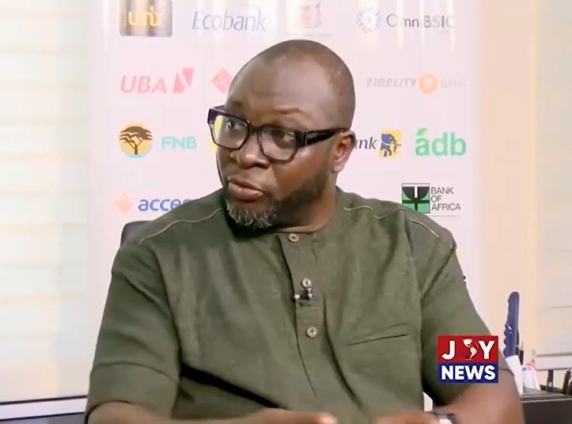
The CEO of Ghana Association of Banks, John Awuah, has revealed that a significant portion of the cedi’s past depreciation was driven not by real economic fundamentals but by calculated profiteering.
Speaking on Joy News’ PM Express Business Edition on Thursday, May 29, Awuah described a worrying trend of currency manipulation that he said accounted for as much as 30 per cent of the cedi’s past falls.
“I once stated with no proper research behind it that I could clearly read that the extent of speculation in the currency movement was between 20 and 30%,” he said.
“So if there was a depreciation, about 20 to 30% of that depreciation is not backed by any effective transaction, but people who are just playing on the currency for temporary price adjustments to profit from the currency movement.”
According to Mr Awuah, these speculative players were not responding to trade imbalances or macroeconomic shocks. They were simply gaming the market for short-term gains.
“If currency is able to hold its own, what you are doing is making that trade unattractive,” he said.
“Now, the cedi is more attractive. So the people who are holding cedi, they are looking for cedi investments, because the currency is not depreciating as aggressively as we are used to in the past.”
He was quick to caution, however, that appreciation should not be mistaken for stability. For businesses, what matters is not necessarily a stronger cedi, but a stable and predictable one.
“We should not be too excited about significant appreciation,” he warned. “That is not exactly what the business community is looking for.”
He explained that wild swings in the currency’s value—whether positive or negative—make it impossible for businesses to plan effectively.
“The business community is looking at predictability. Not that the currency has depreciated to ¢5 to the dollar, and tomorrow it is ¢10. Another time it is ¢9.”
Inconsistent currency movements hurt forecasting, banking, and investment decisions, he said.
“You need to plan effectively. You need some variables to hold their own and not be oscillating significantly beyond levels that you are unable to predict and have a proper forecast,” Mr Awuah explained.
“Even if you are talking to your banks, your ability to project your revenue generation is hampered if a component of your revenue is foreign currency-based.”
While Awuah expressed some confidence in the current performance of the cedi, he avoided making bold projections.
“I don’t want to say a wait and see, because I don’t have any reason to doubt the ability of the currency to hold its own. Coming down to single digits, I am not sure,” he said.
Latest Stories
-
Conflicts among care providers linked to maternal, neonatal deaths – Expert
60 minutes -
GIS marks 10th TIME conference, champions improved teaching practices
1 hour -
BRICS Or Balance? What Ghana’s bid really means
2 hours -
GPRTU wants full TRAFFITECH-GH implementation to start in 2027
2 hours -
Mahama announces plans to import electric wheelchairs for PWDs
2 hours -
KGL U17 Colts 2026: Western beat Prempeh Elite Academy to set up final final with Greater Accra Region
2 hours -
Late Solanke strike salvages 10-man Spurs draw at Man United
2 hours -
Gender Ministry to monitor welfare of Nana Akua Addo’s children amid domestic violence case
3 hours -
Benedict Okyere Yeboah: Ghana’s football problem goes beyond sacking a coach
3 hours -
GPL 2026/27: Darkwah Wiafe’s winner sees All Blacks beat Kotoko
3 hours -
ITF World Tour : Patel Wins Boys’ Singles Final at J100 Accra
3 hours -
Ghana must pursue BRICS partnership if it brings economic benefits – Kpebu
3 hours -
Success and Wright Claims J100 Accra Girls’ Doubles Championship
3 hours -
ITF J100: America’s Wright wins J100 Accra Girls’ Singles Title
3 hours -
Expedition hopes to find aviator Amelia Earhart’s plane on remote island
3 hours