

Audio By Carbonatix
Ghana's pension assets have exceeded GH¢100 billion, highlighting the growing importance of the pensions industry in supporting the country's financial stability and long-term economic development.
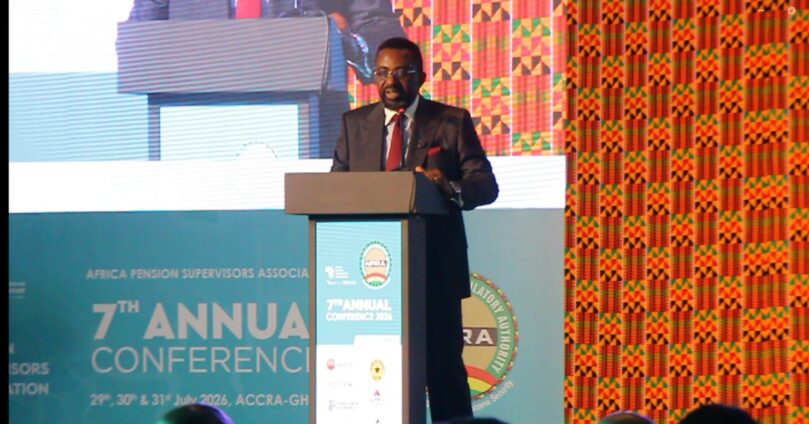
Governor of the Bank of Ghana, Dr. Johnson Pandit Asiama, disclosed that pension assets grew by 26.3 percent in one year, rising from GH¢86.23 billion in 2024 to more than GH¢100 billion in 2025. He added that the pensions industry now accounts for 16.8 percent of Ghana's total financial sector assets.
Speaking at the annual conference of the Africa Pension Supervisors Association (APSA) in Accra, Dr. Asiama said pension systems can no longer be viewed as peripheral institutions but have become major pools of long-term domestic capital that influence monetary and financial conditions.
"At that scale, pensions are not peripheral to the financial system. They are one of its major pools of long-term domestic capital," he said.
According to the Governor, the growth of pension assets underscores the increasing interconnectedness between pension funds and the broader financial system, including sovereign debt markets, banking and capital markets.
He noted that changes in the size and composition of pension fund investments can affect demand for securities, market liquidity, price discovery and investor confidence.
Dr. Asiama explained that pension systems matter to central banks not because they are supervised by them, but because of their growing scale and market influence.
"Pension systems therefore matter to a central bank not because the central bank supervises them, but because their scale, their long horizon and market connections increasingly shape the conditions in which monetary and financial stability are maintained," he stated.
The Governor also stressed that pension funds are well-positioned to provide patient capital for economic growth due to their long-term investment horizon. He said pension funds can help absorb short-term market volatility when supported by sound liquidity and risk management arrangements.
He further described financial stability as a promise made to workers contributing to pension schemes throughout their working lives.
"For the worker making a contribution today, financial stability is not an institutional concept. It is a promise," he said.
"It is the expectation that 30 or 40 years from now, the records will still be accurate, the assets will still be secure, the institutions will still be standing and the money itself will still have meaningful value."
Dr. Asiama noted that as pension assets continue to grow across Africa, regulators and policymakers must strengthen collaboration to ensure pension systems remain resilient, secure and capable of supporting sustainable economic development.
Latest Stories
-
Hawa Koomson pledges experienced and mature leadership of NPP women’s wing
15 minutes -
Young woman found dead at Kasoa Peace Town
48 minutes -
Playback: The Law examined lawful arrest in Ghana
1 hour -
Mahama urges African governments to treat healthcare as an investment, not budget cost
2 hours -
Bawumia congratulates John Boadu and new NPP executives, pledges support ahead of 2028
2 hours -
‘No talent should be left out’ – Bawumia pledges inclusive NPP campaign for 2028
2 hours -
Prof. Mike Oquaye recounts how he blocked Special Prosecutor’s attempt to arrest Bawku Central MP
2 hours -
Make health sovereignty a priority for Africa – Mahama
2 hours -
Dorimon Naa, Wa West DCE lead massive clean-up exercise; threaten sanctions against recalcitrant residents
3 hours -
Photos from Adom FM Y2K Jam
3 hours -
Praye Tiatia steals the show at Adom FM Y2K Jam [Watch]
3 hours -
Boakye Agyarko congratulates John Boadu, pledges support for NPP leadership
3 hours -
Antwi HiMight thrills fans with Antwi ne Antwi hits at Adom FM’s Y2K Jam [Video]
3 hours -
Amb. Edward Boateng congratulates Boadu, Kodua on election wins
4 hours -
John Boadu pledges to rebuild NPP from grassroots and restore ‘winning machinery’
4 hours