

Audio By Carbonatix
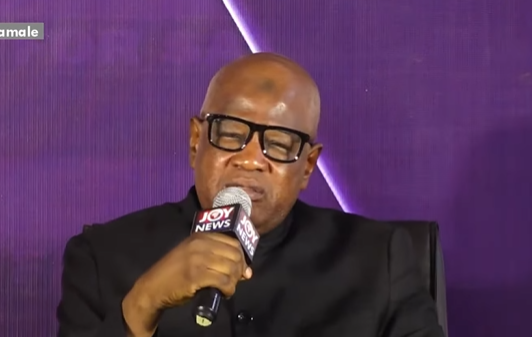
The Dean of the Faculty of Social Sciences at the University for Development Studies, Professor Eliasu Alhassan, has raised concerns over the low reporting of vote-buying incidents in Ghana, warning that the trend is undermining efforts to curb electoral malpractice.
Speaking at JoyNews’ Democracy Is Not for Sale forum held at the GNAT Hall on Friday, March 27, Prof Alhassan said the growing monetisation of politics has become a persistent challenge in the country’s democratic process.
“It is very clear that monetisation of our politics has become a canker. It’s now a canker that we don’t like, but it is with us.
"That is why I said at the beginning that in principle, democracy is not for sale, but practically, it is for sale,” he stated.
He noted that although vote buying is a criminal offence, the absence of credible evidence continues to hinder law enforcement agencies from prosecuting offenders.
According to him, the situation is worsened by the reluctance of citizens to report such incidents.
“We are all aware that buying votes is a crime, but the lack of evidence is what is actually making it difficult for the police to prosecute those involved.
"Most people don’t even report vote buying to the police. Police respond to issues that are reported, so if these incidents are not reported, how do they investigate?” he questioned.
Prof Alhassan pointed out that, unlike other crimes such as armed robbery, which are regularly captured in police statistics, vote-buying cases rarely feature in official data due to underreporting.
He cited common practices during elections, including the distribution of food and other items to voters at polling stations, as clear attempts to influence voter decisions.
According to him, such acts are often visible yet go unchallenged.
“We see people buying votes clearly during elections. Sometimes people are in a queue to vote, and a politician comes to distribute food. If you are in your right senses, you know it is to influence you,” he said.
"Sometimes even the polling agents. Every party knows its polling agent. Political parties go to a polling station and give food to everybody who is there. Clearly, it's just to influence people to vote for them."
The political scientist stressed that the failure to report these incidents allows perpetrators to operate with impunity, making it difficult for authorities to track and address the problem effectively.
He called for greater public responsibility in reporting electoral offences, noting that without citizen cooperation, efforts to tackle vote buying would remain largely ineffective.
Latest Stories
-
A source of excellence across generations – Vice President Opoku-Agyemang lauds Mfantsipim
32 minutes -
(Photos) Mfantsipim School launches historic 150th anniversary
56 minutes -
Knights and Ladies of Marshall group backs Catholic Bishops’ stance on anti-LGBTQ+
2 hours -
Bright Simons writes: All the Filla in the Ibrahim Mahama/E&P – Gold Fields Saga
2 hours -
Monetise Idiocy In Ghana
2 hours -
The Ghanaian prophet and the mysterious death of his scottish wife Charmain Speirs
3 hours -
Nearly 400 sentenced in Nigeria for links to militant Islamists
3 hours -
Ghana’s recovery supported by gold strength despite global oil price pressures – Standard Bank Research
4 hours -
Methodist Church hails Mfantsipim@150; calls for “fresh consecration” to excellence
4 hours -
‘Excellence is our inheritance’ – Nana Sam Brew-Butler hails Mfantsipim’s 150-year reign in leadership
4 hours -
Kwaku Azar writes: A-G vs OSP
4 hours -
Mfantsipim–Adisadel rivalry built excellence, not division – Sam Jonah
5 hours -
Vice President launches Mfantsipim’s 150 years of shaping Ghana’s greatest mind
5 hours -
I assure Otumfuo, Mahama will join him to commission KNUST Teaching Hospital by end of this year – Haruna Iddrisu
6 hours -
Barcelona dominate derby to extend La Liga lead
6 hours