

Audio By Carbonatix
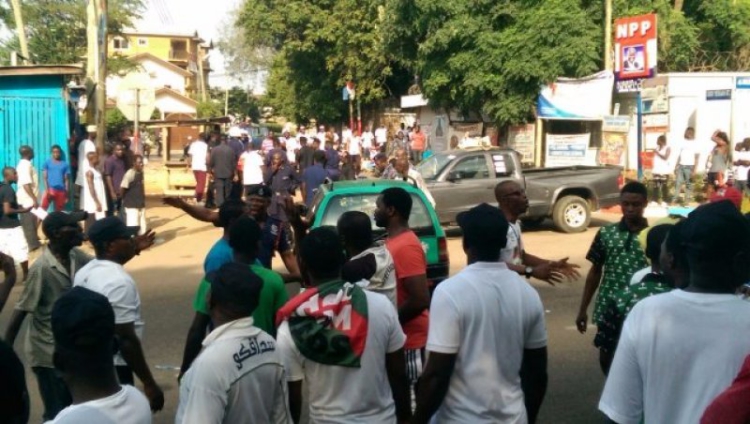
High unemployment and breakdown in family ties are causes of election violence in the Bono and Ahafo Regions, a study has revealed.
The survey also identified weak or inadequate electoral management body structures, including weak democratic institutions, dysfunctional judicial systems and polarized security agencies as major threats to the nation’s multi-party democracy, freedom of speech and rule of law.
The study recommended the need for successive governments to address these critical national challenges to foster unity and social cohesion in the nation’s political space.
It was conducted by Global Media Foundation (GLOMeF), Tim Africa Aid Ghana, and West Africa AIDS Foundation, all NGOs as part of a-15 month Election 2020 project being implemented by the NGOs with support from Star Ghana Foundation.
The project aimed at discouraging and reducing election-related violence in the constituencies through community dialogue and conflict resolution.
It is also to increase women, young people as well as People with Disabilities (PWDs) participation in politics and governance.
It further aimed at increasing the capacities of the electorate and election stakeholders, mostly in hard to reach communities, to influence political party manifesto to promote issue-based electioneering.
Titled “managing election 2020 related violence for democratic stability in Ghana”, the study was conducted in the Asunafo North and Asunafo South constituencies of the Ahafo and Banda and Tain constituencies of the Bono Region.
Police in the two regions have identified these areas as volatile and major election hotspots constituencies with a long history of political violence that threaten national peace and stability.
Societal challenges such as inequality and poverty, ethnicity and gender inequality remained electoral challenges of greater concern, Mr Raphael Godlove Ahenu, the Chief Executive Officer of the GLOMeF who released the outcome of the study indicated.
Speaking at a day’s election reporting training workshop for journalists, held in Sunyani, Mr Ahenu explained the concept of the study was drawn from data collected from Ghana’s 2012 Round five Afro barometers and the pre-election survey conducted by the Center for Democratic Governance (CDD-Ghana).
The three NGOs, implementing the Star Ghana Foundation project, organised the training workshop, which was attended by about 30 selected Journalists from the project implementing regions.
Other electoral challenges the survey mentioned included selfish leadership and weakened civil society activities, Mr Ahenu indicated saying until these challenges were addressed, it would be difficult for the nation to control political and election violence in the country.
Latest Stories
-
Epstein survivors’ calls to meet King Charles and Queen harder to ignore as US visit approaches
27 seconds -
UN Secretary-General names Ghana’s Anita Kiki Gbeho as South Sudan envoy
2 minutes -
Mali withdraws recognition of Sahrawi Republic, backs Morocco’s autonomy plan
7 minutes -
Gov’t distributes over 8,500 laptops to One Million Coders project
8 minutes -
Julius Debrah, ‘man to beat’ as NDC’s James Agbey dismisses Musah Dankwah’s polls
14 minutes -
GPRTU in Savannah Region to protest alleged eviction in Damongo
43 minutes -
Re: Reinsurance does not replace process — A response to the SIGA–SIC defence
58 minutes -
Gender Ministry supports Harriet Amuzu in ongoing abuse case
1 hour -
AG joins plaintiff to scrap OSP ?: We should be mindful of the mischief in this – Bobby Banson
1 hour -
Samson Lardy Anyenini questions willingness of Attorneys-General to prosecute political colleagues
1 hour -
It is only fair the OSP is heard in Supreme Court case – Bobby Banson
1 hour -
Asiedu Nketia resumes Ashanti tour, second leg kicks off on Sunday
2 hours -
NLA denies salary cut claims, threatens legal action over reports
2 hours -
BoG Governor honoured for stabilising cedi, improve inflation
2 hours -
Kyebi Easter Homecoming 2026: A resounding success!
2 hours