


Audio By Carbonatix
Pope Francis has told worshippers in a mosque in the Central African Republic that "Christians and Muslims are brothers and sisters".
He was speaking to Muslims who had sought shelter in the capital Bangui after nearly three years of violence between Christians and Muslims.
The mosque visit was seen as perhaps the most difficult part of his Africa tour, a BBC correspondent says
Pope Francis then held the final Mass of his Africa trip in Bangui.
He was speaking in Latin, which was then translated into the local Sango language.
His message of reconciliation appeared to have an immediate impact, as a reporter from the AFP news agency spotted a group of Muslim rebels turn up at the Mass wearing t-shirts with the Pope's image on them.
The Pope has now left the CAR at the end of his six-day visit to the continent.
More than 100,000 Muslims fled the capital as a result of the fighting but 15,000 are left in an area called PK5, according to the campaign group Human Rights Watch.
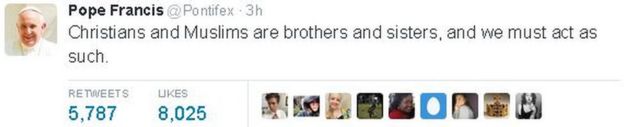
Imam Tidiani Moussa Naibi thanked the Pope for his visit and said it was "a symbol which we all understand", the AP news agency reports.
There was tight security for the visit to the Koudoukou mosque and armed UN peacekeepers were stationed on its minarets watching the crowds who had come to greet the pontiff.
On Sunday, the Pope called on fighting factions in the CAR to lay down their weapons.
About half of CAR's population is Christian and 15% Muslim.
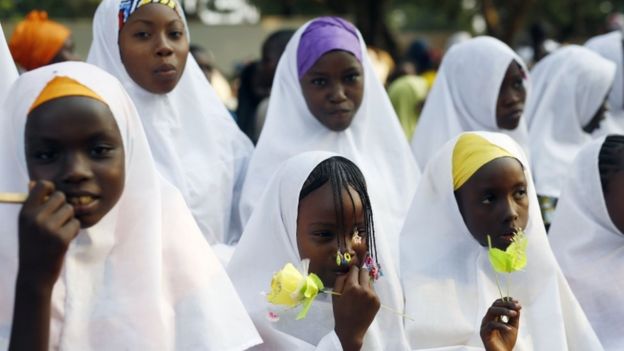
Children waited to greet Pope Francis at the mosque in Bangui
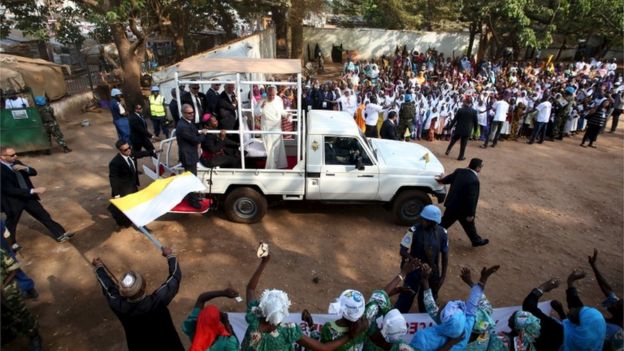
Crowds turned out to see the Pope as he drove into the PK5 neighbourhood
Celebrating Mass in Bangui, he said they should instead arm themselves "with justice, love, mercy and authentic peace".
Earlier, he said he hoped next month's election in the CAR would open a "new chapter" for the country.
The trip to the CAR was the pontiff's first visit to a conflict zone and the final stop on his three-nation African tour that also took in Kenya and Uganda.
Conflict has blighted the CAR for decades but it was only in 2013 that the fighting took on a religious form.
President Francois Bozize was ousted in a coup in March 2013 and a group of mostly Muslim rebels from the north, the Seleka, marched on Bangui, briefly taking control of the country.
Their rebellion tapped into a feeling northerners had of being excluded and unrepresented by the central government, correspondents say.
They targeted churches and Christian communities, which triggered the creation of the anti-Balaka - meaning anti-violence - militias, and led to a downward spiral of tit-for-tat violence which continues.
Towns and villages are divided, with hundreds of thousands of people displaced into camps divided along religious lines.
Latest Stories
-
President Mahama is not sincere with Ghanaians on LGBTQ bill matter – Hassan Tampuli
17 minutes -
Gov’t to establish Prison Industrial Hub to equip inmates with income-generating skills – Prison Service boss
36 minutes -
Alhassan Tampuli donates cement, roofing sheets to support storm victims in Gushegu
36 minutes -
Alhassan Tampuli appeals for urgent support for storm victims in Gushegu
39 minutes -
The hypocrisy must stop; pass Anti-LGBTQ+ Bill now – Alhassan Tampuli to Mahama
43 minutes -
Imprisonment should be rehabilitative, not punitive – Ghana Prisons boss at UNGA
1 hour -
Ga Adangbe traditional priests petition Mahama over McDan aviation licence revocation
1 hour -
Anti-LGBTQ Bill: NDC’s arrogance is worrying – Hassan Tampuli
1 hour -
Let’s give OSP time to mature, not to scrap it – Hassan Tampuli
2 hours -
Nigeria convicts 386 Islamist militants in mass trials
2 hours -
Djibouti president wins election with 97.8% of vote, state media says
2 hours -
We don’t have mandate to deduct tax from rent allowance of security services personnel – Interior Ministry clarifies
2 hours -
Ablakwa receives Presidential Special Envoy on Reparations to advance global agenda
2 hours -
Christina Koch becomes first woman to travel around the moon on Artemis II
2 hours -
Epstein survivors’ calls to meet King Charles and Queen harder to ignore as US visit approaches
2 hours