

Audio By Carbonatix
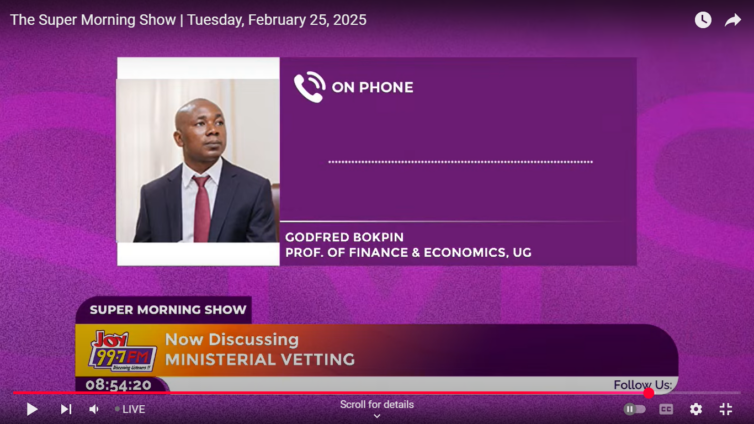
A professor of finance and economics at the University of Ghana, Prof Godfred Bokpin, has critiqued the performance of the Deputy Finance Minister nominee, Thomas Nyarko Ampem, during his vetting, highlighting both areas of disappointment and potential for growth.
Nyarko Ampem appeared before the Appointments Committee of Parliament on Monday, February 24, 2025.
While acknowledging that the nominee may not have met all expectations during the vetting process, Prof Bokpin expressed optimism, suggesting that the Deputy Minister would have learned from the vetting of the Finance Minister.
"Well, he may not have delivered consistently on our expectations, but I believe that he would learn from this and take advantage to be able to assert himself," Bokpin stated.
Speaking on Joy FM’s Super Morning Show during a discussion on the performance of the deputy minister nominees, Prof Bopkin further emphasised the importance of the Deputy Finance Minister’s role in complementing the work of the Finance Minister, clarifying that it is not about competing with the minister but rather enhancing the effectiveness of the ministry as a whole.
"There is nothing wrong, and it is not a case of you trying to outshine your minister or so, but within your own space, having listened to the minister during the vetting, you want to be able to fill in the gaps, you want to be able to tighten the loose ends," he explained.
However, reflecting on the vetting, Prof Bokpin admitted he was slightly disappointed with the nominee's performance, adding that he believed the Deputy Minister could have done better.
"From that perspective, I felt that he could have done better. I was a bit disappointed," he remarked.
In addition to his critique of the vetting performance, Prof Bokpin shared his concerns regarding the ongoing focus on reducing the number of ministers and ministries.
He warned that such a concentration on streamlining could soon lose economic value and may not address the real issues at hand.
"The over concentration on cutting the number of ministers and ministries, and all of that, a time will come when that will not have economic value going forward," he cautioned.
"I think the market is looking for specific measures on cost-cutting rationalisation," he concluded.
Latest Stories
-
Services drive 7.4% expansion in Ghana’s economic activity
8 minutes -
‘I don’t make music for awards, I make it to connect people’ – Rocky Dawuni
20 minutes -
Farmer jailed for three months over assault on wife in viral video
26 minutes -
Police arrest eight in Okaishie operation targeting illicit drugs and medicines
28 minutes -
David Agyemang Yeboah: Marriage is not the problem; your approach is
32 minutes -
Lawyer sues Standards Authority over used-vehicle import restrictions
34 minutes -
Ukraine to restart strikes on Russian oil refineries, Zelensky says
34 minutes -
CIMG awards drive competition among Ghanaian businesses
40 minutes -
NSA regional director Emmanuel Reagan files nomination to contest NDC Ashanti Regional Organiser position
44 minutes -
Obuasi SHTS: Number of students alleging sexual abuse rises to 16
50 minutes -
Ghana’s economy grows by 7.4% in July 2026
1 hour -
NDC member challenges Dennis Yeboah Twumasi’s eligibility for Bono Regional Secretary elections
1 hour -
Popular Nigerian gospel singer Toluwanisings dies
1 hour -
Spio-Garbrah proposes debt swaps to fund reparative justice in Africa and Caribbean
1 hour -
Alban Bagbin calls for governance reforms and coordinated action to address Africa’s debt crisis
2 hours