

Audio By Carbonatix
Disrespectful and abusive midwifery care for child-bearing mothers continues to exist in some of Ghana’s health facilities, a study on maternity care presented by researchers from the Department of Nursing, Kwame Nkrumah University of Science and Technology reveals.
The research was funded by the National Institutes of Health, USA and carried out at the Komfo Anokye Teaching Hospital (KATH) Kumasi. The goal was to address disrespectful and abusive maternal care in Kumasi by testing an intervention to promote respectful facility-based maternity care.
Four Respectful Maternity Care Modules (RMC-M) i.e. Dignified and respectful patient care 2. Communication in patient care 3. Focused antenatal care and 4. Effective birthing positions were developed and implemented at the hospital.
The Principal Investigator (PI) emphasized the importance of the intervention to lessen the trauma associated with childbirth.
“Years after the childbirth, the woman forgets the pain associated with the experience but not the experiences of humiliation that she goes through,” she said.
A total of 110 midwives were trained in these modules and 450 women who received care from the trained midwives were followed up for their feedback on quality of care. The findings indicated satisfactory care, improved patient-provider communication, and increased trust in hospital care.
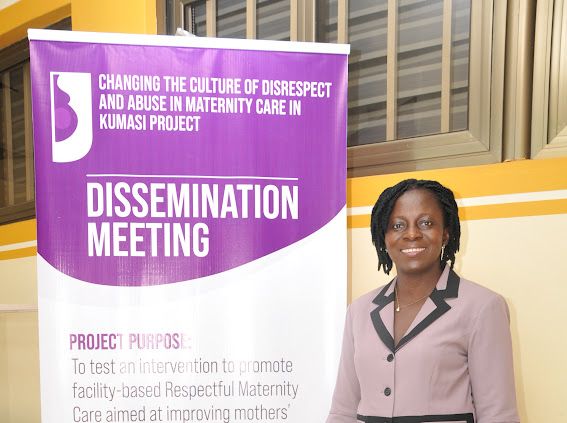
The Principal Investigator (PI) of the research study, Prof Veronica Dzomeku indicated that preliminary studies revealed the existence of disrespect and abuse of women in health care facilities in forms of the patient being disregarded, shouted at, beaten, insulted, not receiving adequate information related to care and long waiting hours. The modules were developed to address some of these forms of abuse and disrespect. The research thus revealed that despite the gains of women receiving facility-based care, we risk losing women preferring this care due to disrespect. This she asserted could increase maternal mortalities.
Some of the midwives attested to the fact that disrespectful care exists, however it is usually intended for the mothers to have a successful outcome.
Logistics constraints, high midwife-to-patient ratio and hospital policies on payment were highlighted by the study as barriers to respectful care.
The study recommended that hospital policies and infrastructure of the labour wards be modified to facilitate respectful care. Birthing suits and chairs could also be introduced in labour wards to afford women privacy and other forms of birthing positions other than lithotomy respectively. The research team hopes to extend the RMC-M training to other facilities outside of Kumasi and also train other disciplines on respectful care.
The trainers who were present at the meeting recommended that the RMC-M should be incorporated into existing curriculum of midwifery training institutions.
Highlighting the success of the research, Ms Esther Abrafi, one of the trainee midwives indicated that the training she received has changed her behaviour and attitude towards patients and their relatives. She reported that “the training has helped me in managing clients better. I respect their views and give a hearing ear to their concerns”.
The Deputy Director of Clinical Care, Ashanti Regional Health Directorate, Dr. Larsen-Reindorf in her remarks, encouraged the trained midwives to be advocates of respectful care and treat every patient as human.
Madam Ama Antiwaa, the chief nursing officer remarked that the high midwife to patient ratio is attributable to the refusal of midwives to accept postings to all levels of care and called on stakeholders to help address this challenge.
Madam Afia Serwaa, Nurse Manager, KATH, emphasized that the training had significantly changed the perception of midwives by the public, as women who accessed the facility during the project implementation period attested that communication by the care providers had improved.
Prof. Peter Donkor, one of the mentors of the PI, admonished the trained midwives to continue to mentor the young ones and encourage them to stay so that knowledge and skills acquired could be harnessed.
Prof. Veronica Dzomeku acknowledged the contributions of her team members – Prof Emmanuel Nakua and Dr. Adwoa Bemah Boamah Mensah to the success of the research. Prof Peter Donkor, (KATH) and Dr. Jody Lori (University of Michigan) were also appreciated for their mentorship to the PI.
Latest Stories
-
A source of excellence across generations – Vice President Opoku-Agyemang lauds Mfantsipim
49 minutes -
(Photos) Mfantsipim School launches historic 150th anniversary
1 hour -
Knights and Ladies of Marshall group backs Catholic Bishops’ stance on anti-LGBTQ+
2 hours -
Bright Simons writes: All the Filla in the Ibrahim Mahama/E&P – Gold Fields Saga
3 hours -
Monetise Idiocy In Ghana
3 hours -
The Ghanaian prophet and the mysterious death of his scottish wife Charmain Speirs
3 hours -
Nearly 400 sentenced in Nigeria for links to militant Islamists
4 hours -
Ghana’s recovery supported by gold strength despite global oil price pressures – Standard Bank Research
4 hours -
Methodist Church hails Mfantsipim@150; calls for “fresh consecration” to excellence
4 hours -
‘Excellence is our inheritance’ – Nana Sam Brew-Butler hails Mfantsipim’s 150-year reign in leadership
4 hours -
Kwaku Azar writes: A-G vs OSP
4 hours -
Mfantsipim–Adisadel rivalry built excellence, not division – Sam Jonah
5 hours -
Vice President launches Mfantsipim’s 150 years of shaping Ghana’s greatest mind
5 hours -
I assure Otumfuo, Mahama will join him to commission KNUST Teaching Hospital by end of this year – Haruna Iddrisu
6 hours -
Barcelona dominate derby to extend La Liga lead
6 hours