

Audio By Carbonatix
The Director of Faculty of Academic Affairs and Research at the Kofi Annan International Peacekeeping Training Centre (KAIPTC) says the refusal of the security services and their political masters in engaging citizens has resulted in the brutalities recorded in recent times.
Prof. Kwesi Aning believes that the experiences and observations of citizens must be an integral part of intelligence gatherings by the Police Service and the military.
According to him, the use of brute force on citizens will only degenerate in civil unrest rather than pouring water on troubled waters.
"As citizens, our experiences and observations are key early warning indicators. They can contribute to the intelligence assessment. It is when the security services and their political masters refuse to listen and engage; that is why Wa, Ejura and Sene [military brutalities] have happened. So we have to ask ourselves how do we create a conducive environment where we can engage and dialogue.”
“The citizens who are raising their voice, those who are complaining are all driven by one aim; we want to partner and collaborate in a manner that will contribute to a functional, stable society; that allows us to go about our business," he said.
Speaking to Samson Lardy Anyenini on JoyNews' Newsfile, Saturday, Prof. Aning said denial of insecurity in Ghana by the Police Service is laughable and will only compound the security situation in parts of the country.
His comment comes in the wake of recent military brutalities recorded in the country in recent times.
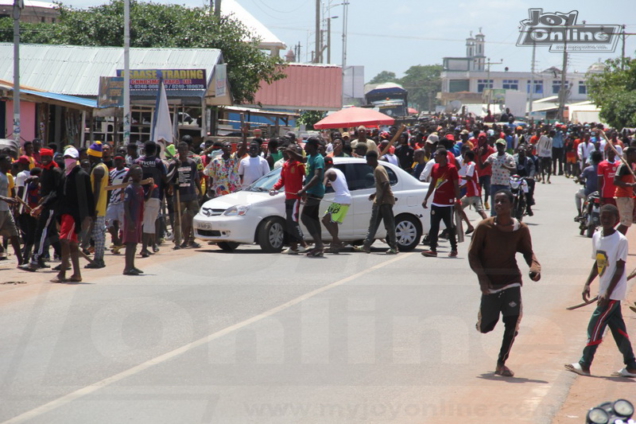
It was first in Ejura, where military personnel shot and killed two protesters and injured four others, demonstrating the killing of Ibrahim “Kaaka” Mohammed, a social activist and member of the #FixTheCountry movement, who was beaten to death by unidentified people.
Within 72 hours, another group of soldiers went on a rampage in the Wa township, brutalising residents after claiming a mobile phone belonging to one of them had been stolen.
Prof. Aning believes the approach adopted by the military was uncalled for, and community engagement would have yielded positive results rather than combat.
The security expert said that the Ghana Police Service has historically failed in its crowd control and management.
Prof Aning also questioned the quality of intelligence gathering and decision-making process among security services in dealing with protests.
He added that the security services must show a duty of care and be measured in their actions when dealing with civilians.
The security expert also blamed the political leaders for failing to act swiftly to assuage the agony and grievances of the youth in Ejura.
Prof Kwesi Aning called on the Defence and Interior Committee of Parliament to interrogate the intelligence assessment, which led to the roping of the military in the internal security situation in the Ejura community.
Latest Stories
-
Chef Abbys: Feeding 50,000 people, putting food security on Ghana’s agenda
23 minutes -
Ho set to host Republic Bank–JoyNews Habitat Fair as multiple firms prepare to showcase housing solutions
30 minutes -
NPP demands public inquiry into alleged $600,000 World Cup visa fraud, wants Sports Minister, GTA CEO summoned
37 minutes -
I want my brand to be bigger than just music – Yaw Wazinga
41 minutes -
Houthi missile attack on Yemeni presidential palace kills two, minister says
41 minutes -
I hoped to win an award; I worked hard – 2026 Best Graduating Law Student
51 minutes -
Fraudsters increasingly target bank customers instead of banking systems – Fraud detection expert
52 minutes -
44 teacher sexual abuse cases tracked since 2015; school heads feature in 40% of recent cases — JoyNews Research
55 minutes -
Unchecked imports and the Middle East crisis threaten Ghana’s fragile food inflation anchor
1 hour -
Ecobank Junior Saver Big Pitch to reward 10 winners with GH¢2,000 each
1 hour -
AMA demolishes unauthorised pigsty obstructing Agbogbloshie waste evacuation exercise
1 hour -
I was filled with disbelief – Akosua Achia Sarpong Esq. shares her first reaction
1 hour -
Snake Village: A look at Volta Region’s hidden snake village and its tourism potential (Video)
1 hour -
Election Watch Ghana calls for constitutional reforms to strengthen Electoral Commission independence
1 hour -
NACOC, Postal and Courier Services Regulatory Commission intensify efforts to curb drug trafficking
1 hour