

Audio By Carbonatix
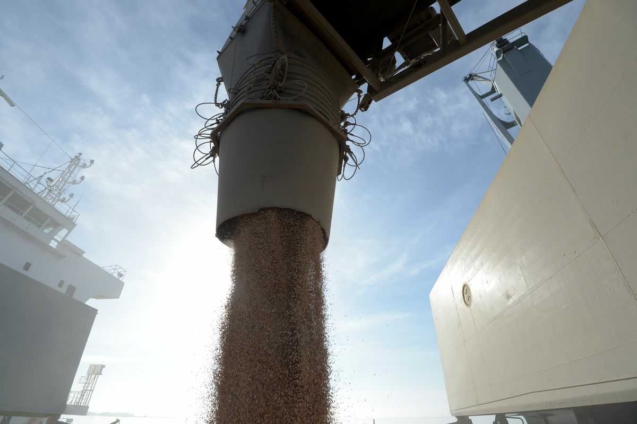
The war in Ukraine will put further pressure on grain-importing countries in Africa and Asia as a reduced number of vessels for delivering cargoes drives up shipping rates, according to the head of the International Chamber of Shipping.
About 80 to 100 ships, mostly bulk carriers, have been unable to leave Ukrainian waters for almost two months due to underwater mines and military blockades, ICS Chairman Esben Poulsson said in an interview. Bulk freight rates are rising as owners and charterers price in the fact that ships will be tied up for longer periods.
Trade flows of grains are undergoing significant shifts, he said, and the distance that ships will have to travel to get shipments from the Americas to customers is further than voyages from the Black Sea.
“This will have repercussions for poorer countries in Africa, which can ill afford to pay huge amounts more for their grain,” Poulsson said.
Russia’s war in Ukraine has thrown the $120 billion global grains trade into disarray as deliveries from the Black Sea breadbasket region get increasingly complicated. New trades are emerging, with producers in the Americas sending cargoes to customers in Africa and Southeast Asia, some for the first time in years. China is ramping up purchases of U.S. corn, while Brazil is shipping wheat to places like Turkey, South Africa and Sudan.
A surge in freight rates could further drive up food costs, piling more inflationary pain on consumers and worsening a global hunger crisis. A United Nations’ index of global food prices is already at a record, and the impact is felt most in poor countries where groceries make up a large share of consumer budgets.
“For the here and now, freight rates will stay high and may go a little higher,” said Poulsson, whose organization represents shipowners and operators that cover about 80% of the world’s merchant trade. “But it will be volatile because things can change.”
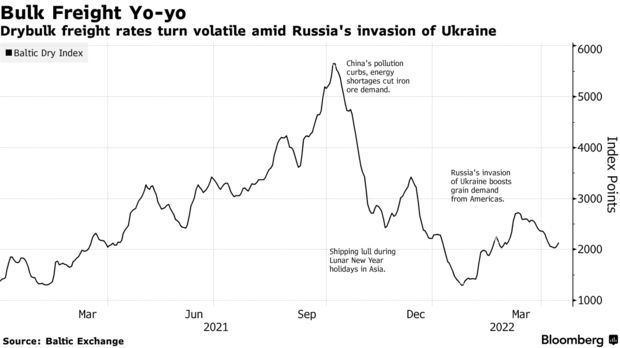
The Baltic Dry Index, the widely watched benchmark for bulk freight rates, has whipsawed in the past year, surging to a 13-year high in October on production shortages of raw materials, and then plunging as China’s curbs on factory pollution weakened iron ore demand. The gauge has climbed 65% from a low in January.
In addition to the situation in Ukraine, freight rates are also being affected by China’s efforts to battle the spread of Covid-19. Hundreds of bulk ships are facing delays off China’s coast as authorities in cities including Shanghai lock down cities.
Latest Stories
-
Nhyiaeso NPP Chairman provides GH₵50,000 support to executives, party members, and community
3 minutes -
Man nearly drowns while swimming to catch missed pontoon on Volta Lake
9 minutes -
Belgian student protests against education costs echo France
10 minutes -
Haruna Iddrisu rejects Bawumia’s claims of Free SHS setbacks
12 minutes -
African Union launches continent’s first credit rating agency
14 minutes -
Ghana’s digital finance story still not complete, as more transactions end up as cash – BoG Governor
18 minutes -
Free speech does not protect criminal threats against public officials – Kwakye Ofosu
19 minutes -
Former NPP Chairman and Minority Leader Samuel Odoi-Sykes passes on
29 minutes -
Ayawaso West Assembly cracks down on unauthorised market near Villagio
41 minutes -
Lastec CEO Lasisi Oseni nominated for Ghana Auto Fix Award
46 minutes -
Polo Beach Club land belongs to La Traditional Council, not Labadi Beach Hotel – Freddie Blay
47 minutes -
‘Don’t speculate’ – Upper West Minister charges SOCO facilitators as project delivers 127 projects, 173 more underway
48 minutes -
Finance Ministry approves 3 months’ rent allowance for security personnel
1 hour -
Ten people linked to Kenya’s first-ever Ebola case quarantined as screening concerns grow
1 hour -
Ghana warns medical travellers to South Africa to obtain visas for treatment beyond 90 days
1 hour