

Audio By Carbonatix
Research from ETH Zurich's Crowther Lab has warned that meeting the Sustainable Development Goals (SDGs) by 2030, covering seventeen issues from poverty to education, from clean energy to sustainable cities and climate action hinges on leveraging microorganisms, whose innovations can simultaneously address multiple goals and foster a more sustainable future, despite being overlooked in current plans.
“Much effort has already been spent to develop tools and policies to achieve the SDGs but mentions of the life-sustaining processes bacteria, fungi and other microorganisms maintain are few and far between,” the report said.
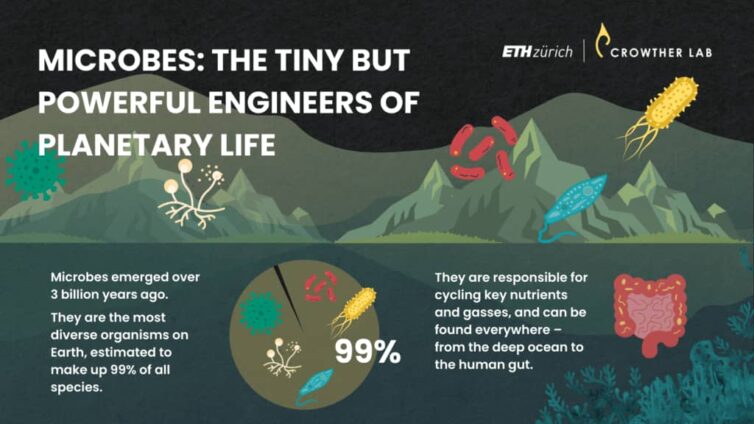
The study reveals that the emergence of microorganisms about three billion years ago was a pivotal event in Earth's history, enabling the development and sustenance of all subsequent life forms.

“All across the world, these powerful organisms contribute to the functioning of the planetary system by processing key nutrients and gasses for our survival – deep in the ocean, buried in our soils, or in our human guts. Together they represent a wealth of biodiversity and an estimated 99% of all species on Earth,” the study said.
A new paper titled, “Scientists’ call to action: Microbes, planetary health, and the Sustainable Development Goals offers a first-time overview of the myriad of ways microbes can help to achieve the SDGs.
The authors identified seven key areas where microbial technologies can strengthen sustainable practices which include disease prevention, nutrition and food production, clean energy, recycling, bioremediation, ecosystem restoration and maintaining global biogeochemical cycles.
Lead author Laura van Galen, a postdoctoral researcher in the Crowther Lab said the microbial technologies can be used to tackle the SDGs in incredibly versatile ways adding that microbes can be used to produce vaccines and pharmaceuticals to improve human health and reduce poverty and inequality.
“But they can also be used to boost food production – as mycoprotein they are in fact a food source themselves – and reduce our use of pesticides and fertilizers. Microbial communities contain huge potential to speed up plant growth and facilitate ecosystem restoration, and can help with providing clean energy through biofuels, thus mitigating climate change,” Laura stated.
The paper cited examples of how microbes can be applied to tackle issues such as food insecurity, climate change, or pandemics, and raised critical awareness for how microbes can tackle the SDGs synergistically.
It said that bacteria, archaea, fungi, or microalgae can be used to remove contaminants from the environment in a process called bioremediation will not only directly improve life on land and in the water (SDGs 14 and 15), clean water availability (SDG 6) and human health through disease prevention (SDG 3), but will help efforts to reach up to nine other SDGs as well.
“Flow-on benefits from microbial bioremediation will also positively impact key SDGs related to reducing inequalities, providing safe food, and sustainably managing waste. To reach these goals we need things like better healthcare targeted at women and minority groups, and more equitable food production and distribution. Though we still have a long way to go before their full potential can be scaled-up and used in real-world situations, microbial technologies can go a long way in helping us achieve these things,” remarks Laura.
Laura said that, given the urgency and pressure to facilitate a more sustainable future, harnessing the world’s microbes presents an efficient, cost-effective opportunity to tackle various sustainability agendas at once.
Latest Stories
-
President Mahama ends Resetting Ghana tour of Ahafo Region
11 minutes -
African negotiators seek delivery of climate commitments at COP31
12 minutes -
BoG develops AI rules for financial sector
14 minutes -
‘Big Push’: Government assures contractors of prompt payments
18 minutes -
Court fines miner for breaking into gold buying shop
28 minutes -
Tarkwa court jails labourer for three years over GH¢123,000 theft
1 hour -
GAEC must retain nuclear scientists for Ghana’s nuclear ambitions – Minister
2 hours -
Man reportedly mistaken for game and shot by hunter dead in forest
2 hours -
19-year-old mason jailed 15 years for defiling seven-year-old pupil
2 hours -
Ghana’s banking sector assets rise 20.47% to GH¢500.2bn – BoG Governor
2 hours -
22 injured as Sprinter bus overturns at Sege after tyre burst
2 hours -
UN housing expert urges Ghana to strengthen Rent Control Department amid housing affordability concerns
2 hours -
Delta-BCI partnership reaches 166,000 people with breast cancer education
2 hours -
Power restoration fault suspected in Kumasi Central Market fire
8 hours -
The 7-foot giant of Ngleshie Amanfro: Seven-foot Ghanaian Ephraim Saawa dreams of joining the national basketball team
8 hours