

Audio By Carbonatix
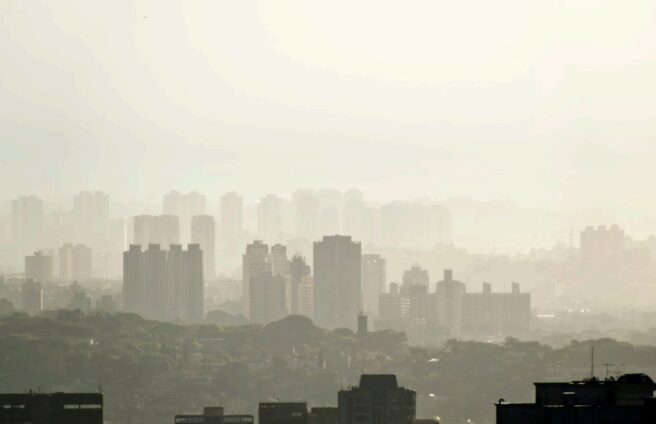
For more than four months in 2025, parts of West Africa were breathing air that failed the World Health Organization's daily safety guideline.
That is according to the new Africa Air Quality Brief 2026, the first continent-wide air quality report from the Africa Clean Air Network (AfriCAN).
The report combines satellite and ground data from the Copernicus Atmosphere Monitoring Service with analysis from State of Global Air.
The WHO's daily guideline looks at PM2.5, tiny particles of dust, smoke and soot that can travel deep into the lungs.
The least stringent interim limit is 75 micrograms per cubic metre of air.
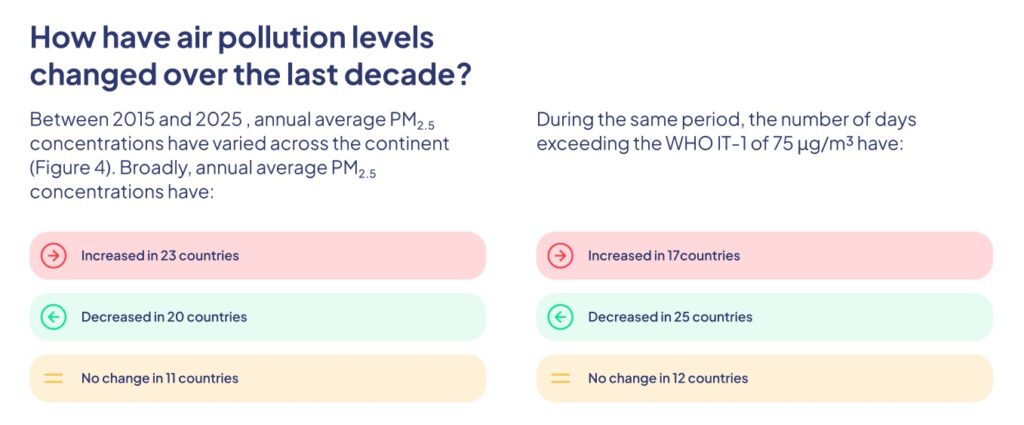
Between January and June 2025, parts of West Africa recorded more than 120 days above that level. That is roughly four days out of every five. The main culprit was seasonal Saharan dust, blowing south and west towards the Atlantic. Senegal and Cape Verde, sitting directly in the path of the dust plume, were among the worst affected.
The problem was not limited to dust. Over the full year, Nigeria, Rwanda and South Africa each recorded more than 50 days when daily PM2.5 exceeded the WHO's guideline. Nigeria, Niger and Senegal also recorded some of the continent's worst annual average pollution levels.
West Africa is dealing with both seasonal dust and pollution from everyday activities such as traffic, cooking, waste burning and other sources. But countries in the region are also beginning to respond.
In Togo, the Air Quality Project is monitoring pollution in 11 cities using reference-grade monitors and low-cost sensors. Its Coordinator, Lantam Djeri-Wake, says the country is also developing national standards and working to bring air quality into development planning.
“We have also developed national standards, and consultations are underway with municipalities, various government ministries and public agencies, research institutions, and the private sector to integrate AQ considerations into development initiatives, to foster an ecological transition in consumption and production patterns.”
Ghana is also taking on a regional role. The West Africa Centre for Clean Air (WACCA), hosted at KNUST in Kumasi, was established to strengthen regional capacity to tackle air pollution.
Its Coordinator, Dr Yen Adams Sokama-Neuyam, says sustaining the centre beyond its initial funding is now a priority.
“We need to be able to drive this regional centre of excellence that we've just established. We've also been working with several institutions, funding agencies, to be able to give sustainability to the centre at the end of the funding cycle.”
The challenge is that West Africa's air pollution has no single cause. There is seasonal dust from the Sahara. Then there is the pollution people create every day, from traffic exhaust and cooking smoke to waste burning.
Prof. Engineer Bainomugisha of AirQo says the story about Africa's air pollution must now move beyond simply identifying the most polluted cities.
“I think before, what used to make a story is this is the most polluted city in Africa. But I think now we start seeing stories that actually are talking about what cities are doing. And I think this is the kind of narrative we need.”
For West Africa, that shift cannot come soon enough. Because for millions of people, clean air is more than just a target on a report.
This story was a collaboration with New Narratives. Funding was provided by the Clean Air Fund, which had no say in the story’s content.
END.
Latest Stories
-
French PM warns against escalation of school protests after 164 arrested
3 hours -
UK tries to stop Trump’s diesel export ban
3 hours -
Late Olise goal gives France win over Belgium
3 hours -
Mancini enjoys first win since return as Italy boss
3 hours -
Interest payments to average a high 20% of government revenue over next 4 years
3 hours -
Anthropic warns AI may pose ‘existential risks to humanity’ in IPO filing
3 hours -
Joe Hart trusts Man City chair Al Mubarak over ruling
4 hours -
Strategy of accumulating foreign reserves, gold carries high fiscal cost – S&P Global
4 hours -
Weak institutional arrangements, high debt servicing constrain Ghana’s rating – S&P
4 hours -
Man City CEO defiant over Premier League charges
4 hours -
Infantino makes bigger cash pledge to Fifa members
4 hours -
Bond market: Turnover declined by 28% to GH¢1.56bn
4 hours -
Volta Region National Public Speaking contest advances drug prevention conversation
4 hours -
New health training facility at Ampoma-Jema to address admission shortfalls, but Minister flags missing amenities
5 hours -
Black Challenge unveiled with sights set on Amputee World Cup glory
5 hours