

Audio By Carbonatix
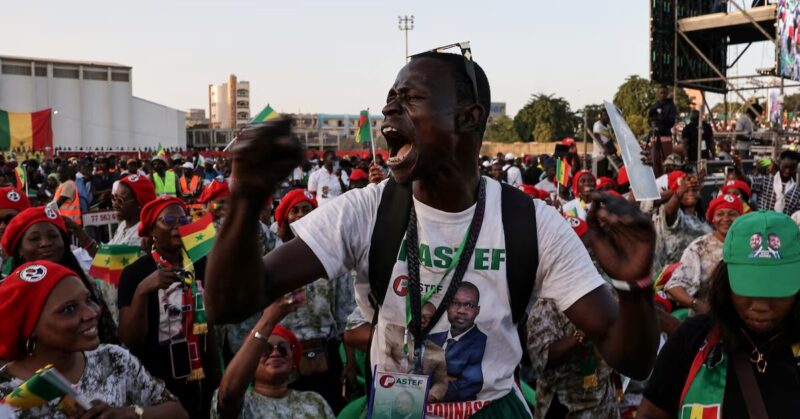
Senegal will vote in legislative elections on Sunday that will determine whether the new president and government can gain control over the national assembly and push through their agenda for reforms.
The high stakes in the election are threatening to spark renewed unrest following a period of calm. The run-up to the presidential election in March saw some of the worst violence in the country's recent history.
Campaigning has grown heated in recent days and comes at a precarious time for the new government, which is navigating a spiralling fiscal crisis that could undermine its ability to deliver on promises to boost the economy and create jobs.
Prime Minister Ousmane Sonko, known for his fiery rhetoric, said this week that his supporters had come under attack and urged them to take revenge. He has also warned that restraint should not be mistaken for weakness.
"Let them not say that we've changed and that since we came, everyone can do as they please," he said on Tuesday evening. "We could have used our strength, but we didn't."
The top priorities for Senegalese voters are jobs and the economy, as inflation has squeezed livelihoods and the nation's growing youth population struggle to find employment.
More than 7 million registered voters will have the chance to vote for candidates for the 165-seat assembly, choosing between 41 registered parties or other entities. Polls open at 8 a.m. (0800 GMT) and close at 6 p.m.
"We want a lower cost of living, affordable water, electricity, and transport, so everyone can work and live decently," said Cheikh Diagne, a street seller in downtown Dakar.
Babacar Ndiaye, research director at the think-tank WATHI, said that Senegalese have historically voted in favour of the president during previous parliamentary elections.
"When they choose a president, they then give that president the means to work and govern," he said. "Every time a president has won, he has in due course also gained an absolute majority in the National Assembly."
The West African country is plunging towards a debt crisis after the new government said it had discovered the budget deficit was much wider than reported by the previous government. A $1.9 billion IMF programme is on hold while the government audit is reviewed.
The main threat to the ruling party Pastef's ambitions is the unexpected alliance of two opposition parties, including the Republic party (APR) headed by former Prime Minister Macky Sall.
The race also includes two smaller opposition coalitions. The one led by Dakar's mayor, Barthelemy Dias, has clashed with supporters of Pastef.
Mariam Wane Ly, a former parliamentarian and trailblazer for women in politics in Senegal, said the campaign period had given leaders a chance to explain their agendas and she expected Pastef to win the majority it is seeking.
"I think it's going to make up for all the unhappiness," she said.
Latest Stories
-
JoyNews’ Jacqueline Ansomah Yeboah selected for UK Media Excellence for Emerging Technology Fellowship
4 minutes -
Mental Health Alliance urges government to operationalise Mental Health Fund
19 minutes -
Ghana–Holy See agreement heads to Parliament after Cabinet approval
23 minutes -
Luv FM Corporate Games 2026: Kumasi Central Prisons, Amanfiman Bank win big amid fun
35 minutes -
WAFU B U17: Ghana top Group A after win over Togo
1 hour -
Ho Central Mosque reopens amid unresolved leadership dispute that led to closure
2 hours -
Minority caucus questions GH¢16.4m in Ablakwa’s SA evacuation spending, demands independent audit
2 hours -
Gender Ministry meets Nana Akua Addo’s husband over domestic violence after hospital discharge
3 hours -
UG Vice-Chancellor urges swift operationalisation of National Research Fund
4 hours -
Pope Leo to have surgery after lump found in lung
4 hours -
Joseph Cudjoe writes: Ghana must break free from the dangerous mindset that natural resources are the foundation for wealth
4 hours -
Children among 109 dead after boat capsizes off Djibouti, UN says
4 hours -
OmniBSIC Bank’s 11th health walk promotes fitness and business growth
4 hours -
2026 World Maritime Day: Danish Embassy organises “The Gulf of Guinea Speaks”
5 hours -
New Economy will tackle unemployment and restore hope – Ato Forson
5 hours