

Audio By Carbonatix
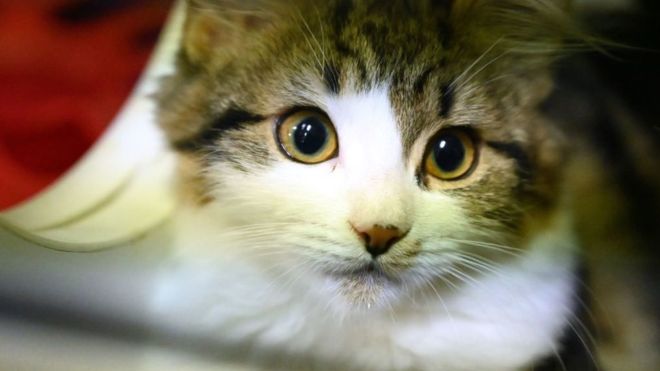
Shenzhen has become the first Chinese city to ban the sale and consumption of dog and cat meat.
It comes after the coronavirus outbreak was linked to wildlife meat, prompting Chinese authorities to ban the trade and consumption of wild animals.
Shenzhen went a step further, extending the ban to dogs and cats. The new law will come into force on 1 May.
Thirty million dogs a year are killed across Asia for meat, says Humane Society International (HSI).
However, the practice of eating dog meat in China is not that common - the majority of Chinese people have never done so and say they don't want to.
"Dogs and cats as pets have established a much closer relationship with humans than all other animals, and banning the consumption of dogs and cats and other pets is a common practice in developed countries and in Hong Kong and Taiwan," the Shenzhen city government said, according to a Reuters report.
"This ban also responds to the demand and spirit of human civilization.
Animal advocacy organisation HSI praised the move.
"This really could be a watershed moment in efforts to end this brutal trade that kills an estimated 10 million dogs and 4 million cats in China every year," said Dr Peter Li, China policy specialist for HSI.
However, at the same time as this ruling, China approved the use of bear bile to treat coronavirus patients.
Bear bile - a digestive fluid drained from living captive bears - has long been used in traditional Chinese medicine.
The active ingredient, ursodeoxycholic acid, is used to dissolve gallstones and treat liver disease. But there is no proof that it is effective against the coronavirus and the process is painful and distressing for the animals
Brian Daly, a spokesman for the Animals Asia Foundation, told AFP: "We shouldn't be relying on wildlife products like bear bile as the solution to combat a deadly virus that appears to have originated from wildlife."
A wildlife market
In February, Chinese authorities banned the trade and consumption of wild animals.
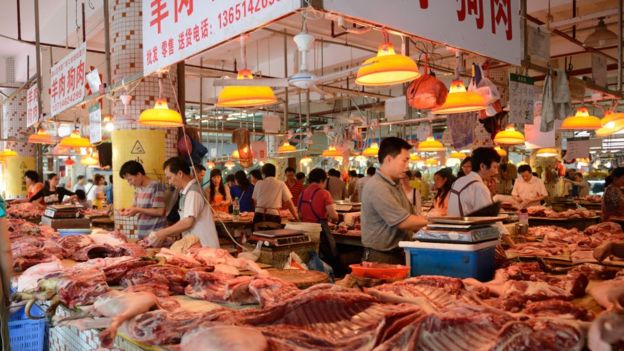
The move came after it emerged that a market in Wuhan selling wild animals and wildlife meat could have been the starting point for the outbreak of the new coronavirus, providing the means for the virus to travel from animals to humans.
News of this led the Chinese government to crack down strongly on the trade and on the markets that sold such products.
There are now close to one million confirmed cases of the virus worldwide, and more than 47,000 deaths, according to a Johns Hopkins University tally.
In China alone, there are 81,589 confirmed cases and 3,318 deaths, said the National Health Commission.
Scientists and researchers are still no closer to finding out what the source of the virus is and how it could have spread to humans.
Latest Stories
-
GNFS, GWL inspect fire hydrants in Ministries enclave; 23 found faulty
4 seconds -
Gov’t directs release of 50,000 bags of grain to ECOWAS
2 minutes -
Ghana, Germany deepen cooperation on railways, labour mobility
7 minutes -
Huge crowds greet Pope in Paris for open-air Mass
18 minutes -
‘I never said I’ll declare a state of emergency’ – President Mahama on galamsey
58 minutes -
Bobby Banson condemns EOCO’s attempted arrest of Nana Agyei Baffour Awuah
1 hour -
When Kumasi begins to look like somebody is in charge
1 hour -
Parliamentary probe into cocaine seizure would be a waste of time – Inusah Fuseini
2 hours -
Cocaine seizure: Focus on Ghana’s reputation, not partisan blame – Osae-Kwapong
2 hours -
Two Invitations, Three Interrogations: Did Baffour Awuah tell the whole story?
2 hours -
Drug cartels may be seeing Ghana as easy route – Lenin Anane Agyei
3 hours -
Ghana risks gaining notoriety as drug-trafficking hub – Bobby Banson
3 hours -
Government dismissed my drug trafficking warning, then tried to arrest me – Ntim Fordjour
3 hours -
Day Two: 3rd Republic Bank-JoyNews Habitat Fair Clinic underway at Junction Mall
3 hours -
NACOC addressing inherited gaps in fight against drug trafficking – Deputy Director-General
3 hours